


Development of a Patient-Oriented Intervention to Support Patient-Provider Conversations about Unnecessary Lower Back Pain Imaging
- PMID: 33803431
- PMCID: PMC7967489
- DOI: 10.3390/ijerph18052786
Development of a Patient-Oriented Intervention to Support Patient-Provider Conversations about Unnecessary Lower Back Pain Imaging
Abstract
Background: despite the efforts of multiple stakeholders to promote appropriate care throughout the healthcare system, studies show that two out of three lower back pain (LBP) patients expect to receive imaging. We used the Choosing Wisely Canada patient-oriented framework, prioritizing patient engagement, to develop an intervention that addresses lower back pain imaging overuse.
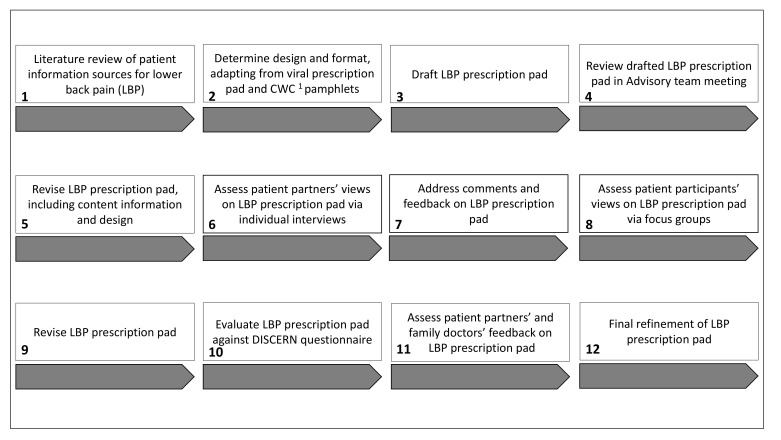
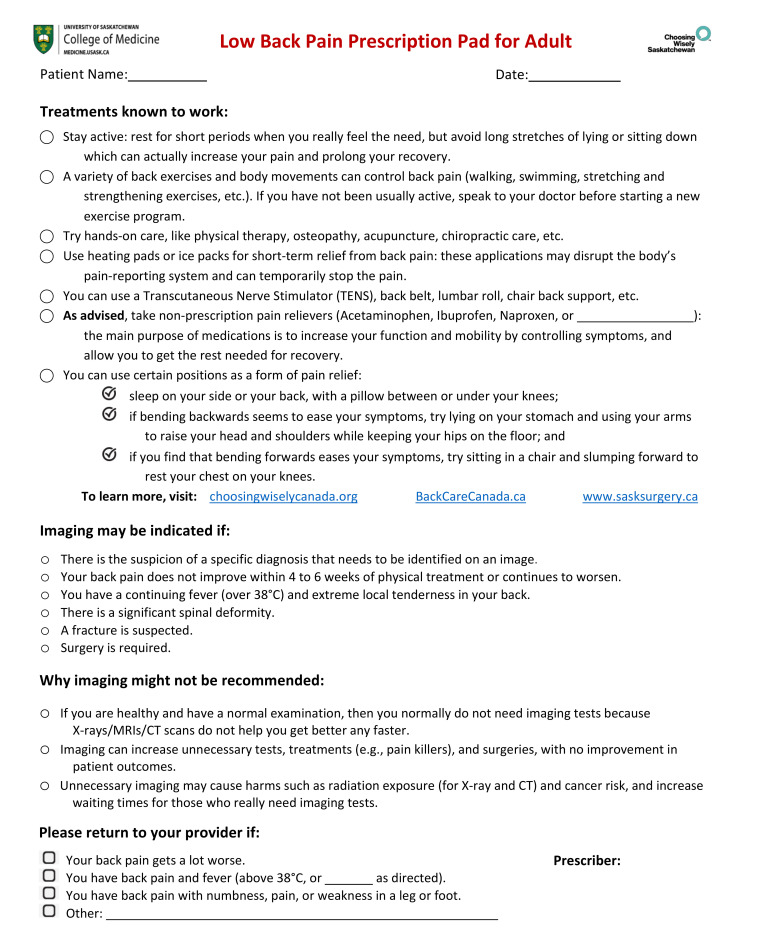
Methods: to develop this intervention, we collaborated with a multidisciplinary advisory team, including two patient partners with lower back pain, researchers, clinicians, healthcare administrators, and the Choosing Wisely Canada lead for Saskatchewan. For this qualitative study, data were collected through two advisory team meetings, two individual interviews with lower back pain patient partners, and three focus groups with lower back pain patient participants. A lower back pain prescription pad was developed as an outcome of these consultations.
Results: participants reported a lack of interactive and informative communication was a significant barrier to receiving appropriate care. The most cited content information for inclusion in this intervention was treatments known to work, including physical activity, useful equipment, and reliable sources of educational material. Participants also suggested it was important that benefits and risks of imaging were explained on the pad. Three key themes derived from the data were also used to guide development of the intervention: (a) the role of imaging in LBP diagnosis; (b) the impact of the patient-physician relationship on LBP diagnosis and treatment; and (c) the lack of patient awareness of Choosing Wisely Canada and their recommendations.
Conclusions: the lower back pain patient-developed prescription pad may help patients and clinicians engage in informed conversations and shared decision making that could support reduce unnecessary lower back pain imaging.
Keywords: Choosing Wisely Canada; diagnostic imaging; lower back pain; patient education; patient engagement; physician-patient relation; primary healthcare.
Conflict of interest statement
The authors declare no conflict of interest.
Figures
References
-
- Canadian Institute for Health Information Emergency Department Visits in 2014–2015: Information Sheet. [(accessed on 26 November 2020)]; Available online: https://secure.cihi.ca/free_products/NACRS_ED_QuickStats_Infosheet_2014-....
-
- Edwards J., Hayden J., Asbridge M., Magee K. The prevalence of low back pain in the emergency department: A descriptive study set in the Charles, V. Keating Emergency and Trauma Centre, Halifax, Nova Scotia, Canada. BMC Musculoskelet. Disord. 2018;19:306. doi: 10.1186/s12891-018-2237-x. - DOI - PMC - PubMed
-
- Busse J., Alexander P.E., Abdul-Razzak A., Riva J.J., John Dufton D., Zhang M., Faulhaber M., Couban C.R., Guyatt M.G., Rampersaud Y.R., et al. Appropriateness of Spinal Imaging Use in Canada. [(accessed on 5 November 2020)];2013 Available online: http://nationalpaincentre.mcmaster.ca/documents/AppropriatenessofSpinalI....
Publication types
MeSH terms
Grants and funding
LinkOut - more resources
Full Text Sources
Other Literature Sources
Miscellaneous
