Review
. 2021 Mar 18;22(6):3099.
doi: 10.3390/ijms22063099.

Extranuclear Inheritance of Mitochondrial Genome and Epigenetic Reprogrammability of Chromosomal Telomeres in Somatic Cell Cloning of Mammals

Affiliations
Review

Extranuclear Inheritance of Mitochondrial Genome and Epigenetic Reprogrammability of Chromosomal Telomeres in Somatic Cell Cloning of Mammals

Marcin Samiec et al. Int J Mol Sci. .

Abstract

The effectiveness of somatic cell nuclear transfer (SCNT) in mammals seems to be still characterized by the disappointingly low rates of cloned embryos, fetuses, and progeny generated. These rates are measured in relation to the numbers of nuclear-transferred oocytes and can vary depending on the technique applied to the reconstruction of enucleated oocytes. The SCNT efficiency is also largely affected by the capability of donor nuclei to be epigenetically reprogrammed in a cytoplasm of reconstructed oocytes. The epigenetic reprogrammability of donor nuclei in SCNT-derived embryos appears to be biased, to a great extent, by the extranuclear (cytoplasmic) inheritance of mitochondrial DNA (mtDNA) fractions originating from donor cells. A high frequency of mtDNA heteroplasmy occurrence can lead to disturbances in the intergenomic crosstalk between mitochondrial and nuclear compartments during the early embryogenesis of SCNT-derived embryos. These disturbances can give rise to incorrect and incomplete epigenetic reprogramming of donor nuclei in mammalian cloned embryos. The dwindling reprogrammability of donor nuclei in the blastomeres of SCNT-derived embryos can also be impacted by impaired epigenetic rearrangements within terminal ends of donor cell-descended chromosomes (i.e., telomeres). Therefore, dysfunctions in epigenetic reprogramming of donor nuclei can contribute to the enhanced attrition of telomeres. This accelerates the processes of epigenomic aging and replicative senescence in the cells forming various tissues and organs of cloned fetuses and progeny. For all the above-mentioned reasons, the current paper aims to overview the state of the art in not only molecular mechanisms underlying intergenomic communication between nuclear and mtDNA molecules in cloned embryos but also intrinsic determinants affecting unfaithful epigenetic reprogrammability of telomeres. The latter is related to their abrasion within somatic cell-inherited chromosomes.

Keywords: SCNT-derived progeny; cloned mammalian embryo; epigenetic reprogrammability; mtDNA; nuclear–mitochondrial interaction; telomere shortening/attrition.


Conflict of interest statement

The authors declare no conflict of interest.

Figures
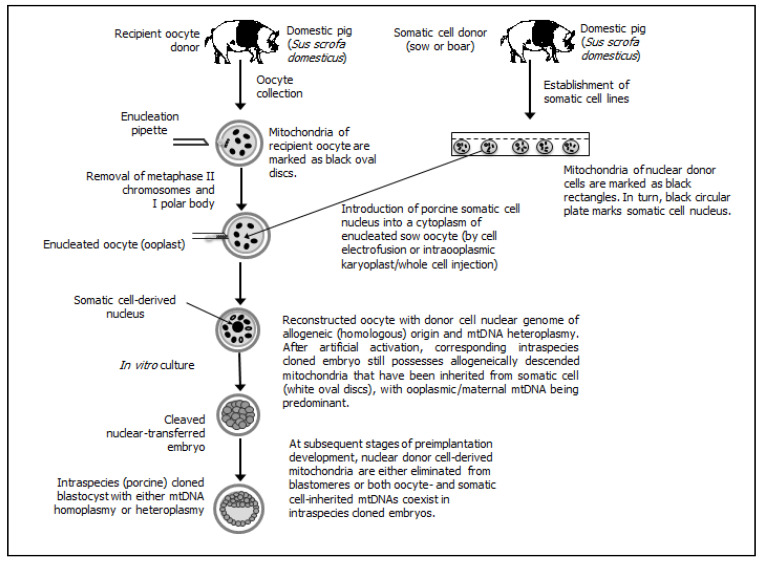
Figure 1
Figure 1
Intraspecies somatic cell cloning, in which the inheritance of allogeneic (homologous) mtDNAs stemming from genetically different nuclear recipient oocytes and nuclear donor cells is still incompletely recognized during preimplantation development of nuclear-transferred pig embryos. In the vast majority of intraspecies (porcine) cloned embryos, mitochondrial genome primarily arises from the nuclear recipient oocytes, whereas in their other counterparts, mtDNA copies appear to be inherited heteroplasmically (i.e., both from nuclear donor cells and from recipient ooplasm).
Figure 2
Figure 2
Interspecies (intrafamily and intragenus) somatic cell cloning, in which nuclear donor cells and recipient oocytes are recovered from phylogenetically consanguineous species (i.e., wild boar and domestic pig, respectively). Porcine oocyte-derived mitochondrial DNA (mtDNA) is inherited predominantly during preimplantation development of interspecies (wild boar→pig) cloned embryos, leading to intracellular mtDNA homoplasmy at the blastocyst stage.
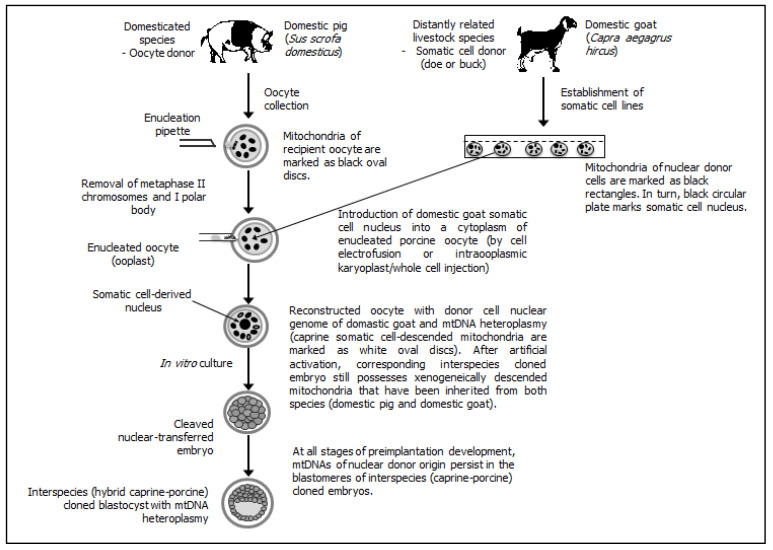
Figure 3
Figure 3
Interspecies (interfamily and intergenus) somatic cell cloning, in which nuclear donor cells and recipient oocytes are recovered from phylogenetically non-consanguineous species (i.e., domestic goat and domestic pig, respectively). Xenogeneic (heterologous) mitochondria that have been inherited from caprine nuclear donor cells and porcine recipient oocytes coexist during preimplantation development of interspecies (goat→pig) cloned embryos, leading to intracellular mtDNA heteroplasmy at the blastocyst stage.

References

    1. Gao R., Wang C., Gao Y., Xiu W., Chen J., Kou X., Zhao Y., Liao Y., Bai D., Qiao Z., et al. Inhibition of aberrant DNA re-methylation improves post-implantation development of somatic cell nuclear transfer embryos. Cell Stem Cell. 2018;23:426–435.e5. doi: 10.1016/j.stem.2018.07.017. - DOI - PubMed
    1. Liu H.J., Xue J., Li K., Ying Z.Z., Zheng Z., Wang R. Improvement of the nuclear transfer efficiency by using the same genetic background of recipient oocytes as the somatic donor cells in goats. Cell Biol. Int. 2012;36:555–560. doi: 10.1042/CBI20110287. - DOI - PubMed
    1. Liu H.J., Peng H., Hu C.C., Li X.Y., Zhang J.L., Zheng Z., Zhang W.C. Effects of donor cells’ sex on nuclear transfer efficiency and telomere lengths of cloned goats. Reprod. Domest. Anim. 2016;51:789–794. doi: 10.1111/rda.12752. - DOI - PubMed
    1. Samiec M., Skrzyszowska M. Transgenic mammalian species, generated by somatic cell cloning, in biomedicine, biopharmaceutical industry and human nutrition/dietetics—recent achievements. Pol. J. Vet. Sci. 2011;14:317–328. doi: 10.2478/v10181-011-0050-7. - DOI - PubMed
    1. Samiec M., Skrzyszowska M. The possibilities of practical application of transgenic mammalian species generated by somatic cell cloning in pharmacology, veterinary medicine and xenotransplantology. Pol. J. Vet. Sci. 2011;14:329–340. doi: 10.2478/v10181-011-0051-6. - DOI - PubMed

LinkOut - more resources