Review
. 2021 Mar 18;13(6):1374.
doi: 10.3390/cancers13061374.

Emerging Trends for Radio-Immunotherapy in Rectal Cancer

Affiliations
Review

Emerging Trends for Radio-Immunotherapy in Rectal Cancer

Claudia Corrò et al. Cancers (Basel). .

Abstract

Rectal cancer is a heterogeneous disease at the genetic and molecular levels, both aspects having major repercussions on the tumor immune contexture. Whilst microsatellite status and tumor mutational load have been associated with response to immunotherapy, presence of tumor-infiltrating lymphocytes is one of the most powerful prognostic and predictive biomarkers. Yet, the majority of rectal cancers are characterized by microsatellite stability, low tumor mutational burden and poor T cell infiltration. Consequently, these tumors do not respond to immunotherapy and treatment largely relies on radiotherapy alone or in combination with chemotherapy followed by radical surgery. Importantly, pre-clinical and clinical studies suggest that radiotherapy can induce a complete reprograming of the tumor microenvironment, potentially sensitizing it for immune checkpoint inhibition. Nonetheless, growing evidence suggest that this synergistic effect strongly depends on radiotherapy dosing, fractionation and timing. Despite ongoing work, information about the radiotherapy regimen required to yield optimal clinical outcome when combined to checkpoint blockade remains largely unavailable. In this review, we describe the molecular and immune heterogeneity of rectal cancer and outline its prognostic value. In addition, we discuss the effect of radiotherapy on the tumor microenvironment, focusing on the mechanisms and benefits of its combination with immune checkpoint inhibitors.

Keywords: immune checkpoint inhibitors; radiotherapy; rectal cancer; tumor microenvironment.


Conflict of interest statement

The authors declare no conflict of interest.

Figures
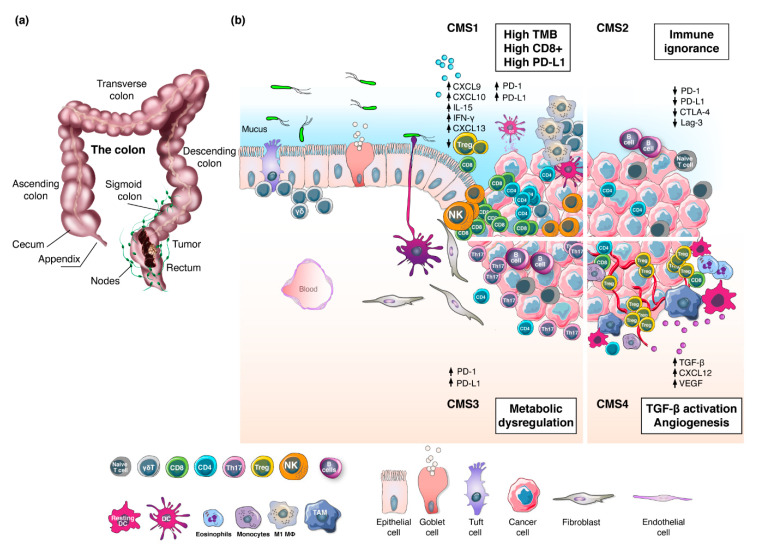
Figure 1
Figure 1
The rectal tumor microenvironment. (a) Illustration representing the anatomy of the large intestine and the development of a tumor localized in the rectum. (b) The four consensus molecular subtypes and their specific stroma-immune microenvironments. CMS1 cluster displays strong immune activation with high levels of CD8+ T cells, CD4+ T cells, γδ T cells, activated dendritic cells (DCs), natural killer (NK) cells and M1 macrophages alongside high expression of cytokines, PD1, PD-L1 and MHC-I. CMS2 shows an immune-desert microenvironment characterized by a few immune cells and poor expression of PD1, PD-L1, LAG-3 and CTLA-4. CMS3 is distinguished by metabolic dysregulation, infiltration of Th17 cells, naive B and T cells, and expression of MHC-I, PD1 and PD-L1. CMS4 exhibits high angiogenesis activity, expression of TGF-β, and infiltration of CD8+ T cells, CD4+ T cells, Tregs, M2 macrophages, monocytes, eosinophils and resting DCs.
Figure 2
Figure 2
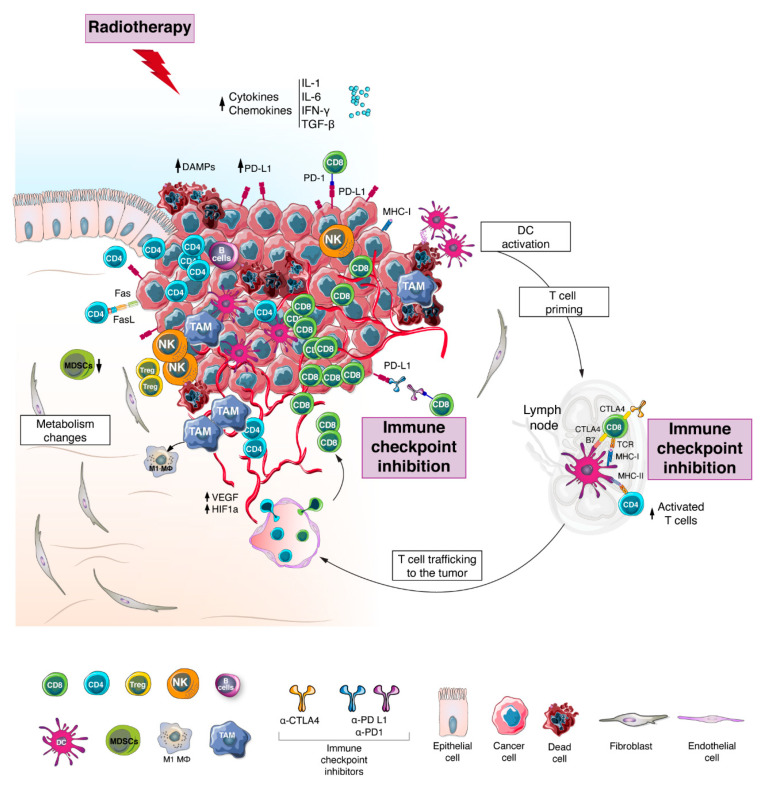
Tumor microenvironment after radiotherapy and immune checkpoint Inhibition. Upon radiotherapy, cancer cells undergo immunogenic cell death that is associated with the release of damage associated molecular patterns (DAMPs), neoantigens and pro-inflammatory cytokines (e.g., IFN-γ, IL-1 and IL-6), which promote the expression of immunomodulatory genes including antigen presentation genes and lead to the recruitment and activation of dendritic cells (DCs). Following migration to the lymph node, DCs are involved in priming and activation of T lymphocytes, which are then recruited into the tumor site alongside other immune cells. Additional modifications in the tumor microenvironment (TME) upon radiotherapy (RT) treatment include shift in macrophage phenotype towards M1, modulation of the tumor vasculature and alteration of the cell metabolism. Altogether these events enhance the recognition and killing of tumor cells. Besides inducing de novo inflammation, RT is also responsible for increasing the expression of immune checkpoints such as PD1, PD-L1 and CTLA-4. In this context, the application of immune checkpoint inhibitors might further add to the ongoing adaptive anti-tumor immunity. Taken together, the effect of RT on the TME could evoke the transition from CMS2-like TME to CMS1-like TME.

References

    1. Bray F., Ferlay J., Soerjomataram I., Siegel R.L., Torre L.A., Jemal A. Global cancer statistics 2018: GLOBOCAN estimates of incidence and mortality worldwide for 36 cancers in 185 countries. CA Cancer J. Clin. 2018;68:394–424. doi: 10.3322/caac.21492. - DOI - PubMed
    1. Arnold M., Sierra M.S., Laversanne M., Soerjomataram I., Jemal A., Bray F. Global patterns and trends in colorectal cancer incidence and mortality. Gut. 2017;66:683–691. doi: 10.1136/gutjnl-2015-310912. - DOI - PubMed
    1. Global Cancer Observatory. [(accessed on 1 January 2021)]; Available online: https://gco.iarc.fr/
    1. Rawla P., Sunkara T., Barsouk A. Epidemiology of colorectal cancer: Incidence, mortality, survival, and risk factors. Prz. Gastroenterol. 2019;14:89–103. doi: 10.5114/pg.2018.81072. - DOI - PMC - PubMed
    1. Jasperson K.W., Tuohy T.M., Neklason D.W., Burt R.W. Hereditary and familial colon cancer. Gastroenterology. 2010;138:2044–2058. doi: 10.1053/j.gastro.2010.01.054. - DOI - PMC - PubMed

LinkOut - more resources