. 2021 Mar 18;10(3):572.
doi: 10.3390/plants10030572.

QTL Analysis of Adult Plant Resistance to Stripe Rust in a Winter Wheat Recombinant Inbred Population

Affiliations

QTL Analysis of Adult Plant Resistance to Stripe Rust in a Winter Wheat Recombinant Inbred Population

Kali M Brandt et al. Plants (Basel). .

Abstract

Stripe rust, caused by the fungus Puccinia striiformis f. sp. tritici, is a worldwide disease of wheat that causes devastating crop losses. Resistant cultivars have been developed over the last 40 years that have significantly reduced the economic impact of the disease on growers, but in heavy infection years it is mostly controlled through the intensive application of fungicides. The Pacific Northwest of the United States has an ideal climate for stripe rust and has one of the most diverse race compositions in the country. This has resulted in many waves of epidemics that have overcome most of the resistance genes traditionally used in elite germplasm. The best way to prevent high yield losses, reduce production costs to growers, and reduce the heavy application of fungicides is to pyramid multiple stripe rust resistance genes into new cultivars. Using genotyping-by-sequencing, we identified 4662 high quality variant positions in a recombinant inbred line population of 196 individuals derived from a cross between Skiles, a highly resistant winter wheat cultivar, and Goetze, a moderately to highly susceptible winter wheat cultivar, both developed at Oregon State University. A subsequent genome wide association study identified two quantitative trait loci (QTL) on chromosomes 3B and 3D within the predicted locations of stripe rust resistance genes. Resistance QTL, when combined together, conferred high levels of stripe rust resistance above the level of Skiles in some locations, indicating that these QTL would be important additions to future breeding efforts of Pacific Northwest winter wheat cultivars.

Keywords: genome wide association study (GWAS); quantitative trait loci (QTL); recombinant inbred line (RIL); stripe rust; wheat.


Conflict of interest statement

The authors declare no conflict of interest.

Figures
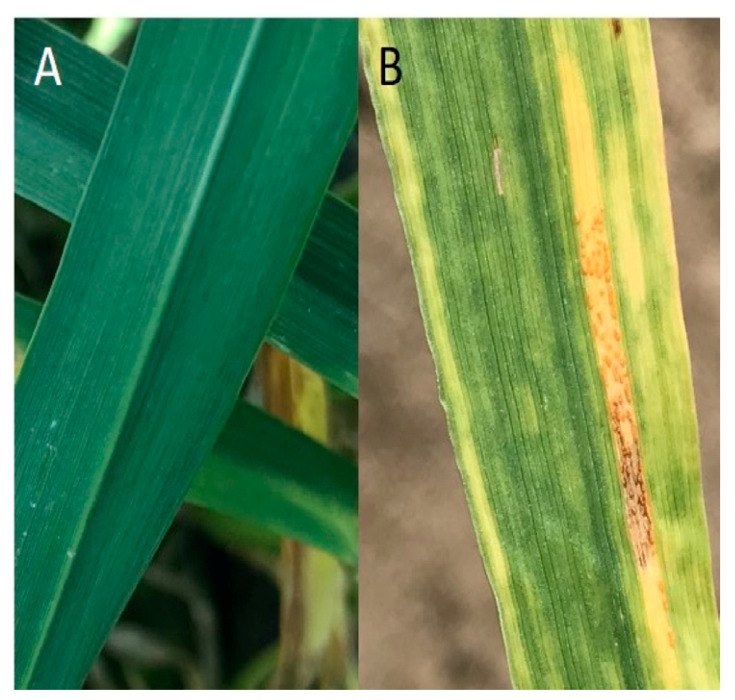
Figure 1
Figure 1
Wheat flag leaves with different levels of stripe rust infection. (A) A healthy, green flag leaf with no signs of infection. (B) A flag leaf infected with stripe rust. Chlorotic flecks and stripes indicate early infection symptoms. Orange uredinia in the chlorotic stripe are a classic sign of stripe rust. The fungus is also producing dark brown/black teliospores.
Figure 2
Figure 2
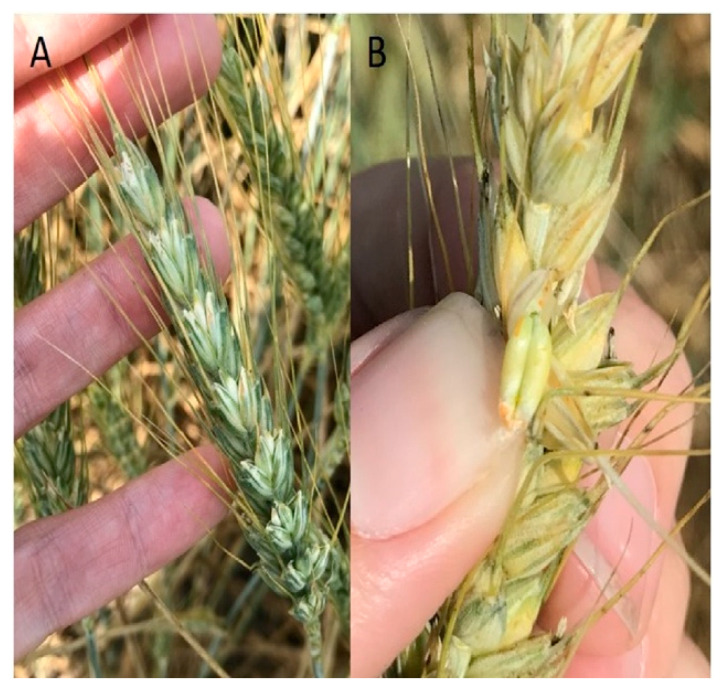
Stripe rust uredinia found on the heads of severely infected winter wheat plants. (A) Orange uredinia can be seen on the spikelets and on the awns of a severely infected plant. (B) This plant is so severely infected that uredinia have developed on the immature seed.
Figure 3
Figure 3
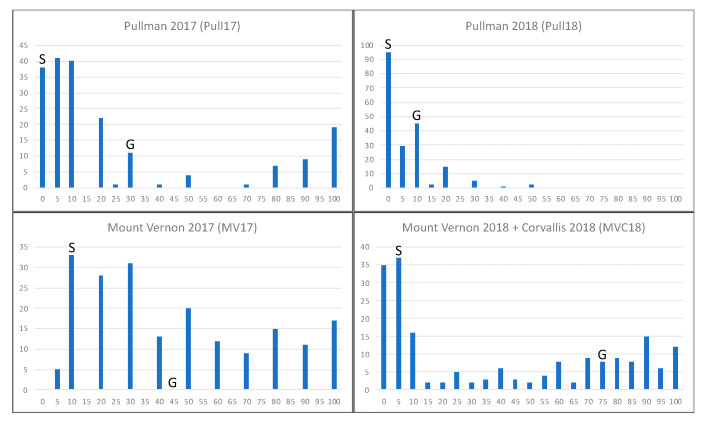
Histograms of the number of lines scored for each stripe rust severity in each treatment. Severity is on the horizontal axis and is a measure of the percentage of leaf area affected by the pathogen. The number of lines is on the vertical axis. “S” shows the severity score for Skiles in each treatment. “G” shows the severity score for Goetze in each treatment. The parental disease severity scores were not counted in the totals.
Figure 4
Figure 4
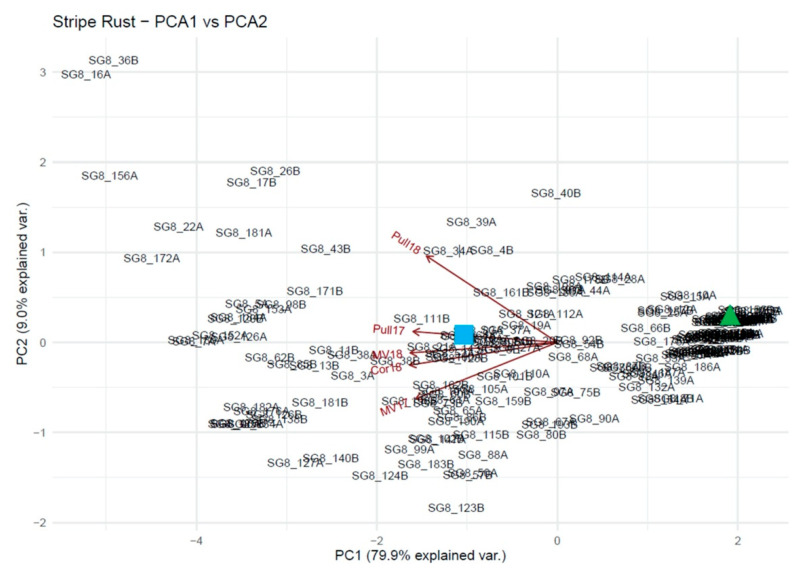
Principal component analysis representing the genetic diversity of the RIL population used in this study. Each principal component (PC) explains the corresponding contribution of each treatment to the PCs. PC1 explains 79.9% of the variation and PC2 explains 9.0% of the variation. The blue square represents Goetze, the moderately susceptible parent, located at approximately −1, 0 (PC1, PC2). The green triangle represents Skiles, the resistant parent, located at approximately 2, 0.25. The treatment vectors listed from top to bottom are Pullman 2018 (Pull18), Pullman 2017 (Pull17), Mount Vernon 2018 (MV18), Corvallis 2018 (Cor18), and Mount Vernon 2017 (MV17). In general, the individuals with high resistance in all treatments are located in the clusters to the right of the center. The most susceptible individuals are located in the top left corner, with various levels of susceptibility and resistance in between.
Figure 5
Figure 5
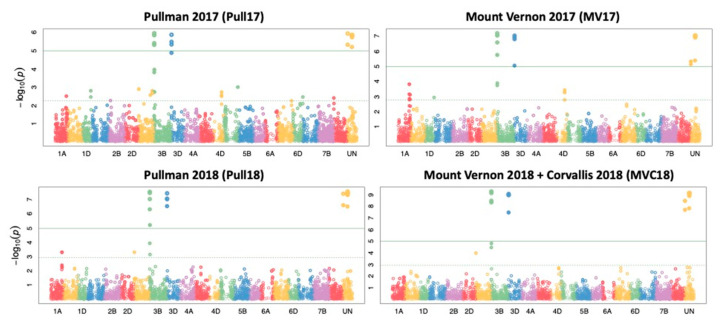
Manhattan plots for each treatment produced by GAPIT (Genome Association and Prediction Integrated Tool). The horizontal axis is the chromosome, with “UN” denoting a genomic scaffold that could not be mapped to any particular chromosome in the reference genome. The vertical axis is the p-value for each single nucleotide polymorphism (SNP)’s association with the trait of interest. The dotted horizontal line represents the –log10 (0.001) threshold. The solid green horizontal line represents the significant –log10 (p-value) threshold. All colored dots are SNPs predicted by TASSEL (Trait Analysis by aSSociation, Evolution and Linkage), and any dot above the solid green line is a significant SNP.
Figure 6
Figure 6
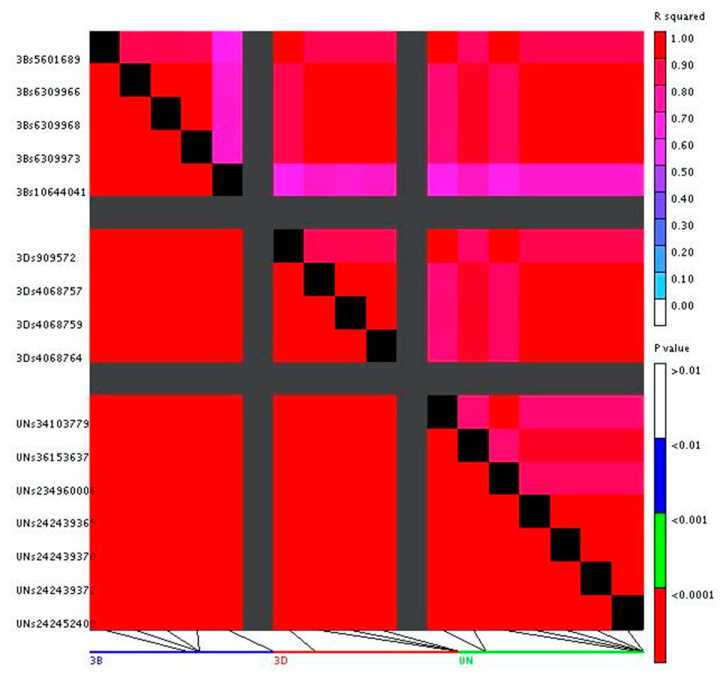
Heatmap of linkage disequilibrium (LD) for significant single nucleotide polymorphisms (SNPs). Tile colors represent the R2 value for each pairwise SNP (top right half), where R2 represents the degree of association between two SNPs. Significance of association between pairs of SNPs is represented in the bottom half of the figure (the p-value of the R2 value, legend in the bottom right). The horizontal line at the bottom is each chromosome with the identified SNPs being shown as black lines pointing to the corresponding placement on the plot.
Figure 7
Figure 7
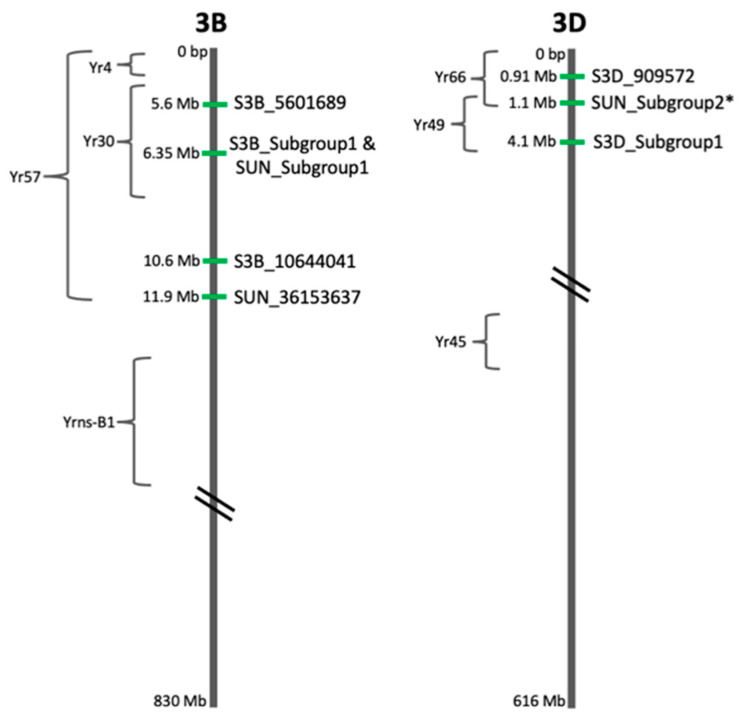
Location of the significant single nucleotide polymorphisms (SNPs) and their subgroups on the respective chromosomes as determined by the reference genome. The known stripe rust genes on each chromosome are also shown in their relative locations based on the GrainGenes maps. The double slash indicates the centromere. Chromosomes are not to scale. * SUN_Subgroup2 is not a highly confident placement, as the BLAST search of the related genes only matched this reference sequence location at 88%.
Figure 8
Figure 8
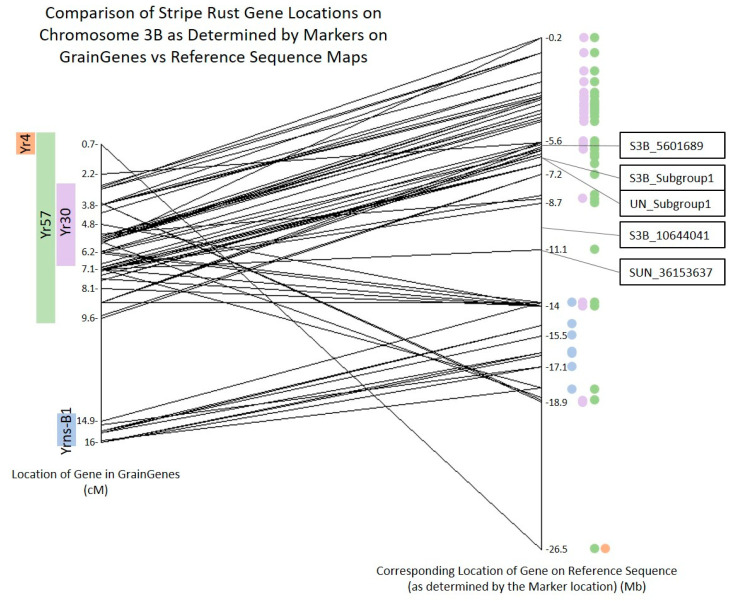
Chromosome 3B markers and their location as determined by the GrainGenes linkage map versus the reference sequence map RefSeq v1.0 (urgi.versailles.inra.fr). Markers from the GrainGenes “Wheat, Yr genes and QTL 3B” linkage map are arranged in map order with the linkage map location of the marker and putative stripe rust gene locations (cM) to the left. The corresponding location of that marker on the wheat reference genome (Mb) is on the right with a line connecting them. The colored circles represent the stripe rust gene that marker was associated with in the linkage map. The SNPs and/or Subgroups found in this study are to the right of the reference sequence location.
Figure 9
Figure 9
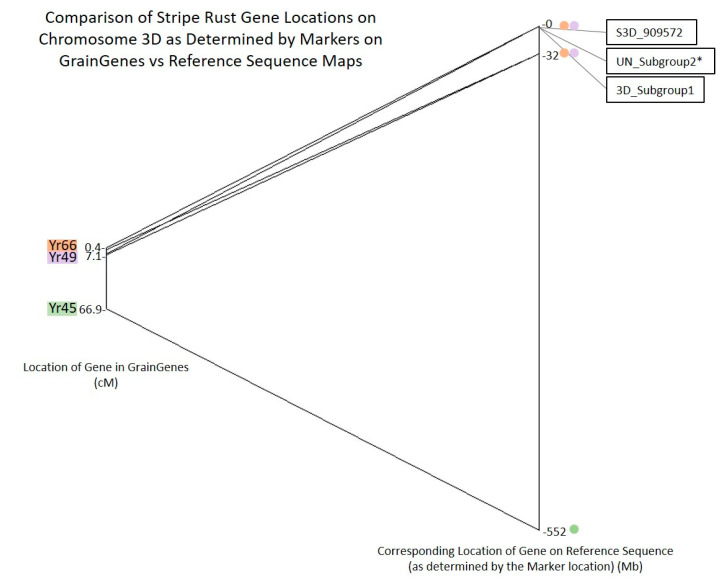
Chromosome 3D markers and their location as determined by the GrainGenes linkage map versus the reference sequence map RefSeq v1.0 (urgi.versailles.inra.fr). Markers from the GrainGenes “Wheat, Yr genes and QTL 3D” linkage map arranged in map order with the linkage map location of the marker and putative stripe rust gene locations (cM) to the left. The corresponding location of that marker on the wheat reference genome (Mb) is on the right with a line connecting them. The SNPs and/or Subgroups found in this study are to the right of the reference sequence location. * SUN_Subgroup2 is not a highly confident placement, as the BLAST search of the related genes only matched this reference sequence location at 88%.

References

    1. Ren R.S., Wang M.N., Chen X.M., Zhang Z.J. Characterization and molecular mapping of Yr52 for high-temperature adult-plant resistance to stripe rust in spring wheat germplasm PI 183527. Theor. Appl. Genet. 2012;125:847–857. doi: 10.1007/s00122-012-1877-8. - DOI - PubMed
    1. Chen X. Review Article: High-Temperature Adult-Plant Resistance, Key for Sustainable Control of Stripe Rust. Am. J. Plant Sci. 2013;4:608–627. doi: 10.4236/ajps.2013.43080. - DOI
    1. Schwessinger B. Fundamental wheat stripe rust research in the 21st century. New Phytol. 2017;213:1625–1631. doi: 10.1111/nph.14159. - DOI - PubMed
    1. Chen X. Integration of cultivar resistance and fungicide application for control of wheat stripe rust. Can. J. Plant Pathol. 2014;36:311–326. doi: 10.1080/07060661.2014.924560. - DOI
    1. Naruoka Y., Garland-Campbell K.A., Carter A.H. Genome-wide association mapping for stripe rust (Puccinia striiformis F. sp. tritici) in US Pacific Northwest winter wheat (Triticum aestivum L.) Theor. Appl. Genet. 2015;128:1083–1101. doi: 10.1007/s00122-015-2492-2. - DOI - PubMed

LinkOut - more resources