


Review
doi: 10.3390/molecules26061707.
Petasis vs. Strecker Amino Acid Synthesis: Convergence, Divergence and Opportunities in Organic Synthesis
Affiliations
- PMID: 33803879
- PMCID: PMC8003338
- DOI: 10.3390/molecules26061707
Item in Clipboard
Review
Petasis vs. Strecker Amino Acid Synthesis: Convergence, Divergence and Opportunities in Organic Synthesis
Molecules.
.
Abstract
α-Amino acids find widespread applications in various areas of life and physical sciences. Their syntheses are carried out by a multitude of protocols, of which Petasis and Strecker reactions have emerged as the most straightforward and most widely used. Both reactions are three-component reactions using the same starting materials, except the nucleophilic species. The differences and similarities between these two important reactions are highlighted in this review.
Keywords: Petasis; Strecker; amino acids; biomolecules; multicomponent reactions; peptides.
Conflict of interest statement
The author declares no conflict of interest.
Figures

Examples of bioactive amino acids prepared by the Strecker synthesis. Purple colour shows the amino nitrile functions obtained as a result of a direct Strecker reaction.

General Petasis and Strecker amino acid synthesis.

General mechanism of the Strecker amino acid synthesis.

Synthesis of radiolabelled [11C]sarcosine.

Green synthesis of α-amino nitriles in the presence of potassium ferrocyanide and its mechanism.

Mechanochemical Strecker synthesis of α-aminonitriles using K3[Fe(CN)6].

Oxidative cyanation of a tertiary amine.

Mechanism for the α-cyanation of tertiary amines with K3[Fe(CN)6]/O2. −•= radical anion, +• = radical cation.

Resolution of chiral amino acids by subtilisin.

Asymmetric Strecker synthesis of (S)-alanine from a chiral amine.

Chiral induction by tert-butylsulfinyl ketimines.
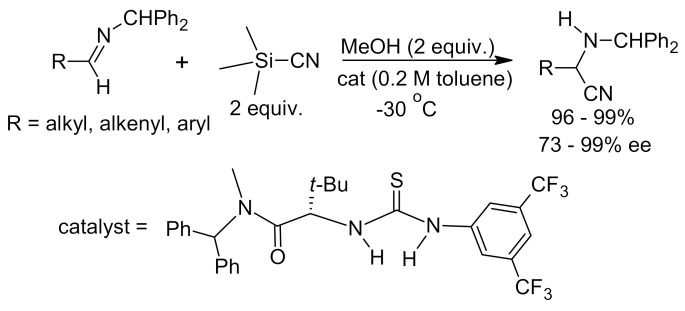
Asymmetric hydrocyanation of imines.

Proposed mechanism for the asymmetric hydrocyanation of imines.

Asymmetric Strecker synthesis mediated by Kobayashi’s catalyst.

Two-step one-pot asymmetric Strecker reaction.

Spontaneous resolution of racemic α-amino nitriles.
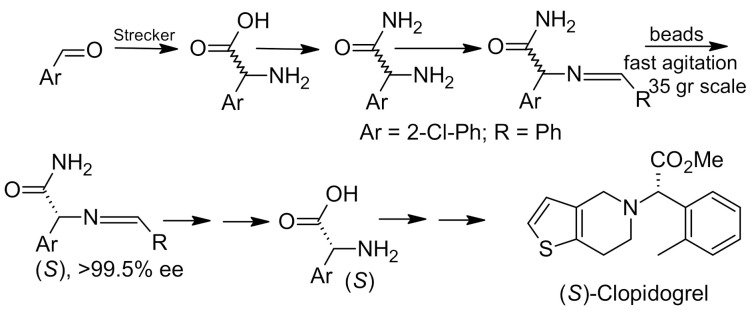
Resolution of racemic 2-chlorophenyl glycine followed by (S)-clopidogrel synthesis.

Synthesis of allyl amine by Petasis reaction.

Mechanism of the Petasis amino acid synthesis.

Cu(I)-catalysed Petasis synthesis of Ethyl glycinates.

Mechanism of Cu(I)-catalysed Patasis reaction of ethyl glyoxylate with amines and boronic acids.

Synthesis of α-propargyl and/or α-allenyl α-amino acids.

Synthesis of azulenylglycine derivatives by Petasis reaction.

Petasis amino acid synthesis in water.
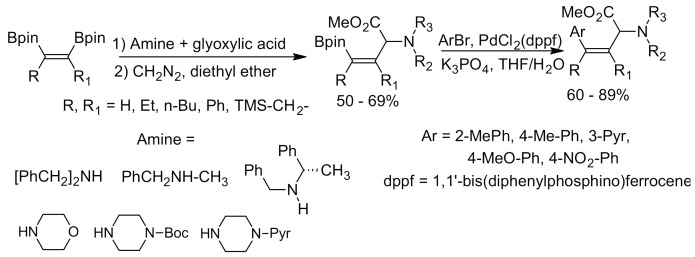
Synthesis of γ-unsaturated amino esters by Petasis reaction followed by Suzuki coupling.

Catalytic asymmetric amino acid synthesis.

Petasis reaction followed by ring-closure metathesis. * signifies an asymmetric center.
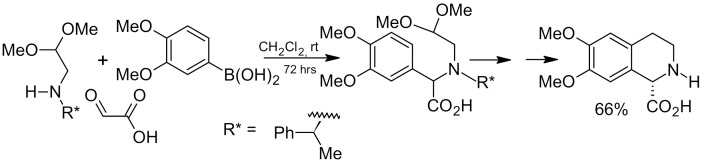
Synthesis of (+)-6,7-dimethoxy-1,2,3,4-tetrahydroisoquinoline-1-carboxylic acid. * indicates that this substituent is chiral and its stereochemistry is specified in the definition of R*.
References
-
- Bada J. Strecker Synthesis. In: Gargaud M., Amils R., Quintanilla J.C., Cleaves H.J. II, Irvine W.M., Pinti D.L., Viso M., editors. Encyclopedia of Astrobiology. Springer; Berlin/Heidelberg, Germany: 2011. p. 1603. - DOI
-
- Strecker A. Ueber die künstliche Bildung der Milchsäure und einen neuen, dem Glycocoll homologen Körper. Justus Liebigs Ann. Der Chem. 1850;75:27–45. doi: 10.1002/jlac.18500750103. - DOI
-
- Strecker A. Ueber einen neuen aus Aldehyd-Ammoniak und Blausäure entstehenden Körper. Justus Liebigs Ann. Der Chem. 1854;91:349–351. doi: 10.1002/jlac.18540910309. - DOI
-
- Pascal R. Bücherer–Bergs Synthesis. In: Gargaud M., Amils R., Quintanilla J.C., Cleaves H.J. II, Irvine W.M., Pinti D.L., Viso M., editors. Encyclopedia of Astrobiology. Springer; Berlin/Heidelberg, Germany: 2011. pp. 221–222. - DOI
-
- Monteiro J.L., Pieber B., Corrêa A.G., Kappe C.O. Continuous synthesis of hydantoins: Intensifying the Bucherer–Bergs reaction. Synlett. 2016;27:83–87. doi: 10.1055/s-0035-1560317. - DOI
Publication types
MeSH terms
Substances
Grants and funding
LinkOut - more resources
Full Text Sources
Other Literature Sources
