


Progress in Molecular Nanoarchitectonics and Materials Nanoarchitectonics
- PMID: 33804013
- PMCID: PMC7998694
- DOI: 10.3390/molecules26061621
Progress in Molecular Nanoarchitectonics and Materials Nanoarchitectonics
Abstract
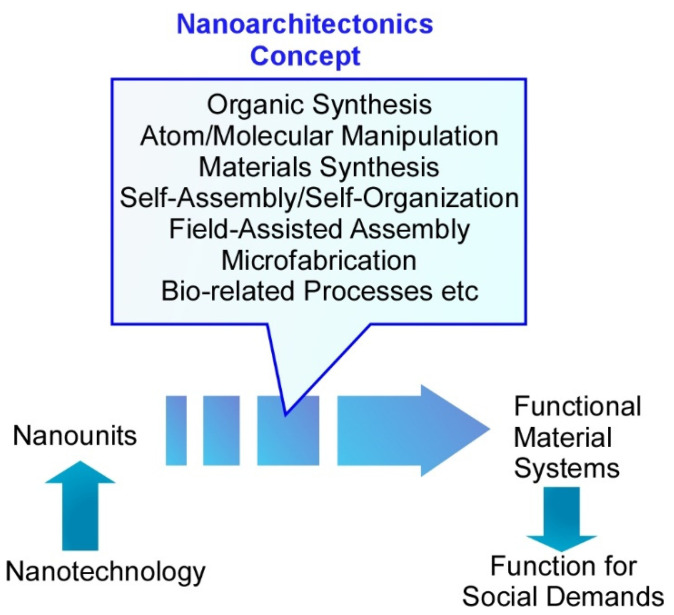
Although various synthetic methodologies including organic synthesis, polymer chemistry, and materials science are the main contributors to the production of functional materials, the importance of regulation of nanoscale structures for better performance has become clear with recent science and technology developments. Therefore, a new research paradigm to produce functional material systems from nanoscale units has to be created as an advancement of nanoscale science. This task is assigned to an emerging concept, nanoarchitectonics, which aims to produce functional materials and functional structures from nanoscale unit components. This can be done through combining nanotechnology with the other research fields such as organic chemistry, supramolecular chemistry, materials science, and bio-related science. In this review article, the basic-level of nanoarchitectonics is first presented with atom/molecular-level structure formations and conversions from molecular units to functional materials. Then, two typical application-oriented nanoarchitectonics efforts in energy-oriented applications and bio-related applications are discussed. Finally, future directions of the molecular and materials nanoarchitectonics concepts for advancement of functional nanomaterials are briefly discussed.
Keywords: bio-related application; energy-oriented application; nanoarchitectonics; nanotechnology.
Conflict of interest statement
The authors declare no conflict of interest.
Figures
References
-
- Ariga K., Ji Q., Nakanishi W., Hill J.P., Aono M. Nanoarchitectonics: A new materials horizon for nanotechnology. Mater. Horiz. 2015;2:406–413. doi: 10.1039/C5MH00012B. - DOI
-
- Ariga K., Minami K., Ebara M., Nakanishi J. What are the emerging concepts and challenges in NANO? Nanoarchitectonics, hand-operating nanotechnology and mechanobiology. Polym. J. 2016;48:371–389. doi: 10.1038/pj.2016.8. - DOI
-
- Muramatsu W., Hattori T., Yamamoto H. Game change from reagent- to substrate-controlled peptide synthesis. Bull. Chem. Soc. Jpn. 2020;93:759–767. doi: 10.1246/bcsj.20200057. - DOI
Publication types
Grants and funding
LinkOut - more resources
Full Text Sources
Other Literature Sources
