Review
. 2021 Mar 15;11(3):242.
doi: 10.3390/life11030242.

Molecular and Supramolecular Structure of the Mitochondrial Oxidative Phosphorylation System: Implications for Pathology

Affiliations
Review

Molecular and Supramolecular Structure of the Mitochondrial Oxidative Phosphorylation System: Implications for Pathology

Salvatore Nesci et al. Life (Basel). .

Abstract

Under aerobic conditions, mitochondrial oxidative phosphorylation (OXPHOS) converts the energy released by nutrient oxidation into ATP, the currency of living organisms. The whole biochemical machinery is hosted by the inner mitochondrial membrane (mtIM) where the protonmotive force built by respiratory complexes, dynamically assembled as super-complexes, allows the F1FO-ATP synthase to make ATP from ADP + Pi. Recently mitochondria emerged not only as cell powerhouses, but also as signaling hubs by way of reactive oxygen species (ROS) production. However, when ROS removal systems and/or OXPHOS constituents are defective, the physiological ROS generation can cause ROS imbalance and oxidative stress, which in turn damages cell components. Moreover, the morphology of mitochondria rules cell fate and the formation of the mitochondrial permeability transition pore in the mtIM, which, most likely with the F1FO-ATP synthase contribution, permeabilizes mitochondria and leads to cell death. As the multiple mitochondrial functions are mutually interconnected, changes in protein composition by mutations or in supercomplex assembly and/or in membrane structures often generate a dysfunctional cascade and lead to life-incompatible diseases or severe syndromes. The known structural/functional changes in mitochondrial proteins and structures, which impact mitochondrial bioenergetics because of an impaired or defective energy transduction system, here reviewed, constitute the main biochemical damage in a variety of genetic and age-related diseases.

Keywords: ATP synthase/hydrolase; ROS; cellular signaling; cristae; mitochondrial dysfunction; mitochondrial permeability transition pore; oxidative phosphorylation; respiratory supercomplexes.


Conflict of interest statement

The authors declare no conflict of interest.

Figures
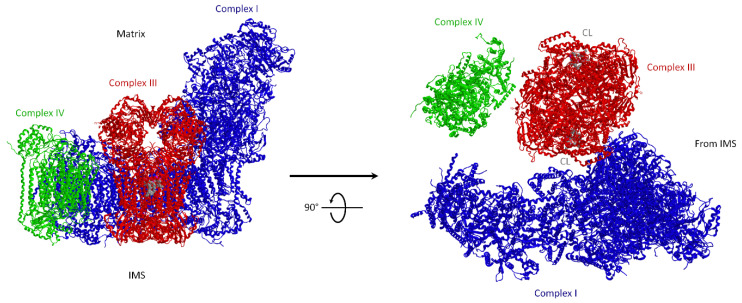
Figure 2
Figure 2
Bovine mitochondrial supercomplex (SC) I1III2IV1. Fitted model by single particle cryo-EM. Side view (on the left) and view from the IMS (on the right) showing two CL (cardiolipin) molecules (in space filling mode) in the cavity of each monomer of CIII formed by cytochromes c1 and b. Image modified from Mileykovskaya and W. Dowhan [58]. The enzyme subunits are drawn as ribbon representations obtained from modified PDB ID code: 2YBB. Blue, CI; red, CIII dimer; green, CIV.
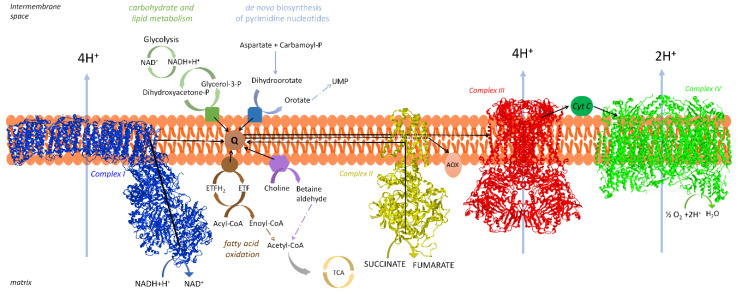
Figure 1
Figure 1
A schematic drawing of the respiratory chain depicting the protein complexes and their substrates. Complex I, Complex III and Complex IV are shown in their free form (modified PDB ID: 6YJ4, 2YBB, 1V54). Blue, CI, NADH-ubiquinone oxidoreductase; yellow, CII, succinate-ubiquinone oxidoreductase (modified PDB ID: 1ZOY); red, CIII, ubiquinol-cytochrome c oxidoreductase; green, CIV, cytochrome c oxidase; AOX, alternative oxidase; CoQ, Coenzyme Q (ubiquinone); Cytc, cytochrome c. Four enzymes that reduce CoQ are also shown together with an indication of their metabolic pathways: from the intermembrane space (IMS), glycerol-3.P dehydrogenase (green) and dihydroorotate dehydrogenase (blue); from the matrix, electron transfer flavoprotein (ETF) dehydrogenase (brown) and choline dehydrogenase (purple). (see text for details).
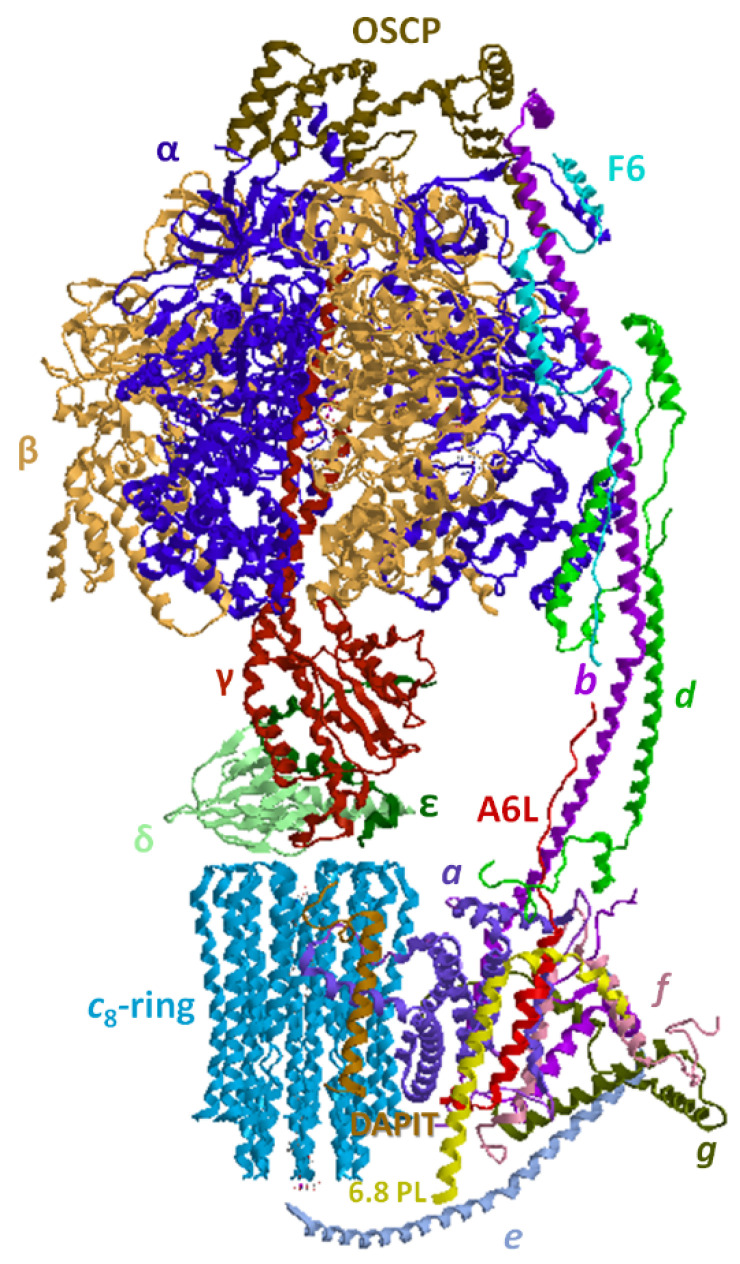
Figure 3
Figure 3
Structure of the mitochondrial F1FO-ATPase in mammals. The enzyme subunits are drawn as ribbon representations obtained from modified PDB ID code: 6TT7. The differently colored letters identify the subunits, drawn in the same color as the letter.
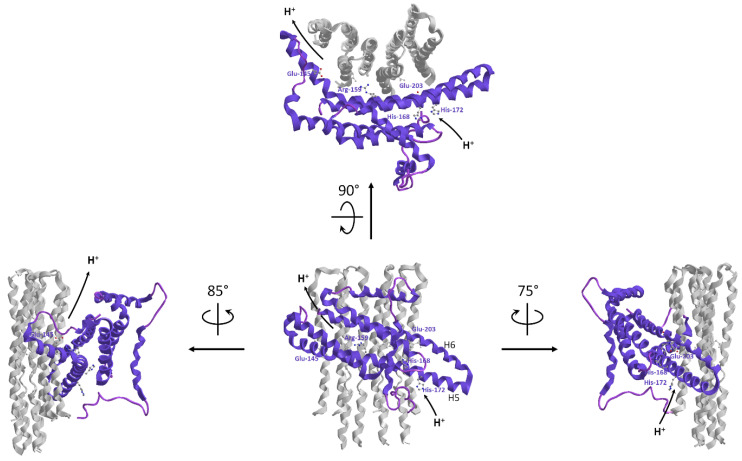
Figure 4
Figure 4
Proton translocation pathway within FO during ATP synthesis. On the top the H+ entry and exit into and from the half channels, viewed from the IMS. On the left and right sides, the H+ outlet and inlet half-channels, respectively, after the rotation angles above the arrows are shown. The horizontal helices H5 and H6 of a subunit (violet) and four c subunits (gray), drawn as ribbon representations, were obtained from modified PDB ID code: 6TT7. The amino acids of a subunit involved in H+ translocation are drawn as ball and stick models.
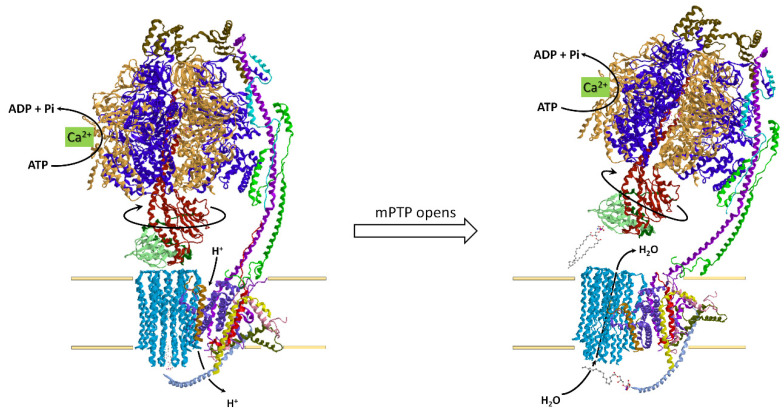
Figure 5
Figure 5
Model of mitochondrial permeability transition pore (mPTP) formation from the Ca2+-activated F1FO-ATPase. On the left Ca2+ bound to the catalytic sites activates the enzyme by triggering the structural change which opens the mPTP. On the right, the pore forms in the core of the c-ring when the lipid plug is pulled out. mPTP opening dissipates the mitochondrial Δp and water entries in the matrix driven by oncotic pressure.
Figure 6
Figure 6
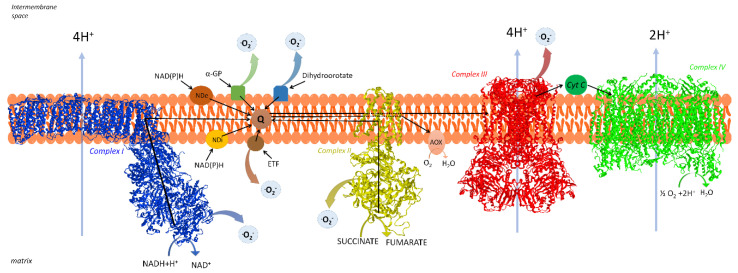
Major sites of superoxide production from the respiratory chain. The arrows represent the sources of superoxide at different sites in relation to the inner mitochondrial membrane. Blue, CI, NADH-ubiquinone oxidoreductase; yellow, CII, succinate-ubiquinone oxidoreductase; red, CIII, ubiquinol-cytochrome c oxidoreductase; green, CIV, cytochrome oxidase; NDi and NDe, internal and external alternative NAD(P)H dehydrogenases; AOX, alternative oxidase; αGP, glycerol-3-phosphate; ETF, electron transfer flavoprotein; Q, Coenzyme Q (ubiquinone); Cyt C, cytochrome c; (see text for details).
Figure 7
Figure 7
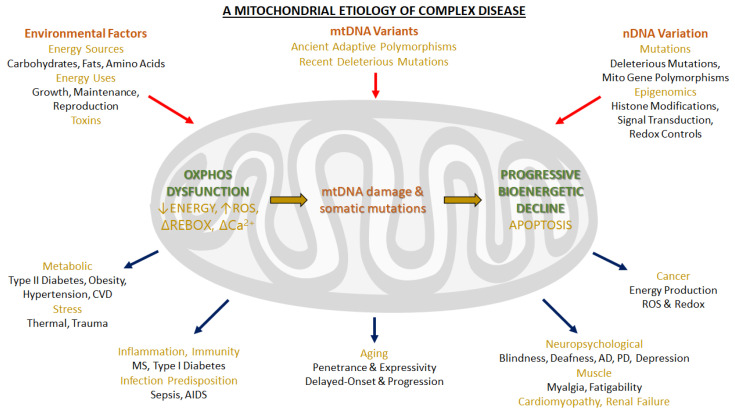
Integrated mitochondrial pattern which shows the genetic and phenotypic features of the “complex” human diseases. The model integrates the genetic and pathophysiological relationships of multi-factor diseases, aging, and cancer (from Wallace [4]). See text for explanations.
Figure 8
Figure 8
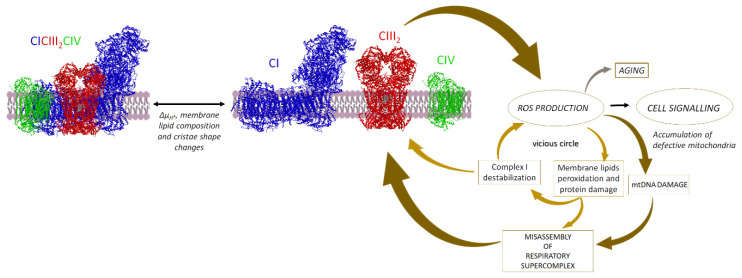
Scheme illustrating how the side chain (SC) organization loss may be involved in a vicious circle of oxidative stress and energy failure. Reactive oxygen species (ROS) production by CI increases due to SC disassembly. Other mitochondrial events, such as membrane phospholipid peroxidation, mtDNA damage and subsequent misassembly of the respiratory complexes with further loss of SC organization, may occur due to the increased oxidative stress, thus fueling and maintaining the vicious circle. In a dose-dependent way, ROS can also operate as molecular signals from mitochondria to the nucleus. See text for explanations.

References

    1. Wallace D.C. A Mitochondrial Paradigm of Metabolic and Degenerative Diseases, Aging, and Cancer: A Dawn for Evolutionary Medicine. Annu. Rev. Genet. 2005;39:359–407. doi: 10.1146/annurev.genet.39.110304.095751. - DOI - PMC - PubMed
    1. Wallace D.C. Mitochondrial Genetic Medicine. Nat. Genet. 2018;50:1642–1649. doi: 10.1038/s41588-018-0264-z. - DOI - PubMed
    1. Picard M., Wallace D.C., Burelle Y. The Rise of Mitochondria in Medicine. Mitochondrion. 2016;30:105–116. doi: 10.1016/j.mito.2016.07.003. - DOI - PMC - PubMed
    1. Wallace D.C. Bioenergetic Origins of Complexity and Disease. Cold Spring Harb. Symp. Quant. Biol. 2011;76:1–16. doi: 10.1101/sqb.2011.76.010462. - DOI - PMC - PubMed
    1. DiMauro S., Hirano M., Schon E.A. Approaches to the Treatment of Mitochondrial Diseases. Muscle Nerve. 2006;34:265–283. doi: 10.1002/mus.20598. - DOI - PubMed

LinkOut - more resources