. 2021 Mar 15;28(2):1204-1215.
doi: 10.3390/curroncol28020116.

Circulating miR-618 Has Prognostic Significance in Patients with Metastatic Colon Cancer

Affiliations

Circulating miR-618 Has Prognostic Significance in Patients with Metastatic Colon Cancer

Maria Radanova et al. Curr Oncol. .

Abstract

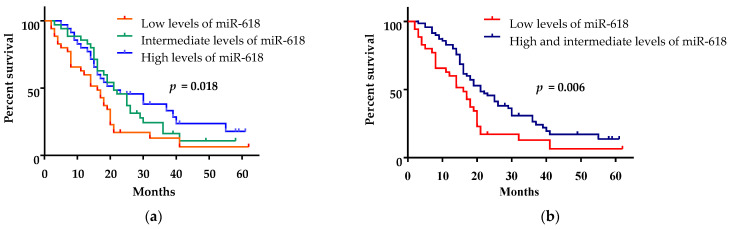
The present study evaluated the prognostic role of circulating miRNA-618 in patients with metastatic colon cancer (mCC) and whether miR-618 gene rs2682818 single nucleotide polymorphisms (SNP) are associated with colon cancer susceptibility and expression levels of mature miR-618. In total, 104 patients with mCC before starting the chemotherapy were investigated. The expression status of circulating miR-618 in mCC was evaluated by quantitative PCR. TaqMan PCR assay was used for rs2682818 SNP genotyping. miR-618 was overexpressed in serum of mCC patients. Patients with high and intermediate expression of miR-618 had a significantly longer mean overall survival (OS) of 21 months than patients with low expression-16 months. In addition, multivariate Cox regression analysis confirmed the association between high/intermediate levels of miRNA-618 and longer OS, HR = 0.51, 95% CI: 0.30-0.86, p = 0.012. miR-618 rs2682818 SNP significantly decreased the risk of colon cancer susceptibility in both heterozygous codominant (AC vs. CC, OR = 0.39, 95% CI: 0.17-0.88, p = 0.024) and overdominant (AC vs. CC + AA, OR = 0.37, 95% CI: 0.16-0.85, p = 0.018) genetic models. Our data suggest that circulating miRNA-618 could be useful as a prognostic biomarker in mCC. Patients harboring AC rs2682818 genotype have a decreased risk for colon cancer in comparison with patients with CC and AA genotypes.

Keywords: metastatic colon cancer; miR-618; rs2682818.


Conflict of interest statement

The authors have no conflict of interest to declare.

Figures
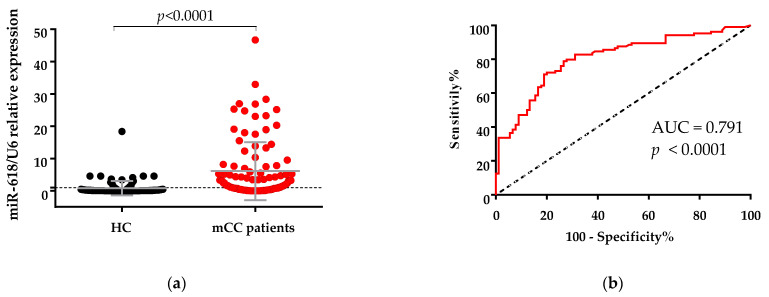
Figure 1
Figure 1
(a) Comparison between levels of miR-618 in serum samples from healthy controls (HC) and patients with metastatic colon cancer (mCC) (Mann-Whitney U test, data are presented as mean ± SD). The expression levels were measured using qPCR. U6 RNA was used as an internal control. Relative gene expression was calculated using 2−∆∆Ct method. (b) Receiver operation characteristics (ROC) curve of using miR-618 to differentiate patients with mCC from healthy controls. Area under the ROC curve (AUC) is 0.791, p < 0.0001.
Figure 2
Figure 2
Kaplan–Meier survival analysis for assessment of the circulating miR-618 levels and the overall survival of mCC patients. (a) Overall survival of patients with high (over the 66th percentile), intermediate (between the 33th and 66th percentile) and low (up to the 33th percentile) levels of miR-618 were compared. (b) Overall survival of patients with high (over the 66th percentile) and intermediate (between the 33th and 66th percentile) level of miR-618 were compared to overall survival of patients with low (up to the 33th percentile) levels of miR-618.
Figure 3
Figure 3
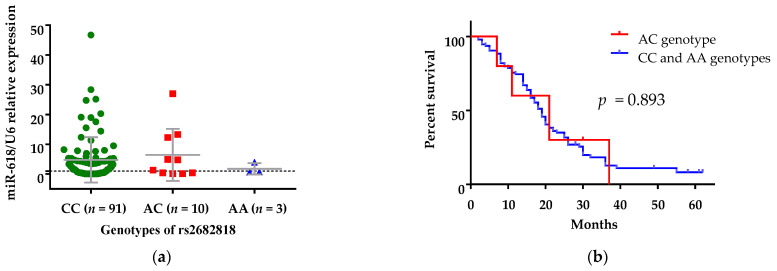
(a) Levels of circulating miR-618 in patients with mCC carrying different genotypes of rs2682818. There were no significant differences between rs2682818l genotypes in regard to expression of miR-618 (Mann-Whitney U test, data are presented as mean ± SD). (b) Kaplan–Meier survival analysis for assessment of AC vs. CC and AA genetic model of rs2682818 and the overall survival of mCC patients. Patients carrying AA genotype and those carrying CC/AA genotypes did not have statistically different overall survival (p = 0.893).

References

    1. Siegel R.L., Miller K.D., Sauer A.G., Fedewa S.A., Butterly L.F., Anderson J.C., Cercek A., Smith R.A., Jemal A. Colorectal cancer statistics. CA Cancer J. Clin. 2020;70:145–164. doi: 10.3322/caac.21601. - DOI - PubMed
    1. Van Cutsem E., Cervantes A., Nordlinger B., Arnold D., ESMO Guidelines Working Group Metastatic colorectal cancer: ESMO Clinical Practice Guidelines for diagnosis, treatment and follow-up. Ann. Oncol. 2014;25(Suppl. 3):iii1–iii9. doi: 10.1093/annonc/mdu260. - DOI - PubMed
    1. Sohel M.M.H. Circulating microRNAs as biomarkers in cancer diagnosis. Life Sci. 2020;248:117473. doi: 10.1016/j.lfs.2020.117473. - DOI - PubMed
    1. Wang H., Peng R., Wang J., Qin Z., Xue L. Circulating microRNAs as potential cancer biomarkers: The advantage and disadvantage. Clin. Epigenet. 2018;10:59. doi: 10.1186/s13148-018-0492-1. - DOI - PMC - PubMed
    1. Ding H.X., Lv Z., Yuan Y., Xu Q. MiRNA Polymorphisms and Cancer Prognosis: A Systematic Review and Meta-Analysis. Front. Oncol. 2018;8:596. doi: 10.3389/fonc.2018.00596. - DOI - PMC - PubMed

Publication types

LinkOut - more resources