


CPAP Therapy Termination Rates by OSA Phenotype: A French Nationwide Database Analysis
- PMID: 33804319
- PMCID: PMC7957656
- DOI: 10.3390/jcm10050936
CPAP Therapy Termination Rates by OSA Phenotype: A French Nationwide Database Analysis
Abstract
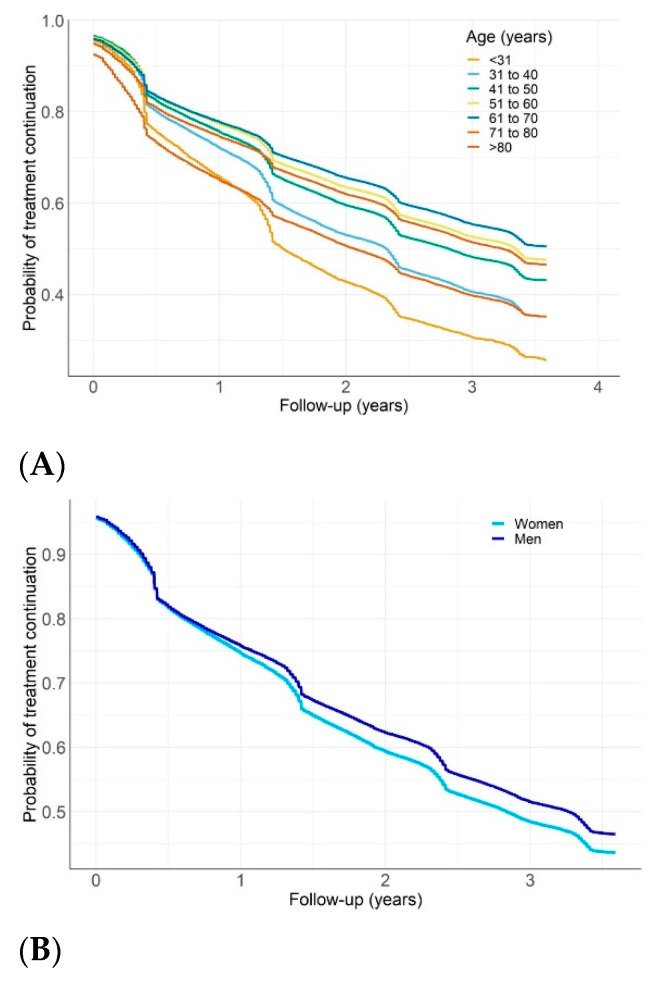
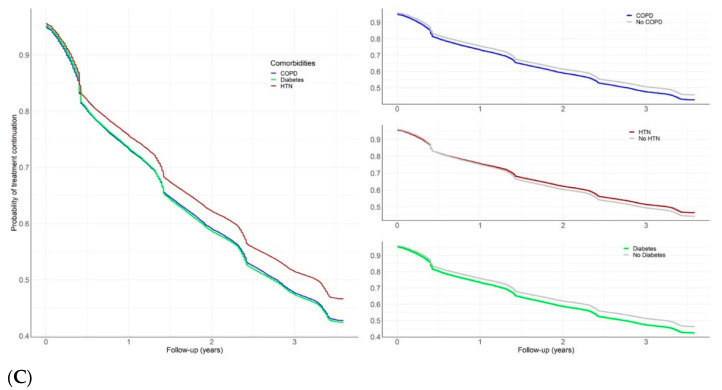
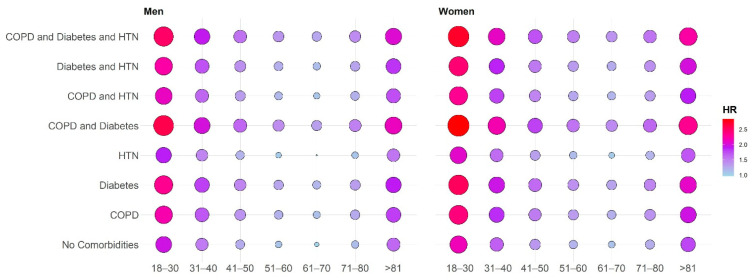
The nationwide claims data lake for sleep apnoea (ALASKA)-real-life data for understanding and increasing obstructive sleep apnea (OSA) quality of care study-investigated long-term continuous positive airway pressure (CPAP) termination rates, focusing on the contribution of comorbidities. The French national health insurance reimbursement system data for new CPAP users aged ≥18 years were analyzed. Innovative algorithms were used to determine the presence of specific comorbidities (hypertension, diabetes and chronic obstructive pulmonary disease (COPD)). Therapy termination was defined as cessation of CPAP reimbursements. A total of 480,000 patients were included (mean age 59.3 ± 13.6 years, 65.4% male). An amount of 50.7, 24.4 and 4.3% of patients, respectively, had hypertension, diabetes and COPD. Overall CPAP termination rates after 1, 2 and 3 years were 23.1, 37.1 and 47.7%, respectively. On multivariable analysis, age categories, female sex (1.09 (1.08-1.10) and COPD (1.12 (1.10-1.13)) and diabetes (1.18 (1.16-1.19)) were significantly associated with higher CPAP termination risk; patients with hypertension were more likely to continue using CPAP (hazard ratio 0.96 (95% confidence interval 0.95-0.97)). Therapy termination rates were highest in younger or older patients with ≥1 comorbidity. Comorbidities have an important influence on long-term CPAP continuation in patients with OSA.
Keywords: adherence; comorbidities; continuous positive airway pressure; obstructive sleep apnea; treatment.
Conflict of interest statement
J.-L.P. has received lecture fees or conference traveling grants from ResMed, Perimetre, Philips, Fisher and Paykel, AstraZeneca, Jazz Pharmaceuticals, Agiradom and Teva and has received unrestricted research funding from ResMed, Philips, GlaxoSmithKline, Bioprojet, Fondation de la Recherche Medicale (Foundation for Medical Research), Direction de la Recherche Clinique du CHU de Grenoble (Research Branch Clinic CHU de Grenoble) and fond de dotation “Agir pour les Maladies Chroniques” (endowment fund “Acting for Chronic Diseases”). A.M. is funded by the NIH, reports income from Merck and Livanova related to medical education, and ResMed provided a philanthropic donation to UC San Diego. P.A.C. has an appointment to an endowed academic Chair at the University of Sydney that was established from ResMed funding, has received research support from ResMed, SomnoMed and Zephyr Sleep Technologies, and is a consultant to ResMed, SomnoMed, Zephyr Sleep Technologies and Signifier Medical Technologies. R.T. has received consulting fees from ResMed, Inspire, Navigant and Jazz Pharmaceuticals, lecture fees from Agiradom, Elivie, ResMed and Philips, conference travel grants from Agiradom, and unrestricted research grants from ResMed, Vitalaire, Philips, APMC foundation Direction de la recherche Clinique du CHU de Grenoble and inter-regional research university hospital group. A.B., F.L. and A.J. are employees of ResMed. P.R., D.S. and P.H. are employees of SEMEIA. S.B. and D.A. have no conflicts of interest to disclose.
Figures
References
-
- Benjafield A.V., Ayas N.T., Eastwood P.R., Heinzer R., Ip M.S.M., Morrell M.J., Nunez C.M., Patel S.R., Penzel T., Pepin J.L., et al. Estimation of the global prevalence and burden of obstructive sleep apnoea: A literature-based analysis. Lancet Respir. Med. 2019;7:687–698. doi: 10.1016/S2213-2600(19)30198-5. - DOI - PMC - PubMed
-
- Sullivan F. In: Hidden Health Crisis Costing America Billions: Underdiagnosing and Undertreating Obstructive Sleep Apnea Draining Healthcare System. Sullivan F., editor. American Academy of Sleep Medicine; Mountain View, CA, USA: 2016.
Grants and funding
LinkOut - more resources
Full Text Sources
Other Literature Sources
