


Multiple Allergen Simultaneous Test-Immunoblot Assay for Immunoglobulin E Detection in Patients with Isolated Allergic Conjunctivitis
- PMID: 33804507
- PMCID: PMC7957652
- DOI: 10.3390/jcm10050960
Multiple Allergen Simultaneous Test-Immunoblot Assay for Immunoglobulin E Detection in Patients with Isolated Allergic Conjunctivitis
Abstract
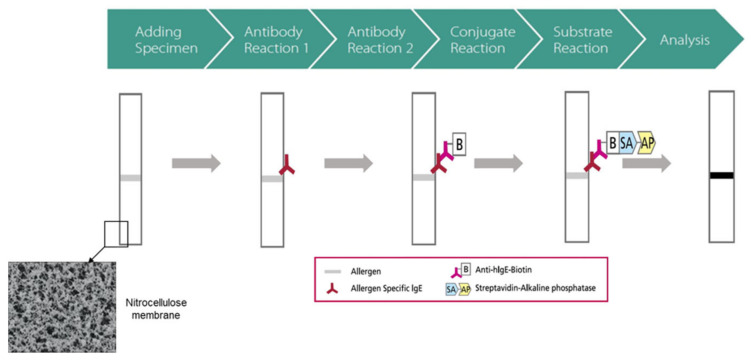
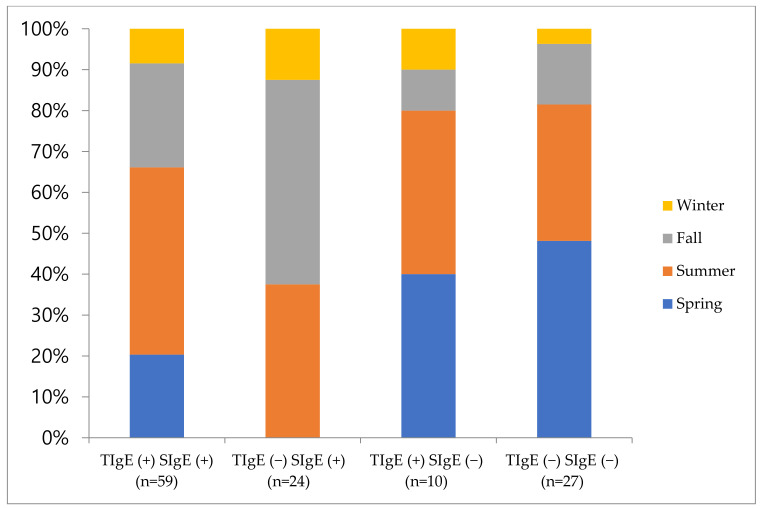
We aimed to investigate the immunoglobulin E (IgE) detection rate and allergen patterns in patients with isolated allergic conjunctivitis using the multiple allergen simultaneous test (MAST)-immunoblot assay. A total of 120 patients with allergic conjunctivitis and no associated rhinitis, asthma, or dermatitis underwent the MAST-immunoblot assay to measure serum total IgE (TIgE) and serum specific IgE (SIgE) against 57 allergens. Patients were classified into subgroups based on the season when the eye symptoms were exacerbated, and TIgE and SIgE positivity. Differences between sex and age groups were also analyzed. Of the 120 patients, 57.5% (69 patients) and 69.2% (83 patients) were positive for TIgE (≥100 IU/mL) and SIgE (≥0.7 IU/mL), respectively. The allergens that most frequently triggered sensitization in the study population were Dermatophagoides farinae, Dermatophagoides pteronyssinus, Tyrophagus putrescentiae, Alternaria, and house dust. House dust mites, such as D. farinae and D. pteronyssinus, showed the highest detection rates regardless of the season. Men had a higher positive rate for TIgE than women, whereas a higher rate of sensitization, detected as SIgE positivity, was seen in younger patients. In conclusion, MAST-immunoblot assay can detect sensitizing allergens in patients with isolated allergic conjunctivitis.
Keywords: allergic conjunctivitis; multiple allergen simultaneous test-immunoblot assay; serum immunoglobulin E.
Conflict of interest statement
The authors declare no conflict of interest. The funders had no role in the design of the study; in the collection, analyses, or interpretation of data; in the writing of the manuscript, or in the decision to publish the results.
Figures
References
-
- Tang A.W. A practical guide to anaphylaxis. Am. Fam. Physician. 2003;68:1325–1332. - PubMed
Grants and funding
LinkOut - more resources
Full Text Sources
Other Literature Sources
