Review
. 2021 Mar 1;18(5):2399.
doi: 10.3390/ijerph18052399.

Food, Nutrition, Physical Activity and Microbiota: Which Impact on Lung Cancer?

Affiliations
Review

Food, Nutrition, Physical Activity and Microbiota: Which Impact on Lung Cancer?

Ersilia Nigro et al. Int J Environ Res Public Health. .

Abstract

Lung cancer still represents the leading cause of cancer-related death, globally. Likewise, malnutrition and inactivity represent a major risk for loss of functional pulmonary capacities influencing overall lung cancer severity. Therefore, the adhesion to an appropriate health lifestyle is crucial in the management of lung cancer patients despite the subtype of cancer. This review aims to summarize the available knowledge about dietary approaches as well as physical activity as the major factors that decrease the risk towards lung cancer, and improve the response to therapies. We discuss the most significant dietary schemes positively associated to body composition and prognosis of lung cancer and the main molecular processes regulated by specific diet schemes, functional foods and physical activity, i.e., inflammation and oxidative stress. Finally, we report evidence demonstrating that dysbiosis of lung and/or gut microbiome, as well as their interconnection (the gut-lung axis), are strictly related to dietary patterns and regular physical activity playing a key role in lung cancer formation and progression, opening to the avenue of modulating the microbiome as coadjuvant therapy. Altogether, the evidence reported in this review highlights the necessity to consider non-pharmacological interventions (nutrition and physical activity) as effective adjunctive strategies in the management of lung cancer.

Keywords: lung cancer; microbiota; nutrition; physical activity; sarcopenia.


Conflict of interest statement

The authors declare no conflict of interest.

Figures
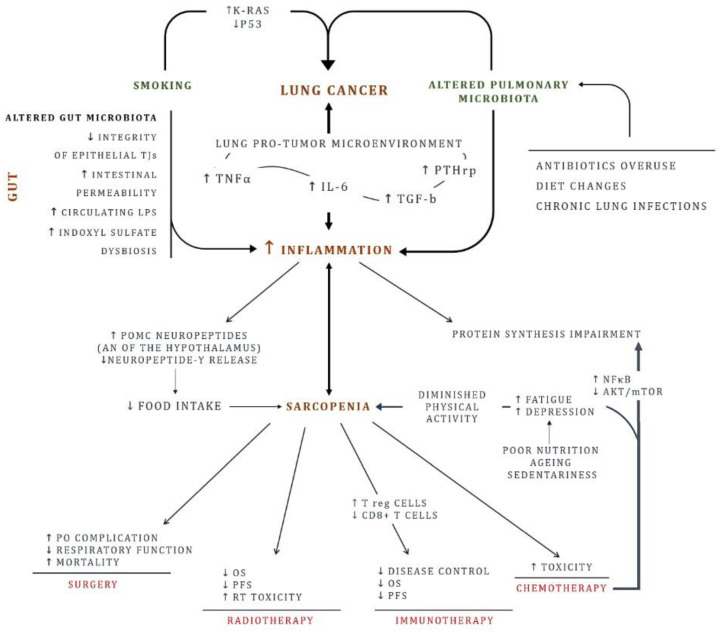
Figure 1
Figure 1
Lung cancer risk factors: focus on inflammation chronic inflammation, and sarcopenia. In addition to smoking, lifestyle (diet change, physical activity, pulmonary and gut microbiota) represents a risk factor postulated to contribute to lung cancer origin. The resulting inflammation ignites the carcinogenesis. On the other hand, inflammation is sustained in the tumor microenvironment, closing the vicious circle. Likewise, gut plays a key role. An impaired intestinal mucosa and an altered gut microbiota promotes inflammation. With time, skeletal muscle weakens. Physical inactivity combined with inadequate diet exacerbates the scenario and sarcopenia development. AKT: Protein kinase B; AN: Arcuate nucleus; IL-6: Interleukin 6; mTOR: mammalian target of rapamycin; NFκB: Nuclear factor kappa-light-chain-enhancer of activated B cells; LPS: Lipopolysaccharides; OS: overall survival; PFS: Progression-free survival; PO: Post-operative; POMC: Pro-opiomelanocortin; PTHrp: Parathyroid hormone-related protein; RT: Radiotherapy; TJs: tight junctions; TGF-β: Transforming growth factor beta; TNFα: Tumor necrosis factor alpha.
Figure 2
Figure 2
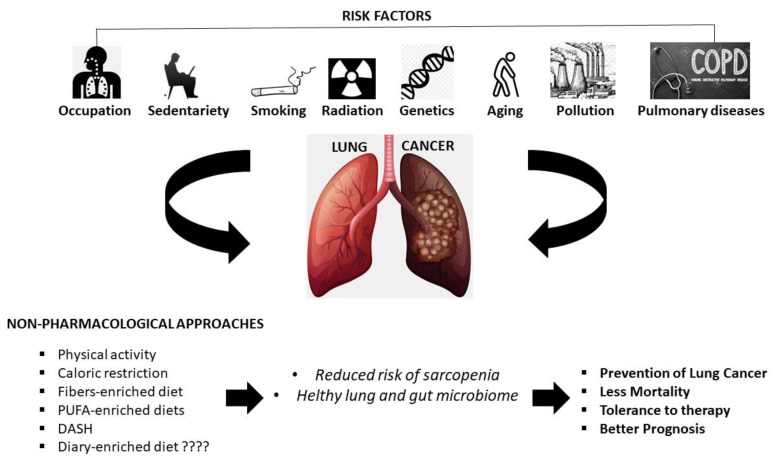
Non-pharmacological approaches acting on lung cancer incidence and management. Regular physical activity, caloric restriction, fibers-enriched diet, PUFA-enriched diets, DASH and diary-enriched diet may reduce the risk of sarcopenia and influence lung and gut microbiome resulting in decreased cancer incidence, reduced mortality, tolerance to therapy and a better prognosis.

References

    1. Ebell M.H., Bentivegna M., Hulme C. Cancer-Specific Mortality, All-Cause Mortality, and Overdiagnosis in Lung Cancer Screening Trials: A Meta-Analysis. Ann. Fam. Med. 2020;18:545–552. doi: 10.1370/afm.2582. - DOI - PMC - PubMed
    1. Siegel R.L., Miller K.D., Jemal A. Cancer Statistics, 2020. CA. Cancer J. Clin. 2020;70:7–30. doi: 10.3322/caac.21590. - DOI - PubMed
    1. Avancini A., Pala V., Trestini I., Tregnago D., Mariani L., Sieri S., Krogh V., Boresta M., Milella M., Pilotto S., et al. Exercise Levels and Preferences in Cancer Patients: A Cross-Sectional Study. Int. J. Environ. Res. Public Health. 2020;17:5351. doi: 10.3390/ijerph17155351. - DOI - PMC - PubMed
    1. Barta J.A., Powell C.A., Wisnivesky J.P. Global Epidemiology of Lung Cancer. Ann. Glob. Health. 2019;85:8. doi: 10.5334/aogh.2419. - DOI - PMC - PubMed
    1. Venuta F., Diso D., Onorati I., Anile M., Mantovani S., Rendina E.A. Lung Cancer in Elderly Patients. J. Thorac. Dis. 2016;8(Suppl. 11):S908–S914. doi: 10.21037/jtd.2016.05.20. - DOI - PMC - PubMed

Publication types

LinkOut - more resources