


Development of Water-Insoluble Vehicle Comprising Natural Cyclodextrin-Vitamin E Complex
- PMID: 33804761
- PMCID: PMC8003986
- DOI: 10.3390/antiox10030490
Development of Water-Insoluble Vehicle Comprising Natural Cyclodextrin-Vitamin E Complex
Abstract
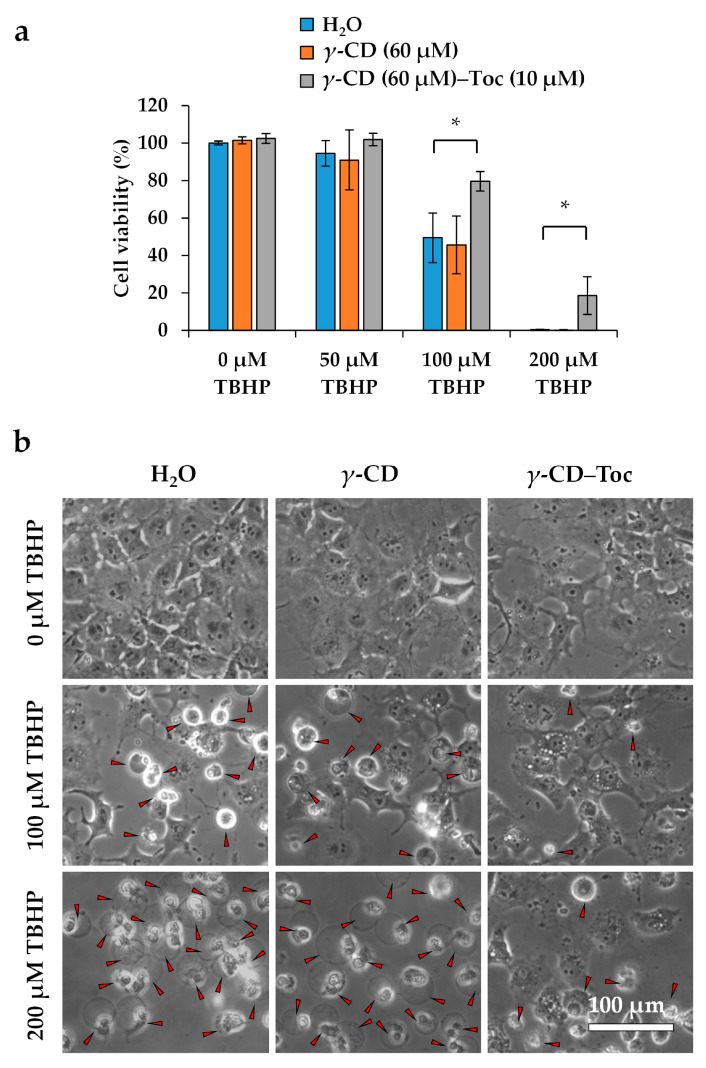
Development of a novel antioxidant-delivery vehicle exerting biosafety has been attracting a great deal of interest. In this study, a vehicle comprising a natural composite consisting of vitamin E (α-tocopherol; Toc) and cyclodextrin (CD) additives was developed, directed toward aqua-related biological applications. Not only β-CD, but also γ-CD, tended to form a water-insoluble aggregate with Toc in aqueous media. The aggregated vehicle, in particular the γ-CD-added system, showed a remarkable sustained effect because of slow dynamics. Furthermore, a prominent cytoprotective effect by the γ-CD-Toc vehicle under the oxidative stress condition was confirmed. Thus, the novel vitamin E vehicle motif using γ-CD as a stabilizer was proposed, widening the usability of Toc for biological applications.
Keywords: cell viability; oxidative stress; radical scavenging; vehicle; vitamin E; γ-cyclodextrin.
Conflict of interest statement
The authors declare no conflict of interest.
Figures


References
-
- Niki E., Abe K. Vitamin E: Structure, properties and functions. In: Niki E., editor. Food Chemistry, Function and Analysis No. 11 Vitamin E: Chemistry and Nutritional Benefits. The Royal Society of Chemistry; London, UK: 2019. pp. 1–11. Chapter 1. - DOI
Grants and funding
LinkOut - more resources
Full Text Sources
Other Literature Sources
