


Rabies in Our Neighbourhood: Preparedness for an Emerging Infectious Disease
- PMID: 33804778
- PMCID: PMC8003993
- DOI: 10.3390/pathogens10030375
Rabies in Our Neighbourhood: Preparedness for an Emerging Infectious Disease
Abstract
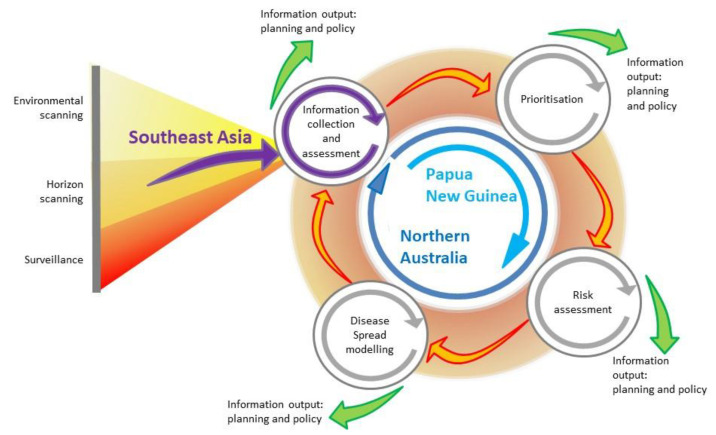
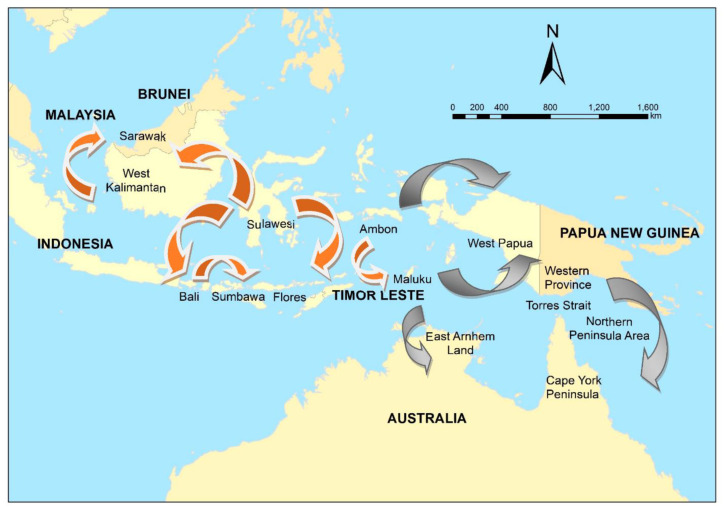
Emerging infectious disease (EID) events have the potential to cause devastating impacts on human, animal and environmental health. A range of tools exist which can be applied to address EID event detection, preparedness and response. Here we use a case study of rabies in Southeast Asia and Oceania to illustrate, via nearly a decade of research activities, how such tools can be systematically integrated into a framework for EID preparedness. During the past three decades, canine rabies has spread to previously free areas of Southeast Asia, threatening the rabies-free status of countries such as Timor Leste, Papua New Guinea and Australia. The program of research to address rabies preparedness in the Oceanic region has included scanning and surveillance to define the emerging nature of canine rabies within the Southeast Asia region; field studies to collect information on potential reservoir species, their distribution and behaviour; participatory and sociological studies to identify priorities for disease response; and targeted risk assessment and disease modelling studies. Lessons learnt include the need to develop methods to collect data in remote regions, and the need to continuously evaluate and update requirements for preparedness in response to evolving drivers of emerging infectious disease.
Keywords: Australia; disease spread modelling; dog; environmental scanning; lyssavirus; policy; rabies; response; risk assessment; surveillance.
Conflict of interest statement
The authors declare no conflict of interest.
Figures
References
-
- Gardner J.W., Stewart W.H. Use of Vital and Health Records in Epidemiologic Research. A Report of the United States National Committee on Vital and Health Statistics. U.S. Department of Health, Education, and Welfare; Washington, DC, USA: 1968. [(accessed on 24 February 2021)]. Available online: http://www.cdc.gov/nchs/data/series/sr_04/sr04_007.pdf.
-
- Johnson A.P., Aucken H.M., Cavendish S., Ganner M., Wale M.C.J., Warner M., Livermore D.M., Cookson B.D., Participants T.U.E. Dominance of EMRSA-15 and -16 among MRSA causing nosocomial bacteraemia in the UK: Analysis of isolates from the European Antimicrobial Resistance Surveillance System (EARSS) J. Antimicrob. Chemother. 2001;48:143–144. doi: 10.1093/jac/48.1.143. - DOI - PubMed
Publication types
LinkOut - more resources
Full Text Sources
Other Literature Sources
Miscellaneous
