Review
. 2021 Mar 24;22(7):3301.
doi: 10.3390/ijms22073301.

The Glioblastoma Microenvironment: Morphology, Metabolism, and Molecular Signature of Glial Dynamics to Discover Metabolic Rewiring Sequence

Affiliations
Review

The Glioblastoma Microenvironment: Morphology, Metabolism, and Molecular Signature of Glial Dynamics to Discover Metabolic Rewiring Sequence

Assunta Virtuoso et al. Int J Mol Sci. .

Abstract

Different functional states determine glioblastoma (GBM) heterogeneity. Brain cancer cells coexist with the glial cells in a functional syncytium based on a continuous metabolic rewiring. However, standard glioma therapies do not account for the effects of the glial cells within the tumor microenvironment. This may be a possible reason for the lack of improvements in patients with high-grade gliomas therapies. Cell metabolism and bioenergetic fitness depend on the availability of nutrients and interactions in the microenvironment. It is strictly related to the cell location in the tumor mass, proximity to blood vessels, biochemical gradients, and tumor evolution, underlying the influence of the context and the timeline in anti-tumor therapeutic approaches. Besides the cancer metabolic strategies, here we review the modifications found in the GBM-associated glia, focusing on morphological, molecular, and metabolic features. We propose to analyze the GBM metabolic rewiring processes from a systems biology perspective. We aim at defining the crosstalk between GBM and the glial cells as modules. The complex networking may be expressed by metabolic modules corresponding to the GBM growth and spreading phases. Variation in the oxidative phosphorylation (OXPHOS) rate and regulation appears to be the most important part of the metabolic and functional heterogeneity, correlating with glycolysis and response to hypoxia. Integrated metabolic modules along with molecular and morphological features could allow the identification of key factors for controlling the GBM-stroma metabolism in multi-targeted, time-dependent therapies.

Keywords: astrocytes; cross-talk; disease progression; glycolysis; high-grade glioma; hypoxia; metabolism; microglia; modules; oxidative phosphorylation.


Conflict of interest statement

The authors declare no conflict of interest.

Figures
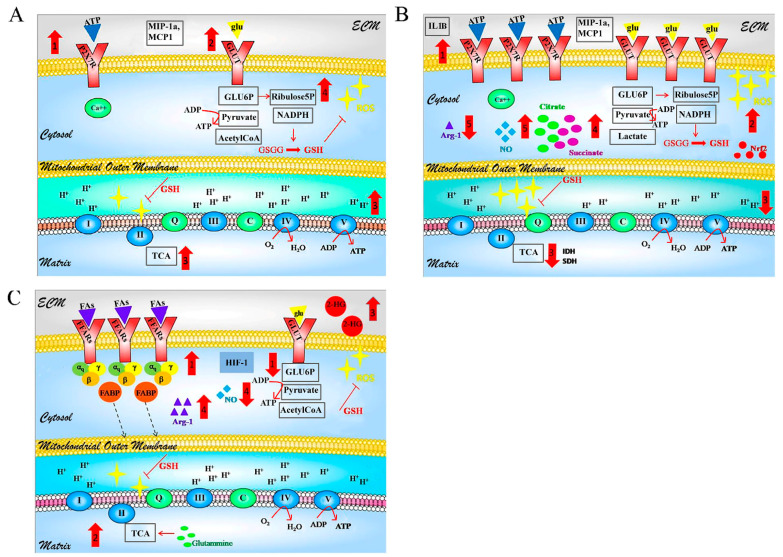
Figure 1
Figure 1
Glioblastoma (GBM)-associated reactive microglia. Activation phases scheme. It is proposed that the pro-inflammatory (M1) activation of microglia and macrophages includes two metabolic steps: early and late activation. (A) The early activation is mediated by P2X7Rs (1). Activated microglia relies on a glycolytic metabolism (2) followed by mitochondrial oxidation with an intact TCA cycle (3). A part of glucose is used in the pentose phosphate pathway (PPP) to obtain the substrates for biosynthesis and NADPH for the reduction of GSGG, gaining antioxidant power (4). (B) In the M1 late activation, microglia and macrophages overexpress P2X7Rs and GLUT (1). Despite the upregulation of Nrf2, excessive ROS are produced (2). ROS leads to mitochondrial impairment (3). TCA cycle has a deficient step in IDH and SDH with consequent accumulation of citrate and succinate (4), which favor the production of inflammatory cytokines. The brain microglial ROS may result in the formation of the NF-kB p50 radical, leading to the loss of function of Arg-1 and the consequent production of NO from L-arginine (5). NO drives the switch toward the aerobic glycolytic metabolism with the release of lactate. (C) M2 activation. The lactate in the ECM and the tumor-induced hypoxia stabilize the HIF1-α while the condition of glucose starvation constrains the cells to FAO metabolism (1) and mitochondrial rewiring. Glutamine-derived compounds enter the TCA cycle (anaplerosis) or are involved in the GSH synthesis (2). HIF-α and 2-HG restrain the inflammatory genes and promote anti-inflammatory behavior (3). Arg-1 upregulation reduces the substrate availability for the inducible nitric oxide synthase (iNOS) with consequent NO reduction (4). All the figures consider the metabolic changes and do not include the nuclear compartment. More detail in the text. ECM = extracellular matrix; ATP = adenosine triphosphate; P2X7Rs = purinergic receptor X7; MIP-1α = macrophage inflammatory protein 1-alpha; MCP1 = monocyte chemoattractant protein 1; glu = glucose; GLUT = Glucose Transporter; glu6P = glucose 6-phosphate; NADPH = nicotinamide adenine dinucleotide phosphate hydrogen; ROS = reactive oxygen species; GSGG = oxidized glutathione; GSH = Reduced glutathione; Ca2+ = calcium ion; I,II,III,IV,V = mitochondrial complex of phosphorylation electron chain; Q = coenzyme Q; C = cytochrome c oxidoreductase; TCA = tricarboxylic acid cycle; Nrf2 = Nuclear factor erythroid 2-related factor 2; Il-1β = Interleukin 1 beta; IDH = Isocitrate dehydrogenase; SDH = Succinate dehydrogenase; HIF-1 = Hypoxia-inducible factor 1; FAs = fatty acids; FFARs = free fatty acids receptor; αq-β-γ = G proteins coupled to receptor; FABP = fatty acid-binding protein; Arg-1 = Arginase-1; 2-HG = 2-hydroxyglutarate; NO = nitric oxide. Figure 1 was partially drawn using the Network Painter open-source tool from Stanford University.
Figure 2
Figure 2
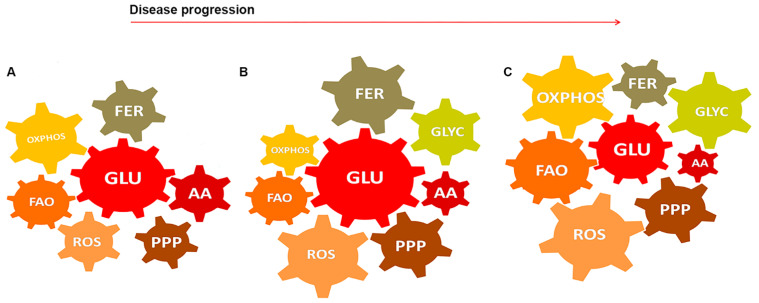
Metabolic modules in the GBM-glial cell network during the disease progression. (A) Metabolic modules may be considered as gears regulating the engine performance, that is the bioenergetic machinery in biological tissues. Based on the literature review, we hypothesized the relationships between the metabolic modules in the GBM-glial cells network. In physiological conditions, glucose oxidation-derived products allow both the OXPHOS, FER, and PPP. The ROS production is counterbalanced by the AA pool, which is partially used for synthesizing anti-oxidant agents. Fatty acid oxidation also precedes ATP production and substrates for biosynthesis. (B) With the presence of GBM, metabolic and mitochondrial rewiring occurs. Both cancer and non-cancer cells are supposed to rely on glycolytic metabolism and PPP for ATP and biosynthesis need respectively. ROS production exceeds and impairs the mitochondrial OXPHOS. Astrocytes maintain the FER to fulfill the neurons’ metabolic needs. Glycogen and non-essential AA are recruited as an alternative source of glucose. (C) In the condition of glucose starvation, glycogen deposits and AA keep on fuel the energetic and biosynthetic metabolism [189]. FAO acquires a major role to sustain the OXPHOS, but the overproduction of ROS may trigger new adaptations and maladaptive plasticity. Glucose oxidation (glycolysis, GLU); anaerobic fermentation (FER), amino acids (AA), oxidative phosphorylation (OXPHOS); reactive oxygen species (ROS); pentose phosphate pathway (PPP); fatty acid oxidation (FAO); glycogenolysis (GLYC).

References

    1. Wesseling P., Capper D. WHO 2016 Classification of gliomas. Neuropathol. Appl. Neurobiol. 2018;44:139–150. doi: 10.1111/nan.12432. - DOI - PubMed
    1. Touat M., Idbaih A., Sanson M., Ligon K.L. Glioblastoma targeted therapy: Updated approaches from recent biological insights. Ann. Oncol. Off. J. Eur. Soc. Med. Oncol. 2017;28:1457–1472. doi: 10.1093/annonc/mdx106. - DOI - PMC - PubMed
    1. DeAngelis L.M. Medical progress: Brain tumors. N. Engl. J. Med. 2001;344:114–123. doi: 10.1056/NEJM200101113440207. - DOI - PubMed
    1. Ventero M.P., Fuentes-Baile M., Quereda C., Perez-Valeciano E., Alenda C., Garcia-Morales P., Esposito D., Dorado P., Manuel Barbera V., Saceda M. Radiotherapy resistance acquisition in Glioblastoma. Role of SOCS1 and SOCS3. PLoS ONE. 2019;14:e0212581. doi: 10.1371/journal.pone.0212581. - DOI - PMC - PubMed
    1. Wenger A., Vega S.F., Kling T., Bontell T.O., Jakola A.S., Carén H. Intratumor DNA methylation heterogeneity in glioblastoma: Implications for DNA methylation-based classification. Neuro Oncol. 2019 doi: 10.1093/neuonc/noz011. - DOI - PMC - PubMed

LinkOut - more resources