


Plant Holobiont Theory: The Phytomicrobiome Plays a Central Role in Evolution and Success
- PMID: 33805166
- PMCID: PMC8064057
- DOI: 10.3390/microorganisms9040675
Plant Holobiont Theory: The Phytomicrobiome Plays a Central Role in Evolution and Success
Abstract
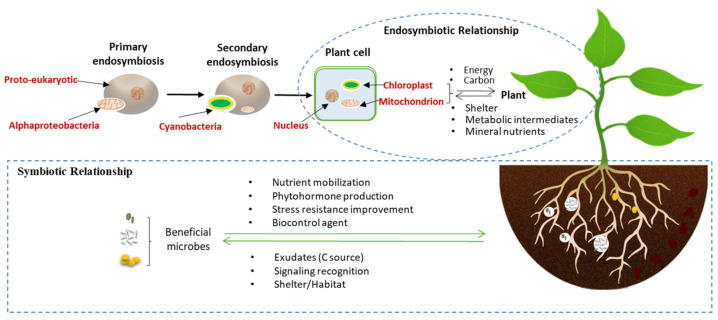
Under natural conditions, plants are always associated with a well-orchestrated community of microbes-the phytomicrobiome. The nature and degree of microbial effect on the plant host can be positive, neutral, or negative, and depends largely on the environment. The phytomicrobiome is integral for plant growth and function; microbes play a key role in plant nutrient acquisition, biotic and abiotic stress management, physiology regulation through microbe-to-plant signals, and growth regulation via the production of phytohormones. Relationships between the plant and phytomicrobiome members vary in intimacy, ranging from casual associations between roots and the rhizosphere microbial community, to endophytes that live between plant cells, to the endosymbiosis of microbes by the plant cell resulting in mitochondria and chloroplasts. If we consider these key organelles to also be members of the phytomicrobiome, how do we distinguish between the two? If we accept the mitochondria and chloroplasts as both members of the phytomicrobiome and the plant (entrained microbes), the influence of microbes on the evolution of plants becomes so profound that without microbes, the concept of the "plant" is not viable. This paper argues that the holobiont concept should take greater precedence in the plant sciences when referring to a host and its associated microbial community. The inclusivity of this concept accounts for the ambiguous nature of the entrained microbes and the wide range of functions played by the phytomicrobiome in plant holobiont homeostasis.
Keywords: biocontrol; endosymbiosis; evolution; growth promotion; phytomicrobiome; plant holobiont; signaling.
Conflict of interest statement
The authors declare no conflict of interest.
Figures
References
-
- Roughgarden J., Gilbert S.F., Rosenberg E., Zilber-Rosenberg I., Lloyd E.A. Holobionts as Units of Selection and a Model of Their Population Dynamics and Evolution. Biol. Theory. 2018;13:44–65. doi: 10.1007/s13752-017-0287-1. - DOI
Publication types
Grants and funding
LinkOut - more resources
Full Text Sources
Other Literature Sources
