Review
. 2021 Mar 29;10(4):747.
doi: 10.3390/cells10040747.

LTβR Signaling Controls Lymphatic Migration of Immune Cells

Affiliations
Review

LTβR Signaling Controls Lymphatic Migration of Immune Cells

Wenji Piao et al. Cells. .

Abstract

The pleiotropic functions of lymphotoxin (LT)β receptor (LTβR) signaling are linked to the control of secondary lymphoid organ development and structural maintenance, inflammatory or autoimmune disorders, and carcinogenesis. Recently, LTβR signaling in endothelial cells has been revealed to regulate immune cell migration. Signaling through LTβR is comprised of both the canonical and non-canonical-nuclear factor κB (NF-κB) pathways, which induce chemokines, cytokines, and cell adhesion molecules. Here, we focus on the novel functions of LTβR signaling in lymphatic endothelial cells for migration of regulatory T cells (Tregs), and specific targeting of LTβR signaling for potential therapeutics in transplantation and cancer patient survival.

Keywords: Treg migration; lymphatic endothelial cells; lymphotoxin; lymphotoxin β receptor signaling; non-canonical nuclear factor κB pathway.


Conflict of interest statement

The authors declare no conflict of interest.

Figures
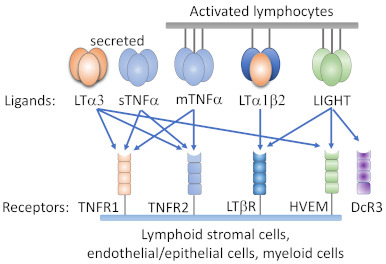
Figure 1
Figure 1
Ligands and receptors of the tumor necrosis factor (TNF)/lymphotoxin system. Both heterotrimeric LTα1/β2 and homotrimeric LIGHT bind to LTβR. Herpes virus entry mediator (HVEM) binds to membrane LIGHT and soluble homotrimeric LTα3. Membrane TNFα (mTNFα), soluble TNFα (sTNFα), and LTα3 bind to TNFRI and TNFR II.
Figure 2
Figure 2
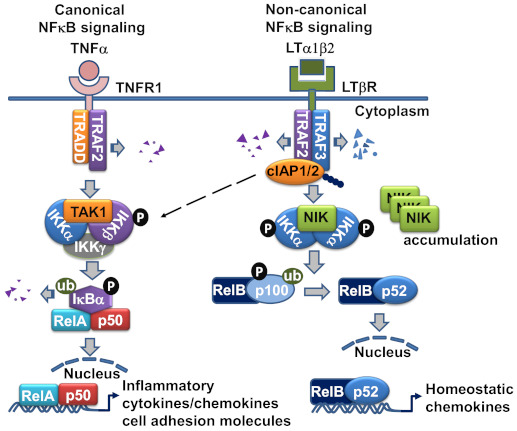
The LTβR signaling pathway in lymphatic endothelial cell (LEC). LTα1β2 engagement of LTβR initiates the recruitment of TRAF2 and TRAF3 to the LTβR complex, where TRAF2 and TRAF3 are degraded by cIAP1/2, and result in NF-κB-inducing kinase (NIK) stabilization and accumulation. NIK complexed with IKKα is activated and leads to the homodimeric IKKα phosphorylation. Eventually, the p100 precursor binding with RelB is cleaved to p52 and causes RelB-p52 heterodimeric complex translocation to the nucleus to initiate chemokine gene transcription. LTβR ligation also activates IKKα/β phosphorylation and RelA/p50 nuclear translocation, which leads to gene transcription of inflammatory and cell adhesion molecules. TRAF-2-mediated K63 ubiquitination of cIAP1/2 is also linked to the activation of canonical NFκB pathway.
Figure 3
Figure 3
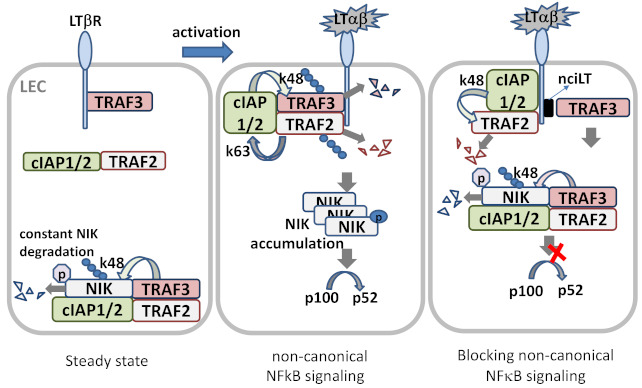
LTβR signaling in LEC. In steady state, newly synthesized NIK is rapidly bound by TRAF3 and targeted to the TRAF-cIAPs E3 ubiquitin ligase complex for K48-polyubiquitination and proteasomal degradation, where TRAF2 bridges TRAF3 and cIAPs. Low level NIK is unable to process p100 under normal conditions. In ligand (LTαβ or LIGHT)-stimulated LECs, the TRAF-cIAPs complex is recruited to the LTβR where cIAP1/2 is activated by TRAF2-mediated K63 ubiquitination, and the activated cIAP1/2 then targets TRAF3 for K48 ubiquitination and degradation. With the lack of TRAF3, de novo synthesized NIK accumulates and is activated via trans-phosphorylation. NIK then activates IKKα, leading to p100 processing and nuclear translocation of RelB/p52. Masking the TRAF3-binding site of LTβR by permeable blocking peptide nciLT leads to TRAF3 targeting NIK for degradation, and hence p100 processing is blocked.
Figure 4
Figure 4
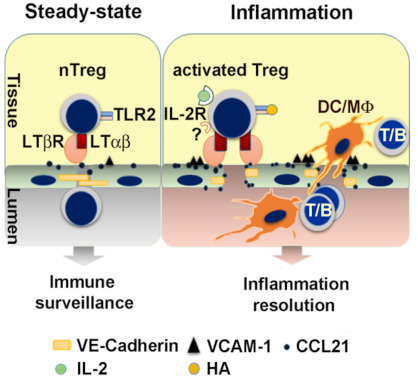
Treg license LEC via LTα1β2-LTβR to facilitate other immune cell lymphatic migration. In homeostatic conditions, patrolling nTreg maintain LEC LTβR constitutive activation, and permit both Treg and naïve or memory T cell recirculation to maintain immune surveillance. In inflammation, activated Treg with the highest LTα1β2 expression trigger LTβR signaling on LEC and increase VCAM-1 and CCL21, and decrease the intercellular tight junction protein VE-cadherin (VE-cad). These changes facilitate the TEM of other immune cells such as dendritic cells (DC), macrophages (Mϕ), B cells, and T cells (including activated CD4, CD8). Activation of TLR2 by endogenous ligands such as hyaluronan (HA) intensifies LEC LTβR signaling (Adopted from [51]).

References

    1. Cyster J.G., Schwab S.R. Sphingosine-1-phosphate and lymphocyte egress from lymphoid organs. Annu. Rev. Immunol. 2012;30:69–94. doi: 10.1146/annurev-immunol-020711-075011. - DOI - PubMed
    1. Pham T.H., Okada T., Matloubian M., Lo C.G., Cyster J.G. S1P1 receptor signaling overrides retention mediated by G alpha i-coupled receptors to promote T cell egress. Immunity. 2008;28:122–133. doi: 10.1016/j.immuni.2007.11.017. - DOI - PMC - PubMed
    1. Iwami D., Brinkman C.C., Bromberg J.S. Vascular endothelial growth factor c/vascular endothelial growth factor receptor 3 signaling regulates chemokine gradients and lymphocyte migration from tissues to lymphatics. Transplantation. 2015;99:668–677. doi: 10.1097/TP.0000000000000561. - DOI - PMC - PubMed
    1. Xiong Y., Piao W., Brinkman C.C., Li L., Kulinski J.M., Olivera A., Cartier A., Hla T., Hippen K.L., Blazar B.R., et al. CD4 T cell sphingosine 1-phosphate receptor (S1PR)1 and S1PR4 and endothelial S1PR2 regulate afferent lymphatic migration. Sci. Immunol. 2019:4. doi: 10.1126/sciimmunol.aav1263. - DOI - PMC - PubMed
    1. Karikoski M., Irjala H., Maksimow M., Miiluniemi M., Granfors K., Hernesniemi S., Elima K., Moldenhauer G., Schledzewski K., Kzhyshkowska J., et al. Clever-1/Stabilin-1 regulates lymphocyte migration within lymphatics and leukocyte entrance to sites of inflammation. Eur. J. Immunol. 2009;39:3477–3487. doi: 10.1002/eji.200939896. - DOI - PubMed

Publication types

Substances