Review
. 2021 Mar 29;13(4):576.
doi: 10.3390/v13040576.

Lagos Bat Virus, an Under-Reported Rabies-Related Lyssavirus

Affiliations
Review

Lagos Bat Virus, an Under-Reported Rabies-Related Lyssavirus

Jessica Coertse et al. Viruses. .

Abstract

Lagos bat virus (LBV), one of the 17 accepted viral species of the Lyssavirus genus, was the first rabies-related virus described in 1956. This virus is endemic to the African continent and is rarely encountered. There are currently four lineages, although the observed genetic diversity exceeds existing lyssavirus species demarcation criteria. Several exposures to rabid bats infected with LBV have been reported; however, no known human cases have been reported to date. This review provides the history of LBV and summarizes previous knowledge as well as new detections. Genetic diversity, pathogenesis and prevention are re-evaluated and discussed.

Keywords: Africa; Lagos bat virus; South Africa; bats; lyssavirus; rabies.


Conflict of interest statement

The authors declare no conflict of interest.

Figures
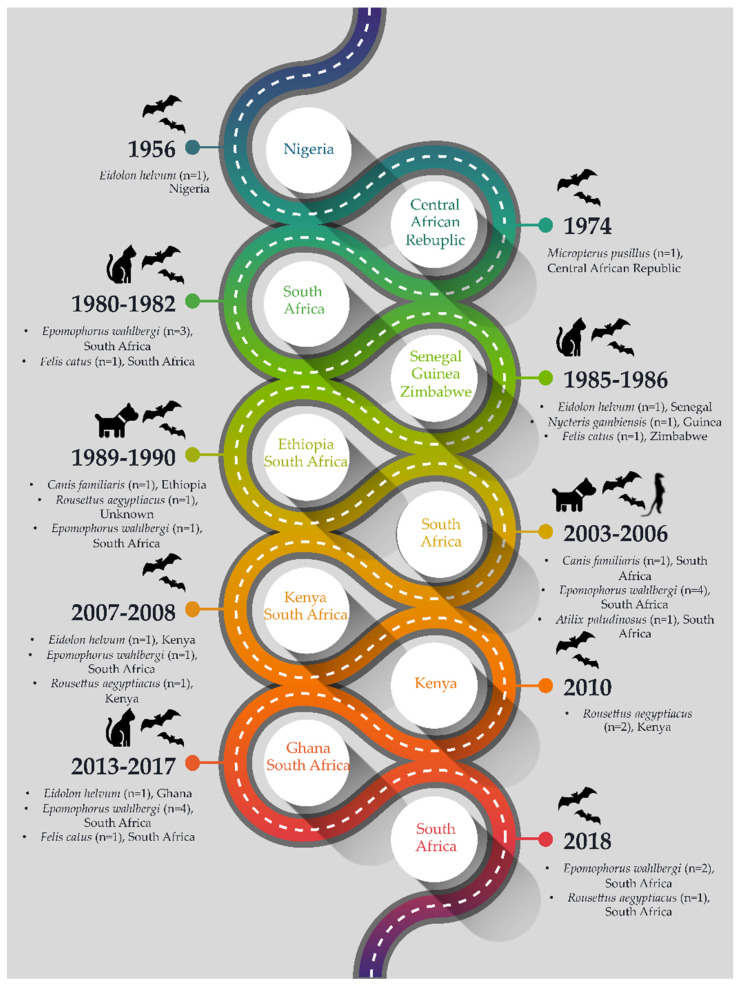
Figure 1
Figure 1
Timeline of laboratory confirmed Lagos bat virus detections.
Figure 2
Figure 2
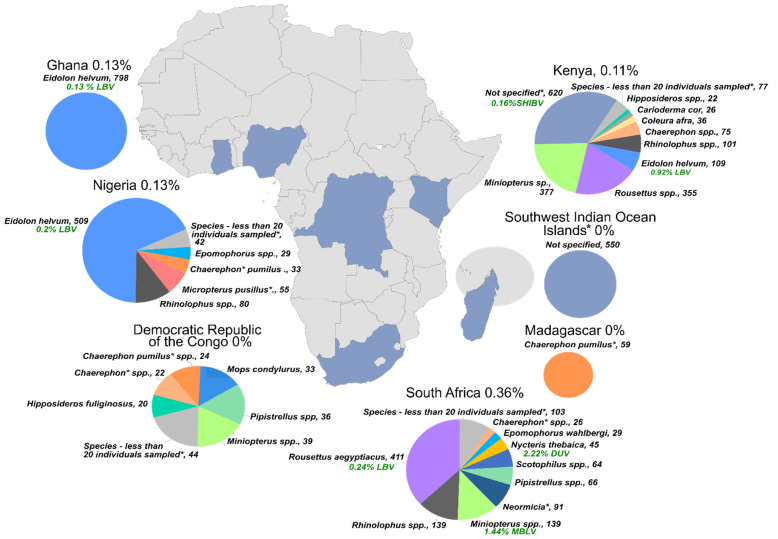
The number of bats surveyed for lyssavirus RNA during active nucleic acid surveillance activities depicted as pie charts. The countries in Africa where the surveillance was conducted are indicated in blue on the map—Ghana, Nigeria, Democratic Republic of Congo, South Africa, Kenya, Madagascar and the South Indian Ocean Islands (circled in grey). The numbers next to species names indicate individuals tested. Species with an asterisk indicate a referral to Table S1 for further details regarding taxonomic changes. All species for whom less than 20 individuals were tested are grouped together for visual simplicity with additional details in Table S1.
Figure 3
Figure 3
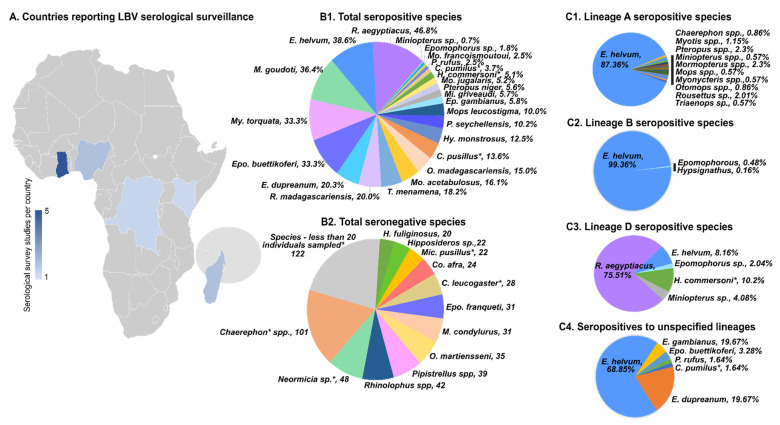
Map depicts the countries where Lagos bat virus serological studies have been reported from bat species, indicated according to the number of studies per country (Ghana, Nigeria, Democratic Republic of Congo, Kenya, Madagascar and Southwestern Indian Islands). Southwestern Indian Ocean islands include Anjouan, La Réunion, Mahé, Mayotte and Mauritius. (B1) Bat species from all studies that were seropositive, indicated as percentage positive per species. (B2) Bat species from all studies that were seronegative, indicated as number of bats tested per species. Bat species with seropositivity to LBV lineage A (C1), lineage B (C2), lineage D (C3) and unspecified lineages (C4) are also indicated as a percentage of the total individuals seropositive for each respective lineage. Table S2 provides more details of taxonomic changes for species indicated with an asterisk and specific sample numbers.
Figure 4
Figure 4
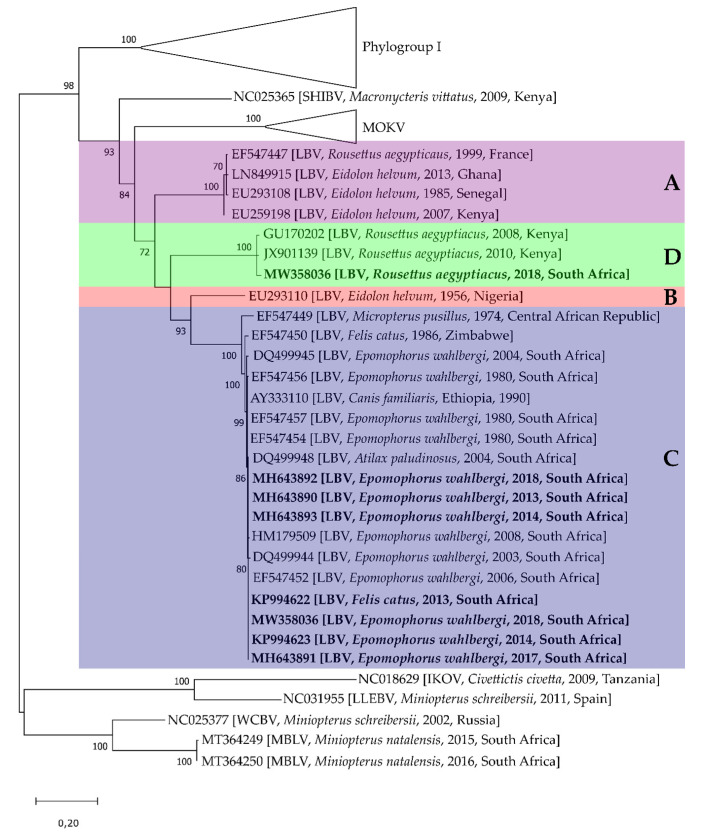
Maximum likelihood phylogenetic tree of the complete nucleoprotein gene of available Lagos bat virus sequences and representatives of all lyssavirus species (Table S3) using the general time reversible model with gamma distribution and invariant sites (GTR + G+I). Lagos bat virus lineages (AD) are indicated in capital letters. The reliability of the branching pattern was statistically evaluated by bootstrap analysis of 1000 replications and are indicated at the nodes. Scale bar indicates the number of substitutions per site. Sequences generated in this report are indicated in bold.
Figure 5
Figure 5
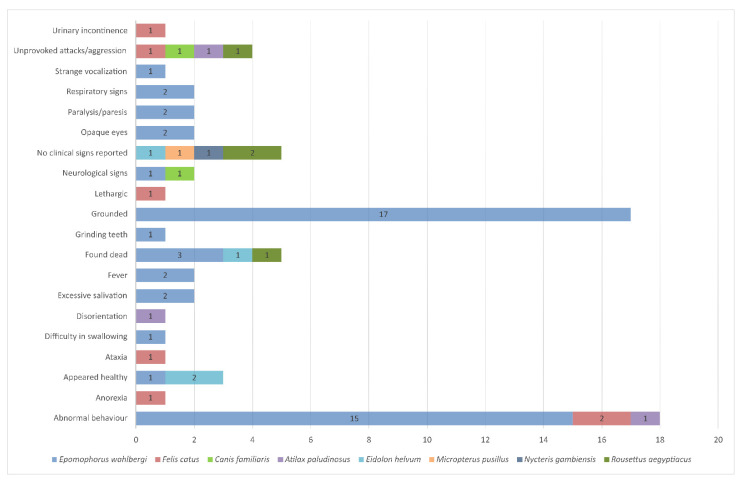
Reported clinical signs for animals naturally infected with Lagos bat virus.

References

    1. Boulger L.R., Porterfield J.S. Isolation of a virus from Nigerian fruit bats. Trans. R. Soc. Trop. Med. Hyg. 1958;52:421–424. doi: 10.1016/0035-9203(58)90127-5. - DOI - PubMed
    1. Markotter W., Coertse J. Bat lyssaviruses. Sci. Tech. Rev. 2018;37:385–400. doi: 10.20506/rst.37.2.2809. - DOI - PubMed
    1. ICTV International Committee on Taxonomy of Viruses. [(accessed on 23 February 2021)]; Available online: https://talk.ictvonline.org/
    1. Coertse J., Grobler C.S., Sabeta C.T., Seamark E.C.J., Kearney T., Paweska J.T., Markotter W. Lyssaviruses in insectivorous bats, South Africa, 2003–2018. Emerg. Infect. Dis. 2020;26:3056–3060. doi: 10.3201/eid2612.203592. - DOI - PMC - PubMed
    1. Badrane H., Tordo N. Host switching in lyssavirus history from the Chiroptera to the Carnivora Orders. J. Virol. 2001;75:8096–8104. doi: 10.1128/JVI.75.17.8096-8104.2001. - DOI - PMC - PubMed

Publication types

Supplementary concepts

LinkOut - more resources