


Genomic Sequencing Results Disclosure in Diverse and Medically Underserved Populations: Themes, Challenges, and Strategies from the CSER Consortium
- PMID: 33805616
- PMCID: PMC7998798
- DOI: 10.3390/jpm11030202
Genomic Sequencing Results Disclosure in Diverse and Medically Underserved Populations: Themes, Challenges, and Strategies from the CSER Consortium
Abstract
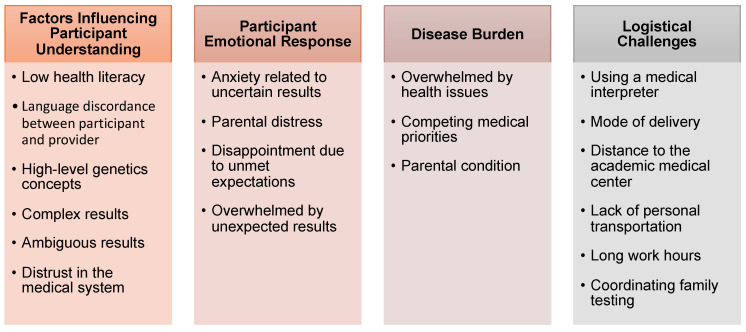
Genomic sequencing results need to be effectively communicated across all populations and practice settings. Projects in the Clinical Sequencing Evidence-Generating Research (CSER) consortium enroll diverse racial/ethnic and medically underserved participants across various clinical contexts. This article explores a set of CSER results disclosure cases to expand the evidence base on experiences returning genomic results. Case details were collected using a structured set of questions. We identified common themes in the case set, and assessed challenges and strategies in achieving six relevant results disclosure objectives. CSER-affiliated patient/community stakeholder impressions of the findings were solicited via video conference calls. Seventeen cases across six CSER projects were included. Case themes sorted into four categories: (1) factors influencing participant understanding, (2) participant emotional response, (3) disease burden, and (4) logistical challenges. Challenges meeting results disclosure objectives included a lack of dialogue, health literacy level, unexpected findings, and complex concepts. Strategies were consistent with traditional genetic counseling practice, but also highlighted approaches being evaluated in CSER projects. Patient/community stakeholders supported the identified themes and provided additional suggestions to improve patient understanding and engagement. These experiences add valuable insights into adapting genomic results disclosure practices to best serve all patient populations.
Keywords: exome sequencing; genetic counseling; genome sequencing; genomic sequencing; return of results; underrepresented populations.
Conflict of interest statement
The authors declare no conflict of interest.
Figures

References
-
- Berg J.S., Amendola L.M., Eng C., Van Allen E., Gray S.W., Wagle N., Rehm H.L., DeChene E.T., Dulik M.C., Hisama F.M., et al. Processes and preliminary outputs for identification of actionable genes as incidental findings in genomic sequence data in the Clinical Sequencing Exploratory Research Consortium. Genet. Med. Off. J. Am. Coll. Med. Genet. 2013;15:860–867. doi: 10.1038/gim.2013.133. - DOI - PMC - PubMed
-
- Schwartz M.L.B., McCormick C.Z., Lazzeri A.L., Lindbuchler D.M., Hallquist M.L.G., Manickam K., Buchanan A.H., Rahm A.K., Giovanni M.A., Frisbie L., et al. A Model for Genome-First Care: Returning Secondary Genomic Findings to Participants and Their Healthcare Providers in a Large Research Cohort. Am. J. Hum. Genet. 2018;103:328–337. doi: 10.1016/j.ajhg.2018.07.009. - DOI - PMC - PubMed
Grants and funding
LinkOut - more resources
Full Text Sources
Other Literature Sources
