Review
. 2021 Mar 13;10(3):642.
doi: 10.3390/cells10030642.

The Pseudo-Circular Genomes of Flaviviruses: Structures, Mechanisms, and Functions of Circularization

Affiliations
Review

The Pseudo-Circular Genomes of Flaviviruses: Structures, Mechanisms, and Functions of Circularization

Louis De Falco et al. Cells. .

Abstract

The circularization of viral genomes fulfills various functions, from evading host defense mechanisms to promoting specific replication and translation patterns supporting viral proliferation. Here, we describe the genomic structures and associated host factors important for flaviviruses genome circularization and summarize their functional roles. Flaviviruses are relatively small, single-stranded, positive-sense RNA viruses with genomes of approximately 11 kb in length. These genomes contain motifs at their 5' and 3' ends, as well as in other regions, that are involved in circularization. These motifs are highly conserved throughout the Flavivirus genus and occur both in mature virions and within infected cells. We provide an overview of these sequence motifs and RNA structures involved in circularization, describe their linear and circularized structures, and discuss the proteins that interact with these circular structures and that promote and regulate their formation, aiming to clarify the key features of genome circularization and understand how these affect the flaviviruses life cycle.

Keywords: RNA structure; circular RNA; circular genomes; flavivirus; virus genomes.


Conflict of interest statement

The authors declare no conflict of interest.

Figures
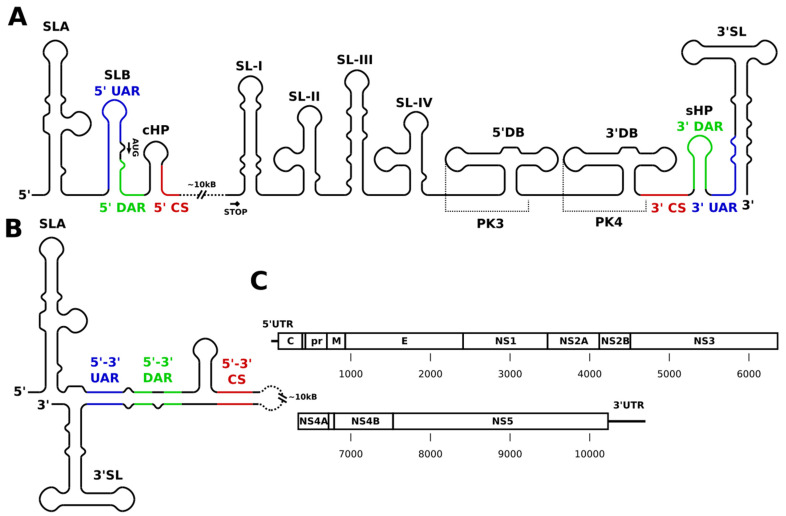
Figure 1
Figure 1
Structural overview of flaviviral genomes. (A) Schematic representation of the linear 5′ and 3′ untranslated region (UTRs). Circularization motifs are indicated and labeled in color. The upstream AUG region (UAR; blue) is followed by the downstream AUG region (DAR; green) and the highly conserved circularization sequence (CS; red). Translation initiation happens within stem loop B (SLB) between 5′ UAR and 5′ DAR. The order of circularization sequence motifs is inverted in the 3′ region. (B) The circular form of the genome (paired motifs shown in color). SLB, capsid hairpin (cHP), short hairpin (sHP), and 3′SL undergo structural reorganization upon circularization. (C) Overview of flaviviral RNA genes. An ≈100 nt 5′ UTR is followed by a ≈10 kb single open reading frame coding a single genome polyprotein, which is post-translationally processed to form the structural (C, prM, and E) and non-structural proteins comprising the flaviviral proteome. The open reading frame is followed by an ≈300–700 nucleotides (depending on species) 3′ UTR containing conserved structural elements.
Figure 2
Figure 2
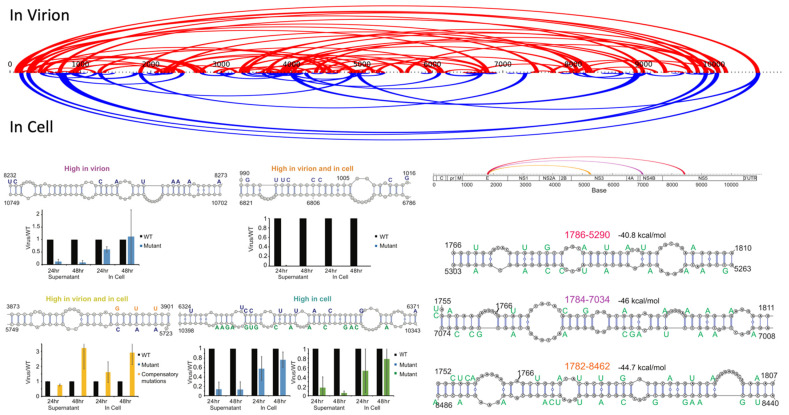
Internal circularization sites of DENV-1 genome, as determined by SPLASH cross-linking [19]. It is apparent that the number of internal circularization motifs in virions (red) is much higher than those identified in infected cells. A number of interactions persist in cells (blue). This may be attributed to the spatial constraints imposed by the virion shell or it may be a prerequisite for packaging. Functional assays demonstrate the importance of these motifs for viral fitness, with structure-disrupting changes causing a pronounced drop in viral activity. Compensatory mutations restore viral fitness. Several of the identified internal circularization sites show multiple interaction partners in the SPLASH experiment and structure models of the relevant regions show competing base pairs among the possible partners. It is currently unclear whether these competing interactions form in a stochastic manner or whether specific interactions are present at different stages of the viral life cycle and/or rearrange dynamically.
Figure 3
Figure 3
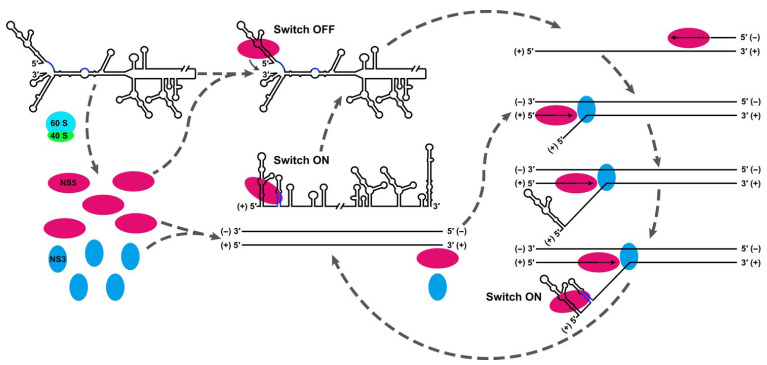
Schematic model elucidating the functional mechanism of the UAR-flanking stem (UFS) switch. Genome cyclization is crucial for the non-structural protein 5 (NS5) translocation to the RNA synthesis initiation site. Adapted with permission from [66].

References

    1. Aedes Albopictus - actsheet for Experts. [(accessed on 6 July 2020)]; Available online: https://www.ecdc.europa.eu/en/disease-vectors/facts/mosquito-factsheets/....
    1. Aedes Aegypti - Factsheet for Experts. [(accessed on 6 July 2020)]; Available online: https://www.ecdc.europa.eu/en/disease-vectors/facts/mosquito-factsheets/....
    1. Dengue and Severe Dengue. [(accessed on 6 July 2020)]; Available online: https://www.who.int/news-room/fact-sheets/detail/dengue-and-severe-dengue.
    1. Zika Virus. [(accessed on 6 July 2020)]; Available online: https://www.who.int/news-room/fact-sheets/detail/zika-virus.
    1. Mukhopadhyay S., Kuhn R.J., Rossmann M.G. A structural perspective of the Flavivirus life cycle. Nat. Rev. Microbiol. 2005;3:13–22. doi: 10.1038/nrmicro1067. - DOI - PubMed

Publication types

LinkOut - more resources