


Airway Surface Liquid pH Regulation in Airway Epithelium Current Understandings and Gaps in Knowledge
- PMID: 33806154
- PMCID: PMC8037888
- DOI: 10.3390/ijms22073384
Airway Surface Liquid pH Regulation in Airway Epithelium Current Understandings and Gaps in Knowledge
Abstract
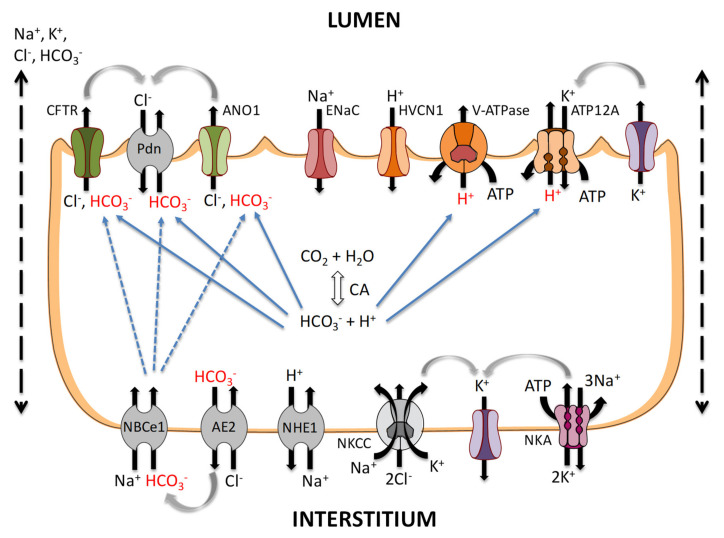
Knowledge on the mechanisms of acid and base secretion in airways has progressed recently. The aim of this review is to summarize the known mechanisms of airway surface liquid (ASL) pH regulation and their implication in lung diseases. Normal ASL is slightly acidic relative to the interstitium, and defects in ASL pH regulation are associated with various respiratory diseases, such as cystic fibrosis. Basolateral bicarbonate (HCO3-) entry occurs via the electrogenic, coupled transport of sodium (Na+) and HCO3-, and, together with carbonic anhydrase enzymatic activity, provides HCO3- for apical secretion. The latter mainly involves CFTR, the apical chloride/bicarbonate exchanger pendrin and paracellular transport. Proton (H+) secretion into ASL is crucial to maintain its relative acidity compared to the blood. This is enabled by H+ apical secretion, mainly involving H+/K+ ATPase and vacuolar H+-ATPase that carry H+ against the electrochemical potential gradient. Paracellular HCO3- transport, the direction of which depends on the ASL pH value, acts as an ASL protective buffering mechanism. How the transepithelial transport of H+ and HCO3- is coordinated to tightly regulate ASL pH remains poorly understood, and should be the focus of new studies.
Keywords: ATP12A; CFTR; SLC26A4; lung; pH.
Conflict of interest statement
I.S.-G. declares the following funding sources from Vertex Pharmaceuticals: Innovation Award funding program 2016 and 2017. She was the PI in clinical trials from Vertex Pharmaceuticals and took part in scientific advisory board meetings organized by Vertex Pharmaceuticals, Eloxx and Proteostasis. G.P. declares the following funding sources from Vertex Pharmaceuticals: Innovation Award funding program 2017. The authors declare no conflict of intrest.
Figures
References
Publication types
MeSH terms
Substances
LinkOut - more resources
Full Text Sources
Other Literature Sources
