Review
. 2021 Mar 4;13(5):1100.
doi: 10.3390/cancers13051100.

Cancer-Associated Fibroblasts as Players in Cancer Development and Progression and Their Role in Targeted Radionuclide Imaging and Therapy

Affiliations
Review

Cancer-Associated Fibroblasts as Players in Cancer Development and Progression and Their Role in Targeted Radionuclide Imaging and Therapy

Sofia Koustoulidou et al. Cancers (Basel). .

Abstract

Cancer Associated Fibroblasts (CAFs) form a major component of the tumour microenvironment, they have a complex origin and execute diverse functions in tumour development and progression. As such, CAFs constitute an attractive target for novel therapeutic interventions that will aid both diagnosis and treatment of various cancers. There are, however, a few limitations in reaching successful translation of CAF targeted interventions from bench to bedside. Several approaches targeting CAFs have been investigated so far and a few CAF-targeting tracers have successfully been developed and applied. This includes tracers targeting Fibroblast Activation Protein (FAP) on CAFs. A number of FAP-targeting tracers have shown great promise in the clinic. In this review, we summarize our current knowledge of the functional heterogeneity and biology of CAFs in cancer. Moreover, we highlight the latest developments towards theranostic applications that will help tumour characterization, radioligand therapy and staging in cancers with a distinct CAF population.

Keywords: CAFs; FAP; radionuclide therapy; theranostics.


Conflict of interest statement

The authors declare no conflict of interest.

Figures
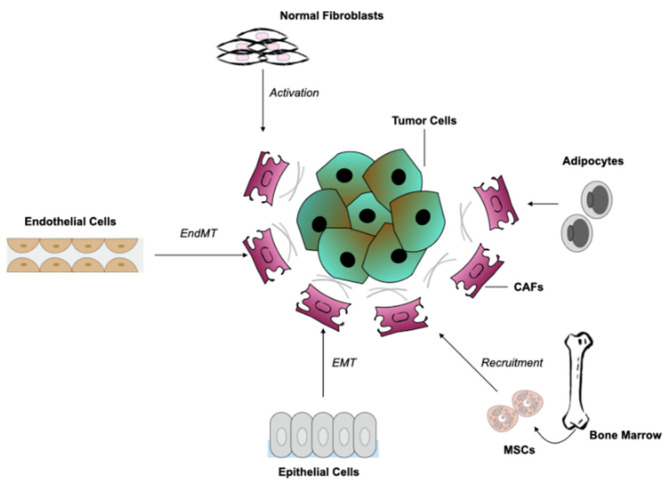
Figure 1
Figure 1
Potential cellular sources for cancer associated fibroblasts (CAFs). Several cellular types might yield CAFs in the TME. This includes normal fibroblasts through activation, recruitment and differentiation of bone marrow-derived mesenchymal stem cells (MSCs); epithelial cells through epithelial-to-mesenchymal transition (EMT) and endothelial cells through endothelial-to-mesenchymal transition (EndMT). Another source could be adipocytes through upregulated expression of mesenchymal bone marrow lineage-committed markers.
Figure 2
Figure 2
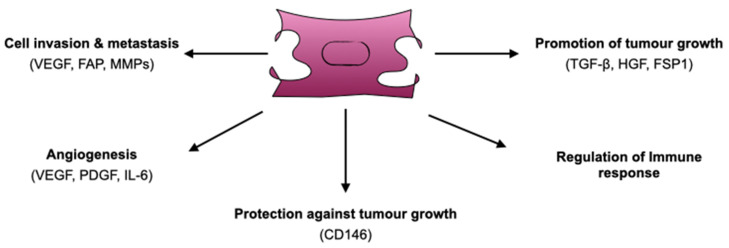
Diverse functions of CAFs: promotion of tumour growth, angiogenesis, cell invasion and metastasis to surrounding tissues, regulation of innate and adaptive immune responses. In addition to tumour-protective roles, CAFs occasionally have anti-tumorigenic functions. VEGF: Vascular Endothelial Growth Factor, FAP: Fibroblast Activation Protein, MMPs: Matrix Metalloproteinases, PDGF: Platelet-Derived Growth Factor, IL-6: Interleukin 6, CD146: Cluster of Differentiation 146, HGF: Hepatocyte Growth Factor, FSP1: Fibroblast-specific Protein 1.
Figure 3
Figure 3
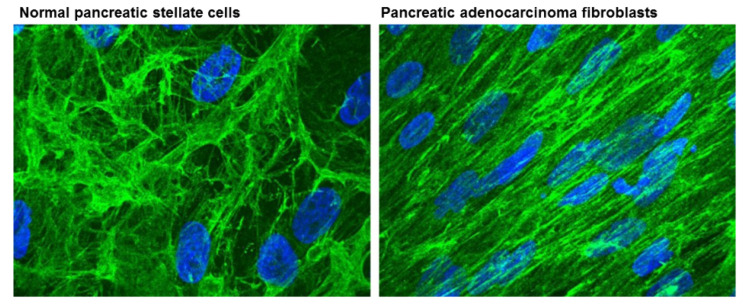
ECM fiber structures from normal pancreatic stellate cells and pancreatic adenocarcinoma associated fibroblasts stained for anti-fibronectin (green). ECMs organized in parallel patterns were observed in pancreatic adenocarcinoma fibroblasts that are similar to those formed by FAP-positive matrices. In contrast, ECM structures of normal pancreatic stellate cells resemble more FAP-negative matrices. Nuclei were stained with DAPI (blue). Reproduced with permission from [39].
Figure 4
Figure 4
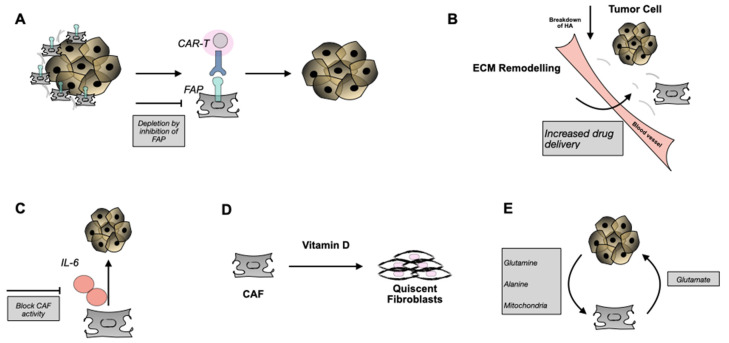
Overview of potential CAF interventions. (A) Use of anti-FAP mAbs or T-cells gene-engineered to express a FAP recognizing mAb (e.g., CAR-T cells) target FAP+ CAFs and result in their immune cell-mediated destruction and removal. (B) Enzymatic breakdown of HA may lead to remodelling of ECM and better tumour accessibility for drugs and/or immune cells. (C) Block CAF activity through IL-6. (D) Transform CAFs into a more quiescent state via Vitamin D. (E) Tackle the metabolic need of tumour cells and their dependence on CAF metabolism. FAP: fibroblast activated protein, CAR: chimeric antigen receptor, HA: hyaluronic acid, IL-6 interleukin-6.

References

    1. Cancer [Internet] [(accessed on 19 November 2020)]; Available online: https://www.who.int/news-room/fact-sheets/detail/cancer.
    1. Valkenburg K.C., de Groot A.E., Pienta K.J. Targeting the tumour stroma to improve cancer therapy. Nat. Rev. Clin. Oncol. 2018;15:366–381. doi: 10.1038/s41571-018-0007-1. - DOI - PMC - PubMed
    1. Yuan Y., Jiang Y.C., Sun C.K., Chen Q.M. Role of the tumor microenvironment in tumor progression and the clinical applications (Review) Oncol. Rep. 2016;35:2499–2515. doi: 10.3892/or.2016.4660. - DOI - PubMed
    1. Balkwill F.R., Capasso M., Hagemann T. The tumor microenvironment at a glance. J. Cell Sci. 2012;125:5591–5596. doi: 10.1242/jcs.116392. - DOI - PubMed
    1. Liu L., Liu L., Yao H.H., Zhu Z.Q., Ning Z.L., Huang Q. Stromal myofibroblasts are associated with poor prognosis in solid cancers: A meta-analysis of published studies. PLoS ONE. 2016;11:e0159947. doi: 10.1371/journal.pone.0159947. - DOI - PMC - PubMed