Review
. 2021 Mar 4;13(5):1103.
doi: 10.3390/cancers13051103.

Bleeding by Bruton Tyrosine Kinase-Inhibitors: Dependency on Drug Type and Disease

Affiliations
Review

Bleeding by Bruton Tyrosine Kinase-Inhibitors: Dependency on Drug Type and Disease

Philipp von Hundelshausen et al. Cancers (Basel). .

Abstract

Bruton tyrosine kinase (Btk) is expressed in B-lymphocytes, myeloid cells and platelets, and Btk-inhibitors (BTKi) are used to treat patients with B-cell malignancies, developed against autoimmune diseases, have been proposed as novel antithrombotic drugs, and been tested in patients with severe COVID-19. However, mild bleeding is frequent in patients with B-cell malignancies treated with the irreversible BTKi ibrutinib and the recently approved 2nd generation BTKi acalabrutinib, zanubrutinib and tirabrutinib, and also in volunteers receiving in a phase-1 study the novel irreversible BTKi BI-705564. In contrast, no bleeding has been reported in clinical trials of other BTKi. These include the brain-penetrant irreversible tolebrutinib and evobrutinib (against multiple sclerosis), the irreversible branebrutinib, the reversible BMS-986142 and fenebrutinib (targeting rheumatoid arthritis and lupus erythematodes), and the reversible covalent rilzabrutinib (against pemphigus and immune thrombocytopenia). Remibrutinib, a novel highly selective covalent BTKi, is currently in clinical studies of autoimmune dermatological disorders. This review describes twelve BTKi approved or in clinical trials. By focusing on their pharmacological properties, targeted disease, bleeding side effects and actions on platelets it attempts to clarify the mechanisms underlying bleeding. Specific platelet function tests in blood might help to estimate the probability of bleeding of newly developed BTKi.

Keywords: Btk; Btk inhibitor; Tec; bleeding; covalent Btk inhibitor; hemorrhage; ibrutinib; platelet; reversible Btk inhibitor.


Conflict of interest statement

The authors have no conflict of interests and nothing to disclose.

Figures
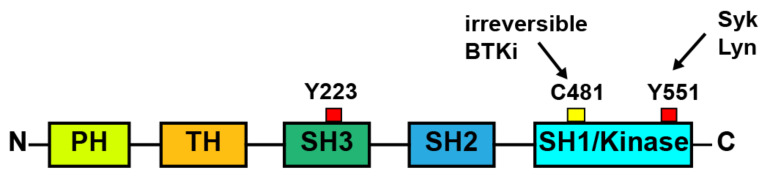
Figure 1
Figure 1
Schematic representation of the domain-structure of Btk. PH, pleckstrin homology; TH, Tec homology; SH, Src homology; the SH1 domain is identical to the kinase domain. Y223, autophosphorylation site.
Figure 2
Figure 2
Btk is activated by platelet glycoprotein receptors and transmits signals to increase cytosolic calcium. The signaling pathways of platelet glycoprotein receptors that are coupled to Btk are depicted. Solid arrows indicate direct interaction, dashed arrows indicate indirect activation. The homologous kinase Tec is activated through the same pathways but plays a functional role only after GPVI activation. For details see text. CLEC-2, C-type lectin domain family 2; DAG, 1,2-diacylglycerol; FcγRIIa, Fc fragment of IgG low affinity IIa receptor; FcRγ, Fc receptor gamma-chain; GPVI, glycoprotein VI; GPIb-V-IX, glycoproteins Ib,V,IX; hemITAM, single-copy tyrosine-based activation motif; IP3, inositol 1,4,5 triphosphate; ITAM, immunoreceptor tyrosine-based activation motif; PLC2γ2, phospholipase Cγ2; PI3-kinase, phosphatidylinositol 3-kinase; PIP2, phosphatidylinositol(4,5)-bisphosphate; PIP3, phosphatidylinositol(3,4,5)-trisphosphate; SFK, Src family kinases; Syk, spleen tyrosine kinase, VWF, von Willebrand factor.
Figure 3
Figure 3
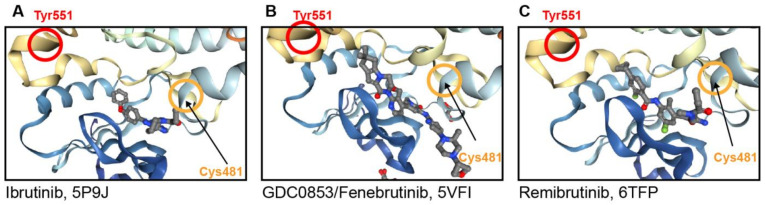
Crystal structures of Btk in complex with inhibitors. Secondary structure cartoons of the catalytic domain of Btk in complex with (A) Ibrutinib (PDB entry code 5P9J), (B) Fenebrutinib (PDB entry code 5VFI) and (C) Remibrutinib (PDB entry code 6TFP). Highlighted are Cys481 (orange circle) and Tyr551 (red circle). Snap shots were visualized using the web-based NGL viewer.

References

    1. Pal Singh S., Dammeijer F., Hendriks R.W. Role of Bruton’s tyrosine kinase in B cells and malignancies. Mol. Cancer. 2018;17:57. doi: 10.1186/s12943-018-0779-z. - DOI - PMC - PubMed
    1. Whang J.A., Chang B.Y. Bruton’s tyrosine kinase inhibitors for the treatment of rheumatoid arthritis. Drug Discov. Today. 2014;19:1200–1204. doi: 10.1016/j.drudis.2014.03.028. - DOI - PubMed
    1. Chang B.Y., Huang M.M., Francesco M., Chen J., Sokolove J., Magadala P., Robinson W.H., Buggy J.J. The Bruton tyrosine kinase inhibitor PCI-32765 ameliorates autoimmune arthritis by inhibition of multiple effector cells. Arthritis Res. Ther. 2011;13:R115. doi: 10.1186/ar3400. - DOI - PMC - PubMed
    1. Liang C., Tian D., Ren X., Ding S., Jia M., Xin M., Thareja S. The development of Bruton’s tyrosine kinase (BTK) inhibitors from 2012 to 2017: A mini-review. Eur. J. Med. Chem. 2018;151:315–326. doi: 10.1016/j.ejmech.2018.03.062. - DOI - PubMed
    1. Rigg R.A., Aslan J.E., Healy L.D., Wallisch M., Thierheimer M.L., Loren C.P., Pang J., Hinds M.T., Gruber A., McCarty O.J. Oral administration of Bruton’s Tyrosine Kinase (Btk) inhibitors impairs GPVI-mediated platelet function. Am. J. Physiol. Cell Physiol. 2015;310:C373–C380. doi: 10.1152/ajpcell.00325.2015. - DOI - PMC - PubMed