


The TCGA Molecular Classification of Endometrial Cancer and Its Possible Impact on Adjuvant Treatment Decisions
- PMID: 33806979
- PMCID: PMC8005218
- DOI: 10.3390/cancers13061478
The TCGA Molecular Classification of Endometrial Cancer and Its Possible Impact on Adjuvant Treatment Decisions
Abstract
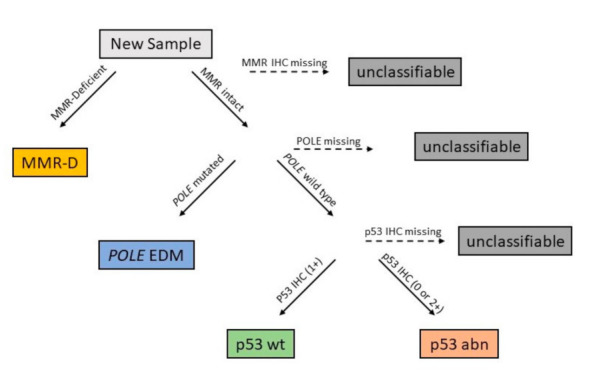
Adjuvant treatment decisions for endometrial cancer (EC) are based on stage, the histological grade of differentiation, histological subtype, and few histopathological markers. The Proactive Molecular Risk Classifier for Endometrial Cancer (ProMisE) identified four risk groups of EC patients using a combination of immunohistochemistry and mutation analysis: Polymerase Epsilon exonuclease domain mutated (POLE EDM), mismatch repair deficient (MMRd), p53 wild-type/copy-number-low (p53 wt), and p53-mutated/copy-number-high (p53 abn). Patients allocated to the POLE or abnormal p53 expression subtype are faced with a significantly altered outcome possibly requiring a modified adjuvant treatment decision. Within this review, we summarize the development of ProMisE, characterize the four molecular subtypes, and finally discuss its value in terms of a patient-tailored therapy in order to prevent significant under or overtreatment.
Keywords: brachytherapy; endometrial cancer; endometrial carcinoma; radiobiology; radiotherapy; uterine cancer; uterine carcinoma.
Conflict of interest statement
The authors declare no conflict of interest.
Figures
References
-
- NIH National Cancer Institute Surveillance Epidemiology, and End Results Program Cancer Stat Facts: Endometrial Cancer. [(accessed on 4 July 2020)];2020 Available online: https://seer.cancer.gov/statfacts/html/corp.html.
Publication types
LinkOut - more resources
Full Text Sources
Other Literature Sources
Research Materials
Miscellaneous
