


Chemical Profiles, Anticancer, and Anti-Aging Activities of Essential Oils of Pluchea dioscoridis (L.) DC. and Erigeron bonariensis L
- PMID: 33807147
- PMCID: PMC8066341
- DOI: 10.3390/plants10040667
Chemical Profiles, Anticancer, and Anti-Aging Activities of Essential Oils of Pluchea dioscoridis (L.) DC. and Erigeron bonariensis L
Abstract
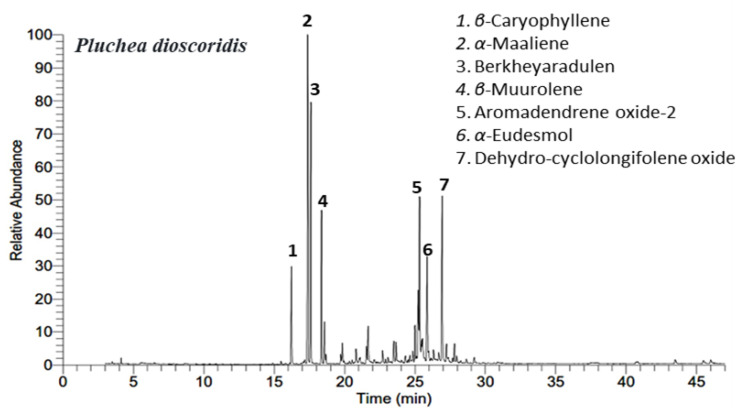
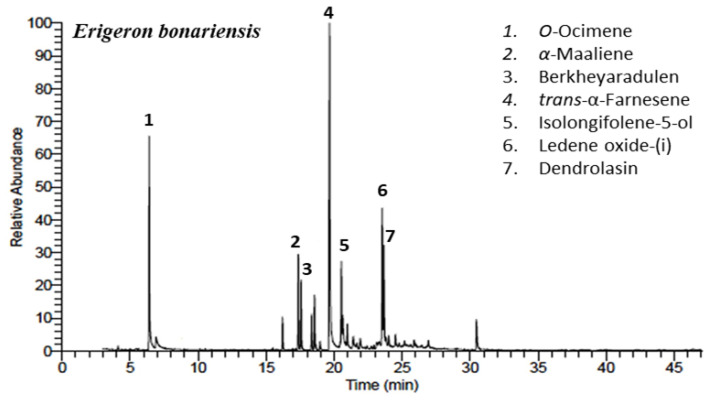
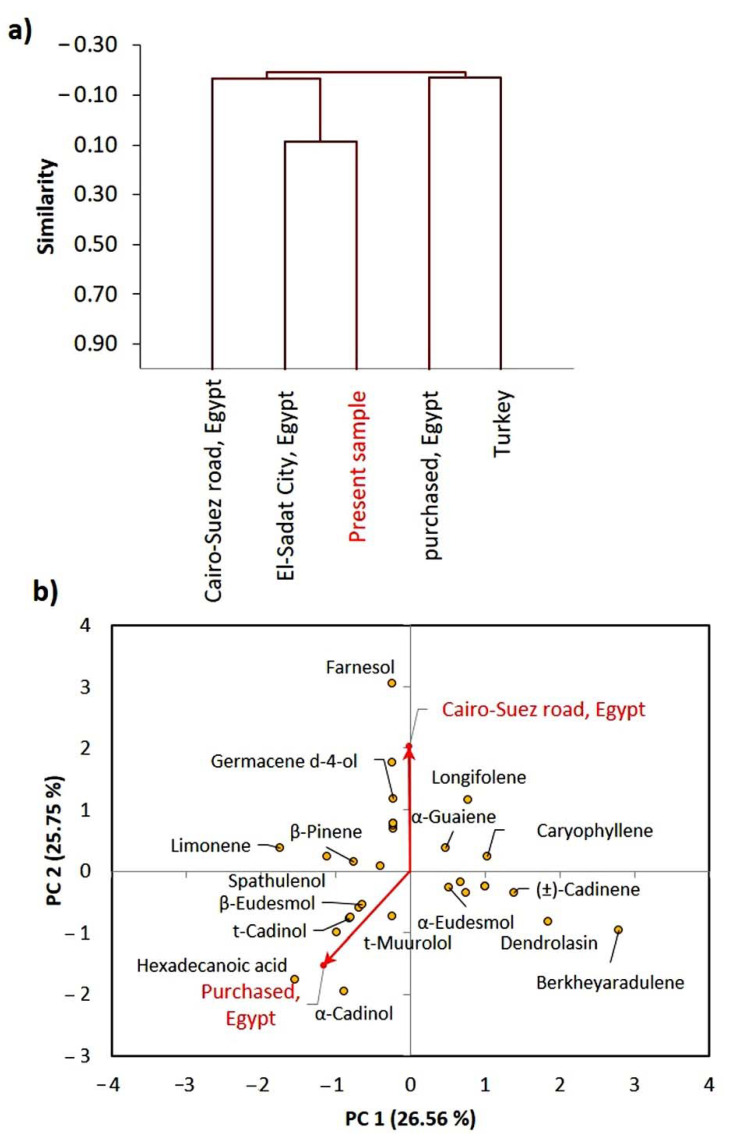
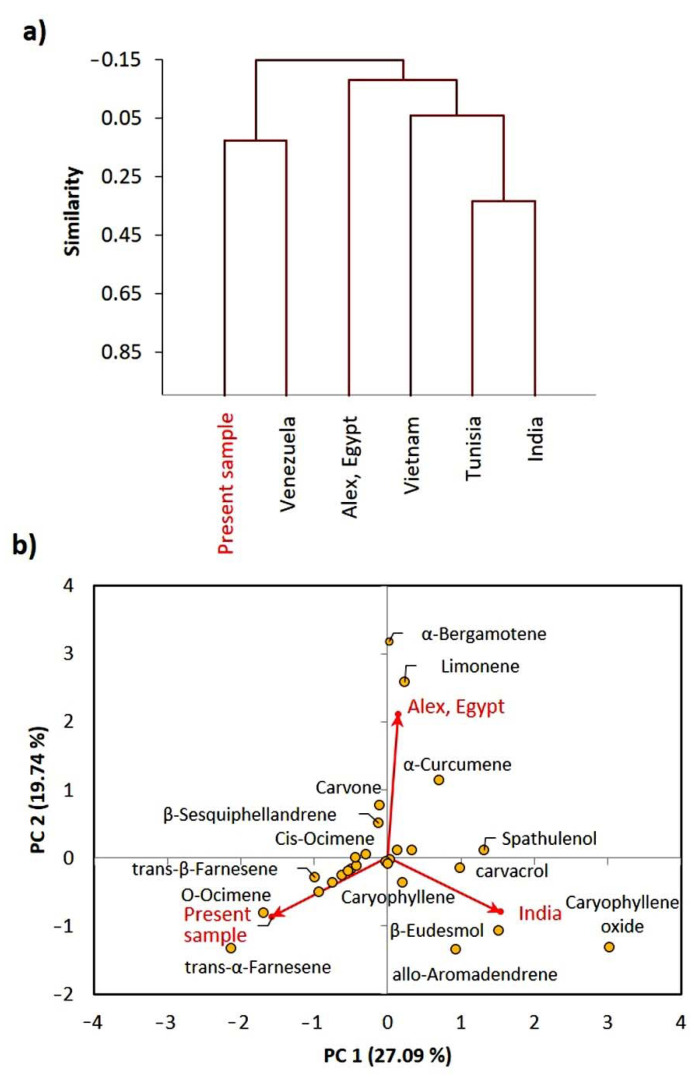
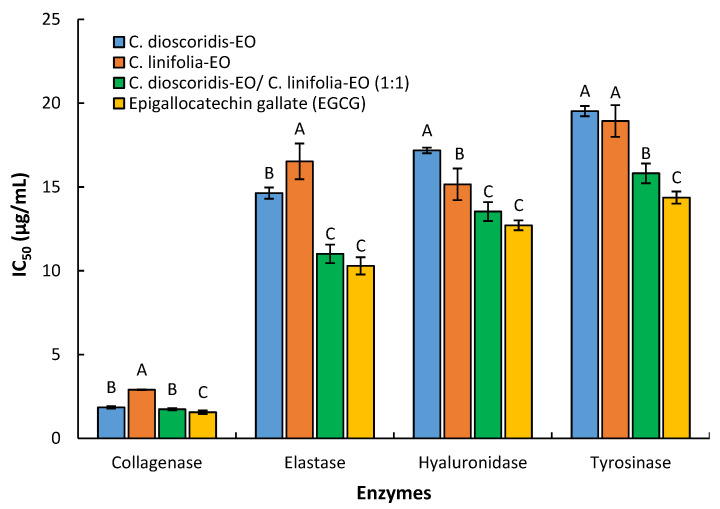
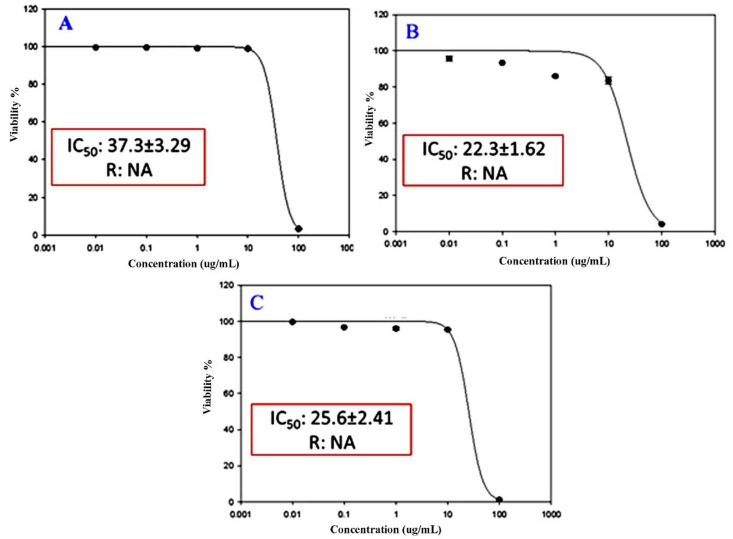
Plants belonging to the Asteraceae family are widely used as traditional medicinal herbs around the world for the treatment of numerous diseases. In this work, the chemical profiles of essential oils (EOs) of the above-ground parts of Pluchea dioscoridis (L.) DC. and Erigeron bonariensis (L.) were studied in addition to their cytotoxic and anti-aging activities. The extracted EOs from the two plants via hydrodistillation were analyzed by gas chromatography-mass spectroscopy (GC-MS). GC-MS of EO of P. dioscoridis revealed the identification of 29 compounds representing 96.91% of the total oil. While 35 compounds were characterized from EO of E. bonariensis representing 98.21%. The terpenoids were found the main constituents of both plants with a relative concentration of 93.59% and 97.66%, respectively, including mainly sesquiterpenes (93.40% and 81.06%). α-Maaliene (18.84%), berkheyaradulen (13.99%), dehydro-cyclolongifolene oxide (10.35%), aromadendrene oxide-2 (8.81%), β-muurolene (8.09%), and α-eudesmol (6.79%), represented the preponderance compounds of EO of P. dioscoridis. While, trans-α-farnesene (25.03%), O-ocimene (12.58%), isolongifolene-5-ol (5.53%), α-maaliene (6.64%), berkheyaradulen (4.82%), and α-muurolene (3.99%), represented the major compounds EO of E. bonariensis. A comparative study of our results with the previously described data was constructed based upon principal component analysis (PCA) and agglomerative hierarchical clustering (AHC), where the results revealed a substantial variation of the present studied species than other reported ecospecies. EO of P. dioscoridis exhibited significant cytotoxicity against the two cancer cells, MCF-7 and A-549 with IC50 of 37.3 and 22.3 μM, respectively. While the EO of the E. bonariensis showed strong cytotoxicity against HepG2 with IC50 of 25.6 μM. The EOs of P. dioscoridis, E. bonariensis, and their mixture (1:1) exhibited significant inhibitory activity of the collagenase, elastase, hyaluronidase, and tyrosinase comparing with epigallocatechin gallate (EGCG) as a reference. The results of anti-aging showed that the activity of mixture (1:1) > P. dioscoridis > E. bonariensis against the four enzymes.
Keywords: anti-senility; cytotoxicity; horseweed; sesquiterpenes; wavy-leaf fleabane.
Conflict of interest statement
The authors declare no conflict of interest.
Figures
References
-
- Cseke L.J., Kirakosyan A., Kaufman P.B., Warber S., Duke J.A., Brielmann H.L. Natural Products from Plants. CRC Press; Boca Raton, FL, USA: 2016.
-
- Della Pepa T., Elshafie H.S., Capasso R., De Feo V., Camele I., Nazzaro F., Scognamiglio M.R., Caputo L. Antimicrobial and phytotoxic activity of Origanum heracleoticum and O. majorana essential oils growing in Cilento (Southern Italy) Molecules. 2019;24:2576. doi: 10.3390/molecules24142576. - DOI - PMC - PubMed
-
- Gruľová D., Caputo L., Elshafie H.S., Baranová B., De Martino L., Sedlák V., Gogaľová Z., Poráčová J., Camele I., De Feo V. Thymol chemotype Origanum vulgare L. essential oil as a potential selective bio-based herbicide on monocot plant species. Molecules. 2020;25:595. doi: 10.3390/molecules25030595. - DOI - PMC - PubMed
LinkOut - more resources
Full Text Sources
Other Literature Sources
Miscellaneous
