Review
. 2021 Mar 31;12(2):22.
doi: 10.3390/jfb12020022.

Osteogenic Peptides and Attachment Methods Determine Tissue Regeneration in Modified Bone Graft Substitutes

Affiliations
Review

Osteogenic Peptides and Attachment Methods Determine Tissue Regeneration in Modified Bone Graft Substitutes

George Bullock et al. J Funct Biomater. .

Abstract

The inclusion of biofunctional molecules with synthetic bone graft substitutes has the potential to enhance tissue regeneration during treatment of traumatic bone injuries. The clinical use of growth factors has though been associated with complications, some serious. The use of smaller, active peptides has the potential to overcome these problems and provide a cost-effective, safe route for the manufacture of enhanced bone graft substitutes. This review considers the design of peptide-enhanced bone graft substitutes, and how peptide selection and attachment method determine clinical efficacy. It was determined that covalent attachment may reduce the known risks associated with growth factor-loaded bone graft substitutes, providing a predictable tissue response and greater clinical efficacy. Peptide choice was found to be critical, but even within recognised families of biologically active peptides, the configurations that appeared to most closely mimic the biological molecules involved in natural bone healing processes were most potent. It was concluded that rational, evidence-based design of peptide-enhanced bone graft substitutes offers a pathway to clinical maturity in this highly promising field.

Keywords: biomimetic peptides; bone repair material; surface functionalisation; tissue engineering.


Conflict of interest statement

The authors declare no conflict of interest.

Figures
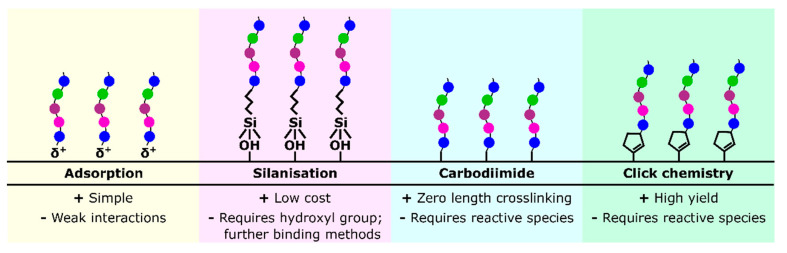
Figure 1
Figure 1
A diagram representing four common peptide attachment methods: adsorption, silanisation, carbodiimide crosslinking and click chemistry.
Figure 2
Figure 2
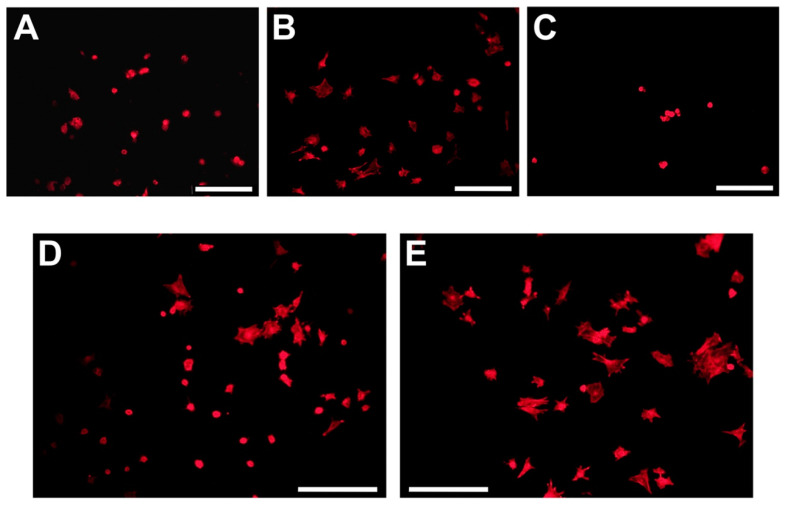
Spreading of Saos-2 cells on biofunctionalized surfaces after 4 h of incubation. (A) Ctrol, (B) RGD, (C) PHSRN, (D) MIX, and (E) Platform. Images were acquired by fluorescence microscopy and show only staining of actin filaments with phalloidin-rhodamine. Scale bars: 200 μm. Reproduced with permission from [47].
Figure 3
Figure 3
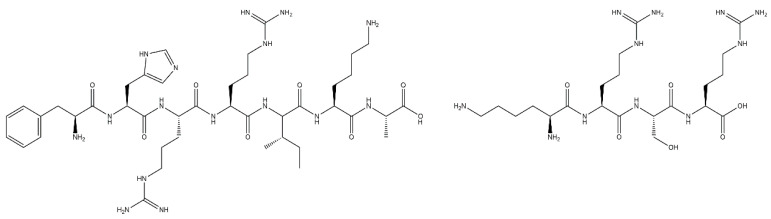
The chemical structure of FHRRIKA (left) and KRSR (right) peptides.
Figure 4
Figure 4
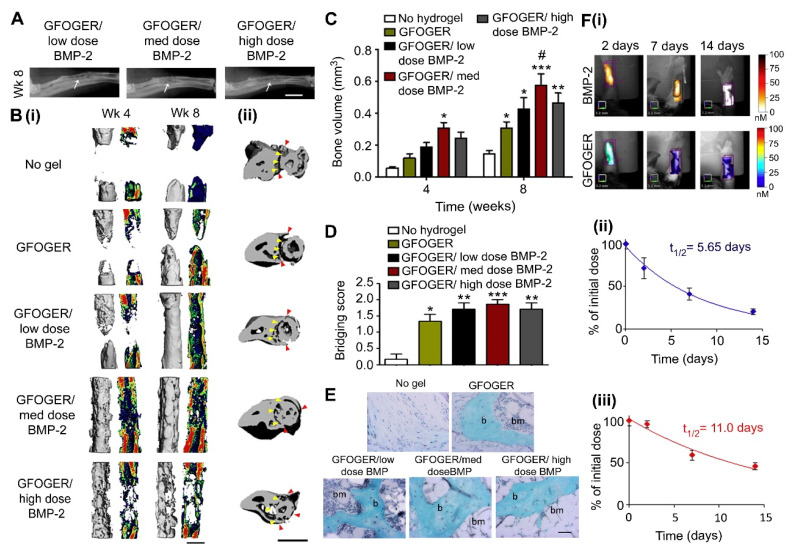
GFOGER-functionalized PEG hydrogels with low dose BMP-2 bridge radial segmental defects without altering ulnar structure. (A) Radiographic images, white arrows indicate space between ulna and radius which is not present in the high BMP-2 dose image, scale bar 2 mm. (B) 3D μCT reconstructions of (i) radius in sagittal view (left) with mineral density mapping (right), and (ii) radius and ulna in transverse view. Yellow arrowheads indicate boundary between the ulna and radius prior to implantation, red arrowheads indicate the position of the ulna closest to the radius at 8 weeks, scale bar 1 mm. (C) μCT measures of bone formation, n = 6–7. (D) Scoring of defect bridging at 8 weeks, n = 6–7. (E) Sections stained with Safranin-O/Fast Green at the center of defect, scale bar 50 μm; b—bone, bm—bone marrow. (F) (i) Representative FMT images and FMT quantification of % implanted dose retained in radial defect space over time in vivo for (ii) high dose BMP-2 labeled with Vivotag 800 and (iii) GFOGER peptide labeled with Vivotag 680, n = 6. * p < 0.05, ** p < 0.01, *** p < 0.001 compared to defect receiving no hydrogel implant, # p < 0.05 compared to GFOGER hydrogel. Reproduced with permission from [78].
Figure 5
Figure 5
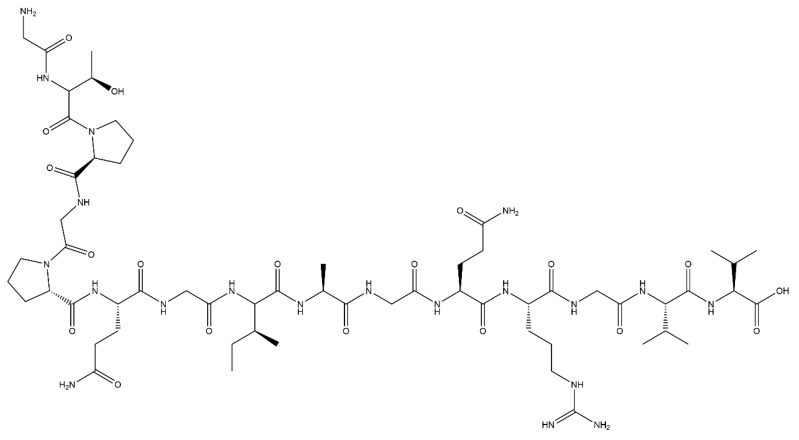
The chemical structure of P15 peptide.
Figure 6
Figure 6
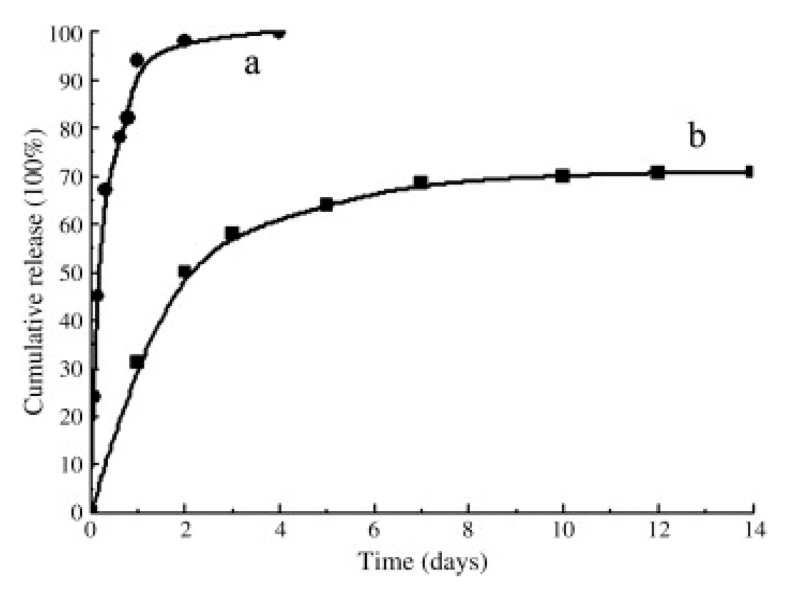
The profiles of P24 peptide released from PLGA-(PEG-ASP)n scaffold in the absence (a) and presence (b) of NHS/EDC. Reproduced with permission from [49].

References

    1. Mantripragada V.P., Lecka-Czernik B., Ebraheim N.A., Jayasuriya A.C. An overview of recent advances in designing orthopedic and craniofacial implants. J. Biomed. Mater. Res. Part A. 2012;101:3349–3364. doi: 10.1002/jbm.a.34605. - DOI - PMC - PubMed
    1. Court-Brown C.M., Caesar B. Epidemiology of adult fractures: A review. Injury. 2006;37:691–697. doi: 10.1016/j.injury.2006.04.130. - DOI - PubMed
    1. Willie B.M., Petersen A., Schmidt-Bleek K., Cipitria A., Mehta M., Strube P., Lienau J., Wildemann B., Fratzl P., Duda G. Designing biomimetic scaffolds for bone regeneration: Why aim for a copy of mature tissue properties if nature uses a different approach? Soft Matter. 2010;6:4976–4987. doi: 10.1039/c0sm00262c. - DOI
    1. Roberts T.T., Rosenbaum A.J. Bone grafts, bone substitutes and orthobiologics. Organogenesis. 2012;8:114–124. doi: 10.4161/org.23306. - DOI - PMC - PubMed
    1. Sen M., Miclau T. Autologous iliac crest bone graft: Should it still be the gold standard for treating nonunions? Injury. 2007;38(Suppl. S1):S75–S80. doi: 10.1016/j.injury.2007.02.012. - DOI - PubMed