. 2021 Mar 31;9(4):733.
doi: 10.3390/microorganisms9040733.

Evaluation of a New Spike (S)-Protein-Based Commercial Immunoassay for the Detection of Anti-SARS-CoV-2 IgG

Affiliations

Evaluation of a New Spike (S)-Protein-Based Commercial Immunoassay for the Detection of Anti-SARS-CoV-2 IgG

Kirsten Alexandra Eberhardt et al. Microorganisms. .

Abstract

Background: The investigation of the antibody response to SARS-CoV-2 represents a key aspect in facing the COVID-19 pandemic. In the present study, we compared the new Immundiagnostik IDK® anti-SARS-CoV-2 S1 IgG assay with four widely-used commercial serological assays for the detection of antibodies targeting S (spike) and NC (nucleocapsid) proteins. Methods: Serum samples were taken from an unbiased group of convalescent patients and from a negative control group. Sample were simultaneously analyzed by the new Immundiagnostik IDK® anti-SARS-CoV-2 S1 IgG assay, by the DiaSorin LIAISON® SARS-CoV-2 S1/S2 IgG assay, and by the Euroimmun anti-SARS-CoV-2 S1 IgG ELISA. Antibodies binding NC were detected by the Abbott SARS-CoV-2 IgG assay and by the pan-immunoglobulin immunoassay Roche Elecsys® anti-SARS-CoV-2. Moreover, we investigated samples of a group of COVID-19 convalescent subjects that were primarily tested S1 IgG non-reactive. Samples were also tested by live virus and pseudovirus neutralization tests. Results: Overall, the IDK® anti-SARS-CoV-2 S1 IgG assay showed the highest sensitivity among the evaluated spike (S) protein-based assays. Additionally, the Immundiagnostik assay correlated well with serum-neutralizing activity. Conclusions: The novel IDK® anti-SARS-CoV-2 S1 IgG assay showed high sensitivity and specificity, representing a valid option for use in the routine diagnostic.

Keywords: COVID-19; antibody; coronavirus; humoral response; neutralization; non-responder; pandemic; protection; sensitivity; titer.


Conflict of interest statement

The University of Cologne (Medical Faculty) receives royalties for the co-development of the IDK® anti-SARS-CoV-2 IgG ELISA and IDK® anti-SARS-CoV-2 IgM ELISA kits. Immundiagnostik had no role in the design of this study; in the collection, analyses, or interpretation of data; in the writing of the manuscript except for the Supplement Figure S1, or in the decision to publish the results.

Figures
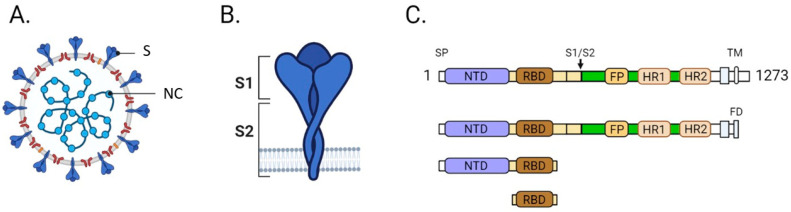
Figure 1
Figure 1
(A) Schematic drawing of the SARS-CoV-2 virus. Spike (S) and nucleocapsid (NC) proteins are highlighted. (B) Schematic drawing of the trimeric S-protein. (C) The domain structure of the S-protein is shown, and the three regions that were tested are depicted. All three versions contain the receptor binding domain (RBD). SP, signal peptide; NTD, N-terminal domain; S1, spike protein subunit 1; S2, spike protein subunit 2; FP, fusion peptide; HR1, heptad repeat 1 domain; HR2, heptad repeat 2 domain; TM, transmembrane domain; FD, foldon motif.
Figure 2
Figure 2
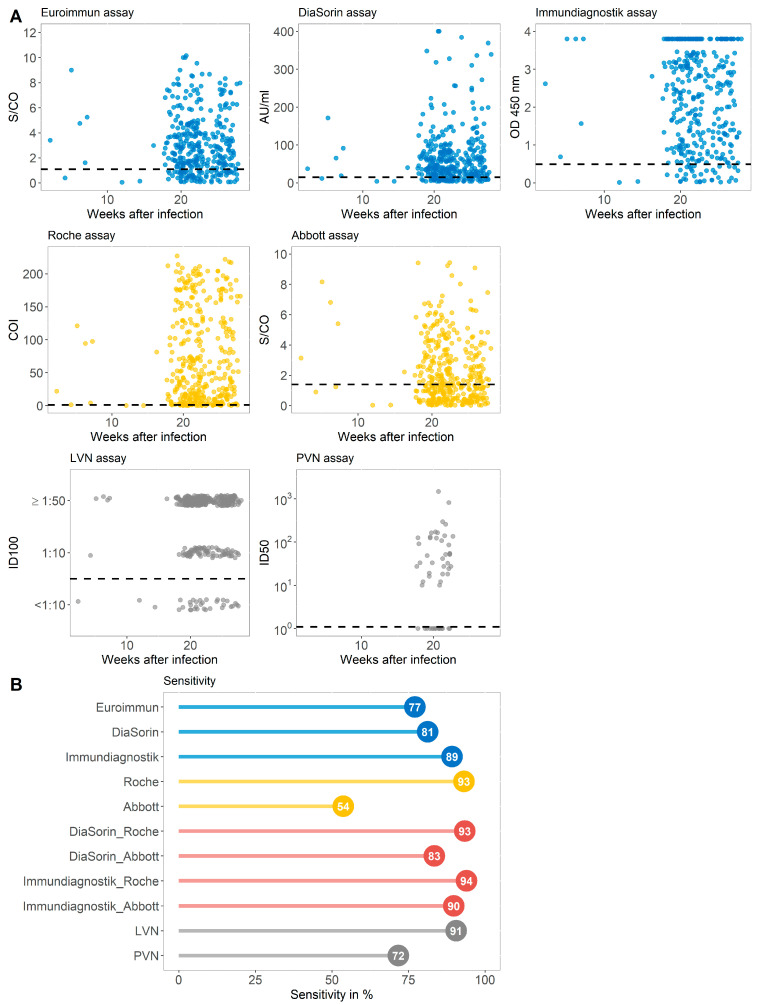
(A) Antibody values of five commercially available immunoassays targeting the S (spike) (blue) or the NC (nucleocapsid) protein (yellow) and virus neutralizing assays (grey) displayed against the weeks after infection for each individual from group A. Dashed horizontal lines display cutoff values of individual serological assays. Results of the virus neutralizing immunoassay are categorized into <1:10, 1:10, and ≥1:50. (B) The sensitivity in % achieved by assays against the S-protein (blue), the NC antigen (yellow), the combination of assays targeting the different proteins (red), and the virus neutralizing (VN) test (grey) for group A. LVN, live virus neutralization assay; PVN, pseudovirus neutralization assay; ID100, 100% inhibitory dilution; ID50, 50% inhibitory dose.
Figure 3
Figure 3
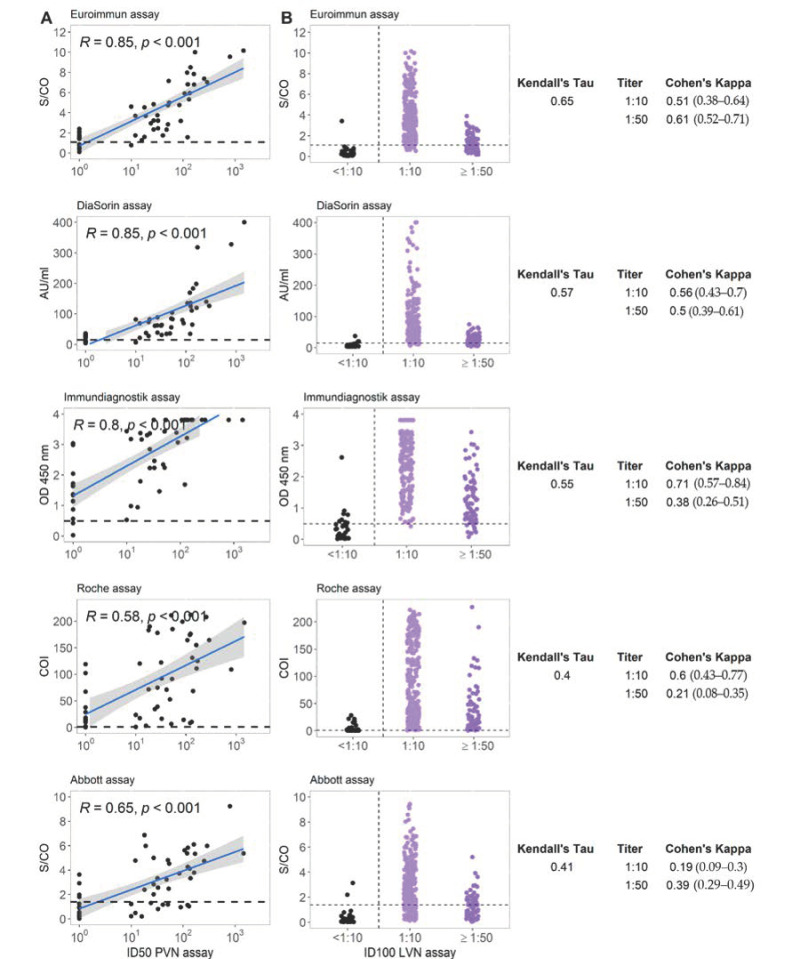
(A) Correlation between five commercial anti-SARS-CoV-2 serological assays and a pseudovirus neutralizing antibody titer for group A. R represents the Spearman rank correlation coefficient ρ. (B) Correlation between five commercial anti-SARS-CoV-2 serological assays and live virus neutralizing antibody titer for group A. Horizontal lines represent cutoff values for individual commercial tests. Kendall’s τ and Cohen’s κ are displayed for each test combination. LVN, live virus neutralization assay; PVN, pseudovirus neutralization assay; ID100, 100% inhibitory dilution; ID50, 50% inhibitory dose.
Figure 4
Figure 4
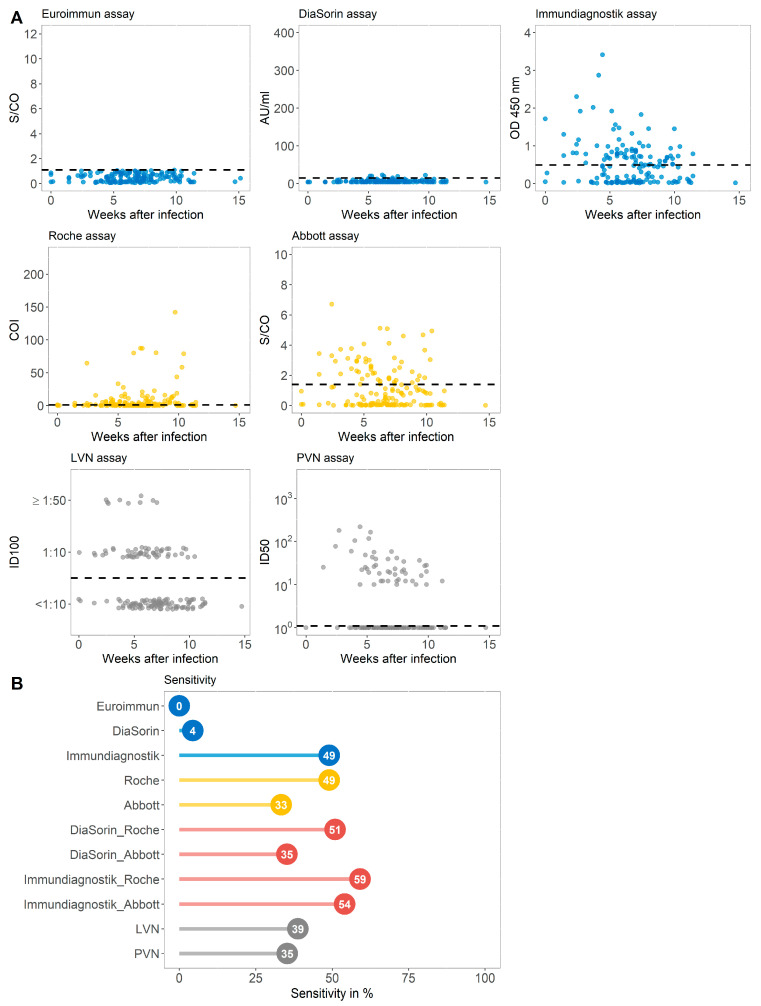
(A) Antibody values of five commercially available immunoassays targeting the S (spike) (blue) or the NC (nucleocapsid) protein (yellow) and virus neutralizing assays (grey) displayed against the weeks after infection for each individual from group B. Dashed horizontal lines display cutoff values of individual serological assays. Results of the virus neutralizing immunoassay are categorized into <1:10, 1:10, and ≥1:50. (B) The sensitivity in % achieved by assays against the S-protein (blue), the NC antigen (yellow), the combination of assays targeting the different proteins (red), and the VN test (grey) for group B. LVN, live virus neutralization assay; PVN, pseudovirus neutralization assay; ID100, 100% inhibitory dilution; ID50, 50% inhibitory dose.
Figure 5
Figure 5
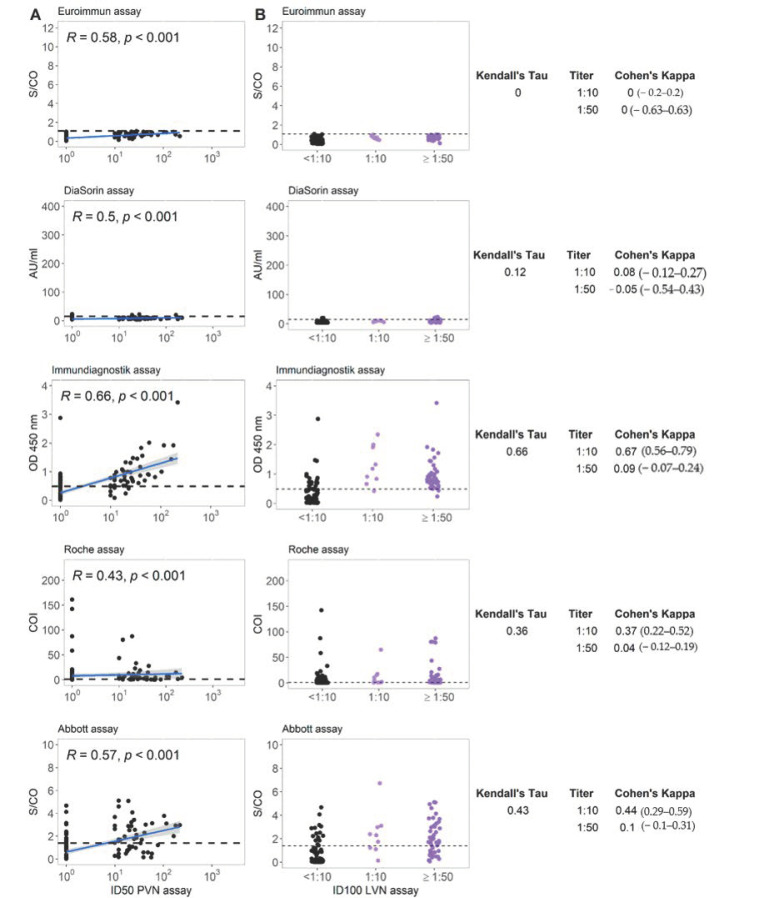
(A) Correlation between five commercial anti-SARS-CoV-2 serological assays and the pseudovirus neutralizing antibody titer for group B. R represents the Spearman rank correlation coefficient ρ. (B) Correlation between five commercial anti-SARS-CoV-2 serological assays and live virus neutralizing antibody titer for group B. Horizontal lines represent cutoff values for individual commercial tests. Kendall’s τ and Cohen’s κ are displayed for each test combination. LVN, live virus neutralization assay; PVN, pseudovirus neutralization assay; ID100, 100% inhibitory dilution; ID50, 50% inhibitory dose.
Figure 6
Figure 6
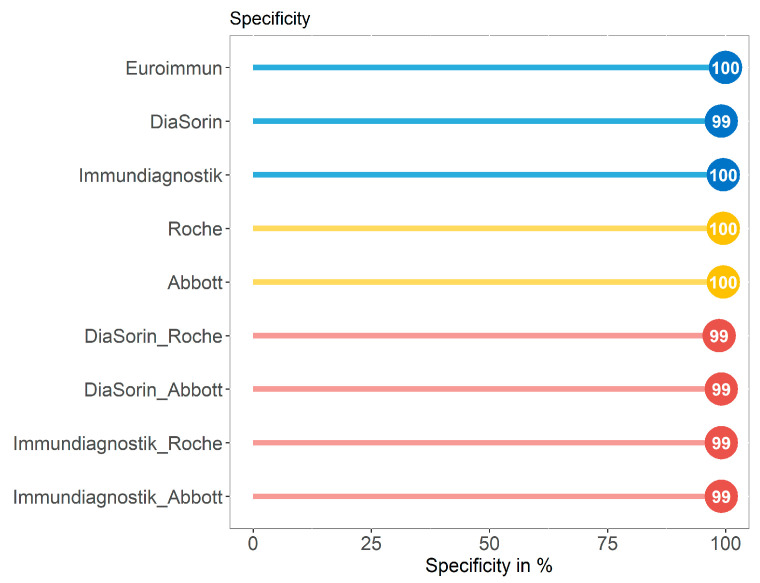
The specificity achieved by assays against the S (spike) protein (blue), the NC (nucleocapsid) antigen (yellow), and the combination of assays targeting the different proteins (red) for group C.

References

    1. Seow J., Graham C., Merrick B., Acors S., Pickering S., Steel K.J.A., Hemmings O., O’Byrne A., Kouphou N., Galao R.P., et al. Longitudinal observation and decline of neutralizing antibody responses in the three months following SARS-CoV-2 infection in humans. Nat. Microbiol. 2020;5:1598–1607. doi: 10.1038/s41564-020-00813-8. - DOI - PMC - PubMed
    1. Addetia A., Crawford K.H.D., Dingens A., Zhu H., Roychoudhury P., Huang M.L., Jerome K.R., Bloom J.D., Greninger A.L. Neutralizing Antibodies Correlate with Protection from SARS-CoV-2 in Humans during a Fishery Vessel Outbreak with a High Attack Rate. J. Clin. Microbiol. 2020;58 doi: 10.1128/JCM.02107-20. - DOI - PMC - PubMed
    1. Wajnberg A., Amanat F., Firpo A., Altman D.R., Bailey M.J., Mansour M., McMahon M., Meade P., Mendu D.R., Muellers K. Robust neutralizing antibodies to SARS-CoV-2 infection persist for months. Science. 2020;370:1227–1230. doi: 10.1126/science.abd7728. - DOI - PMC - PubMed
    1. Weinstein M.C., Freedberg K.A., Hyle E.P., Paltiel A.D. Waiting for Certainty on Covid-19 Antibody Tests - At What Cost? N. Eng. J. Med. 2020;383:e37. doi: 10.1056/NEJMp2017739. - DOI - PubMed
    1. Tang M.S., Case J.B., Franks C.E., Chen R.E., Anderson N.W., Henderson J.P., Diamond M.S., Gronowski A.M., Farnsworth C.W. Association between SARS-CoV-2 neutralizing antibodies and commercial serological assays. Clin. Chem. 2020;66:1538–1547. doi: 10.1093/clinchem/hvaa211. - DOI - PMC - PubMed

LinkOut - more resources