Review
. 2021 Mar 5;9(3):222.
doi: 10.3390/vaccines9030222.

Natural and Synthetic Saponins as Vaccine Adjuvants

Affiliations
Review

Natural and Synthetic Saponins as Vaccine Adjuvants

Pengfei Wang. Vaccines (Basel). .

Abstract

Saponin adjuvants have been extensively studied for their use in veterinary and human vaccines. Among them, QS-21 stands out owing to its unique profile of immunostimulating activity, inducing a balanced Th1/Th2 immunity, which is valuable to a broad scope of applications in combating various microbial pathogens, cancers, and other diseases. It has recently been approved for use in human vaccines as a key component of combination adjuvants, e.g., AS01b in Shingrix® for herpes zoster. Despite its usefulness in research and clinic, the cellular and molecular mechanisms of QS-21 and other saponin adjuvants are poorly understood. Extensive efforts have been devoted to studies for understanding the mechanisms of QS-21 in different formulations and in different combinations with other adjuvants, and to medicinal chemistry studies for gaining mechanistic insights and development of practical alternatives to QS-21 that can circumvent its inherent drawbacks. In this review, we briefly summarize the current understandings of the mechanism underlying QS-21's adjuvanticity and the encouraging results from recent structure-activity-relationship (SAR) studies.

Keywords: QS-21; SAR; VSA-1; VSA-2; adjuvant; mechanism; saponin.


Conflict of interest statement

The author has filed a patent application for VSA-1, VSA-2, and related adjuvants. The authors declare no conflict of interest.

Figures
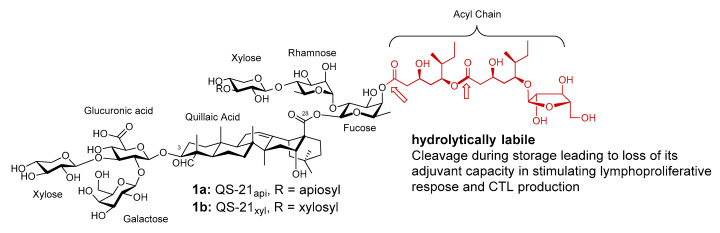
Figure 1
Figure 1
Natural saponin adjuvant QS-21.
Figure 2
Figure 2
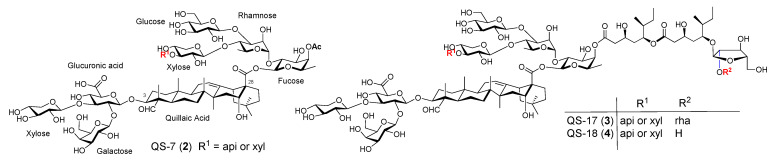
Natural QS saponins QS-7, QS-17, and QS-18.
Figure 3
Figure 3
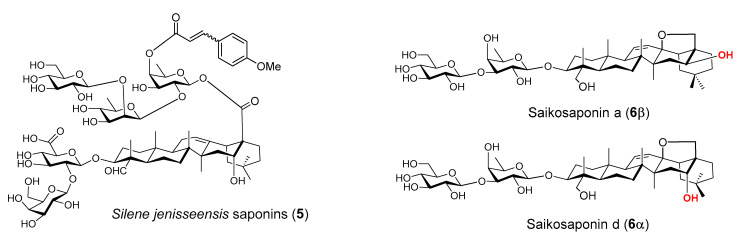
Immunostimulating natural saponins.
Figure 4
Figure 4
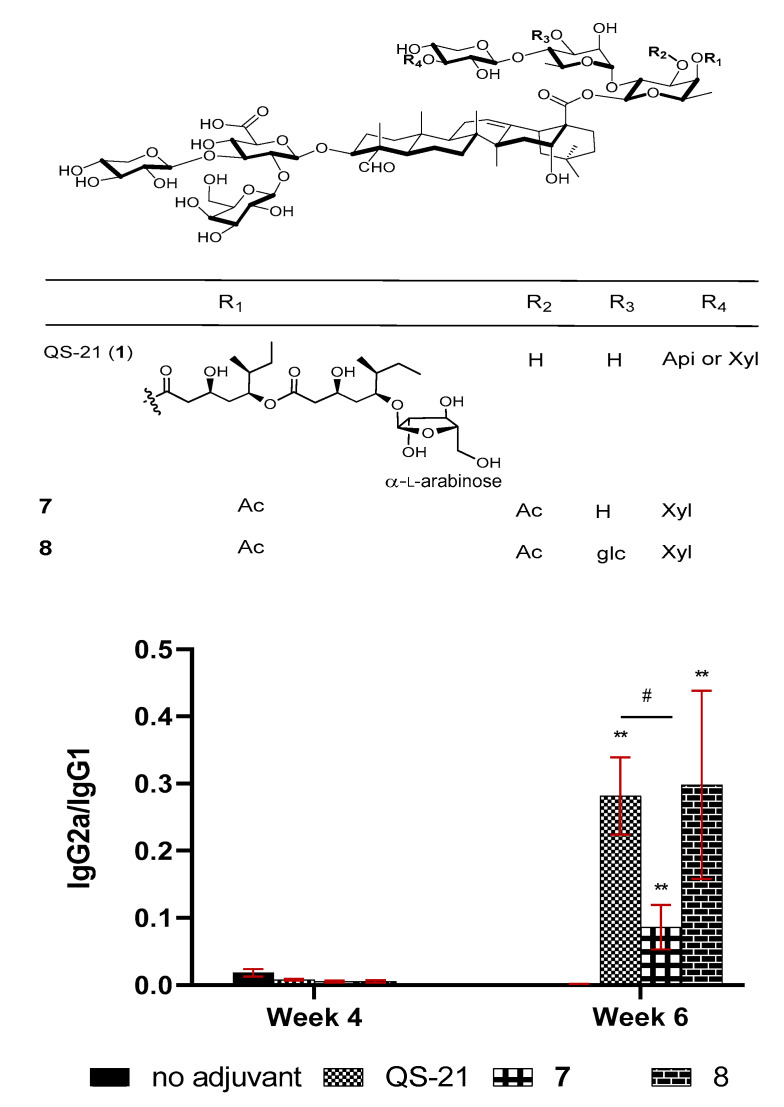
Groups of female BALB/c mice were immunized by the subcutaneous route (s.c.) with OVA (20 µg) alone or with QS-21 (20 µg), or a synthetic saponin (50 μg). IgG2a/IgG1 ratios are expressed as mean ± SEM. Statistical significance was evaluated by t tests (with unpaired, nonparametric, and Mann-Whitney test). ** p < 0.01 compared with the group of OVA alone, and # p < 0.05 compared between the indicated groups.
Figure 5
Figure 5
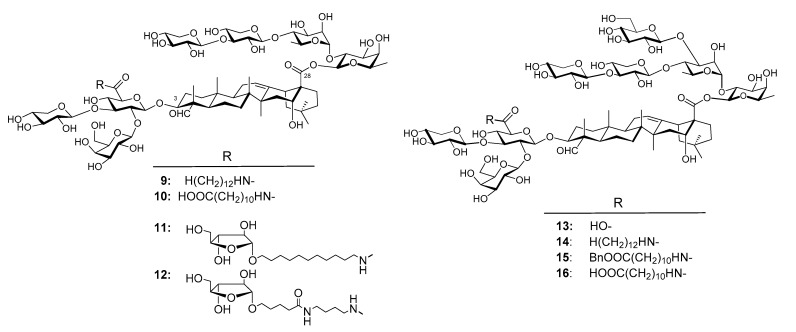
Synthesized QS analogs.
Figure 6
Figure 6
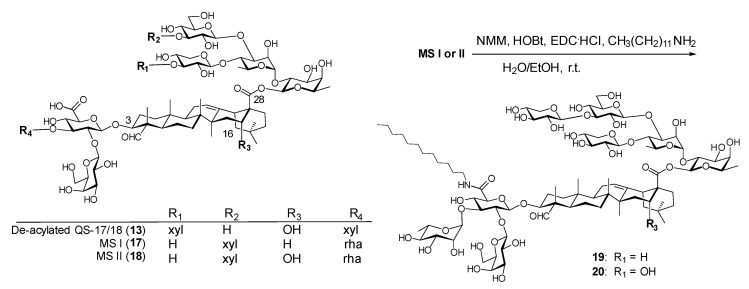
Structural similarity between Momordica saponins (MS) and de-acylated QS-17/18 and MS derivatization.
Figure 7
Figure 7
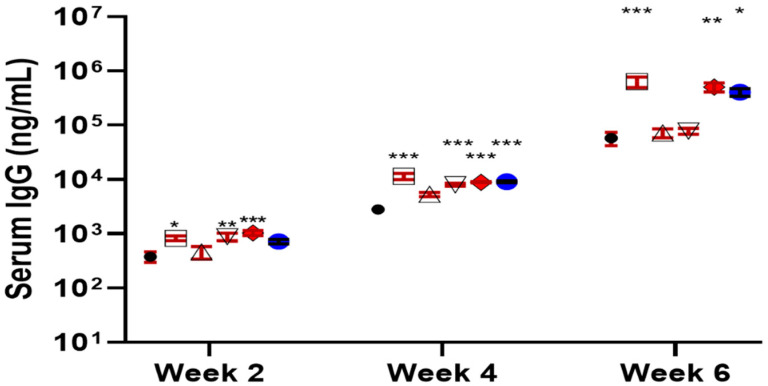
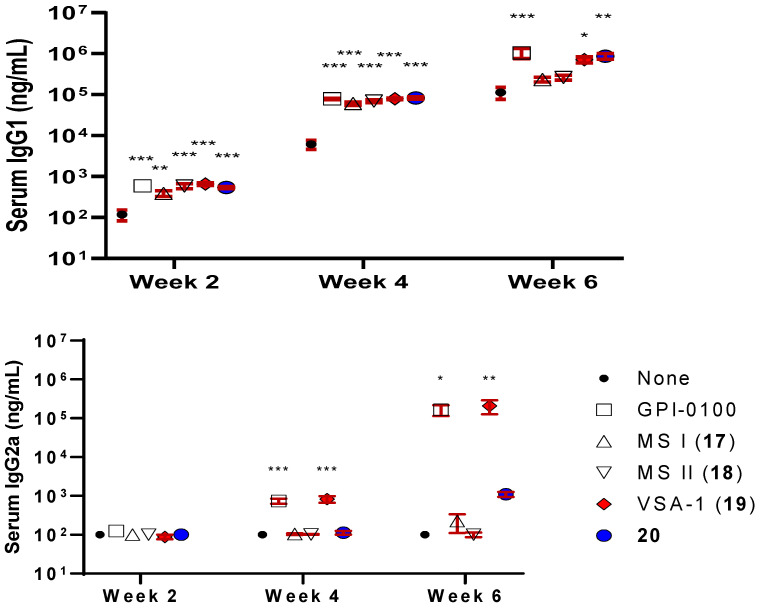
Serum IgG, IgG1, and IgG2a anti-OVA response in mice immunized by the s.c. route with OVA alone or with GPI-0100 or a saponin adjuvant. Mice were immunized on days 0, 14, and 28. Serum samples were collected prior to each immunization and at 6 weeks following the initial immunization. Values are expressed as mean ± SEM. * p < 0.05, ** p < 0.01, and *** p < 0.001 compared with mice immunized with OVA alone.
Figure 7
Figure 7
Serum IgG, IgG1, and IgG2a anti-OVA response in mice immunized by the s.c. route with OVA alone or with GPI-0100 or a saponin adjuvant. Mice were immunized on days 0, 14, and 28. Serum samples were collected prior to each immunization and at 6 weeks following the initial immunization. Values are expressed as mean ± SEM. * p < 0.05, ** p < 0.01, and *** p < 0.001 compared with mice immunized with OVA alone.
Figure 8
Figure 8
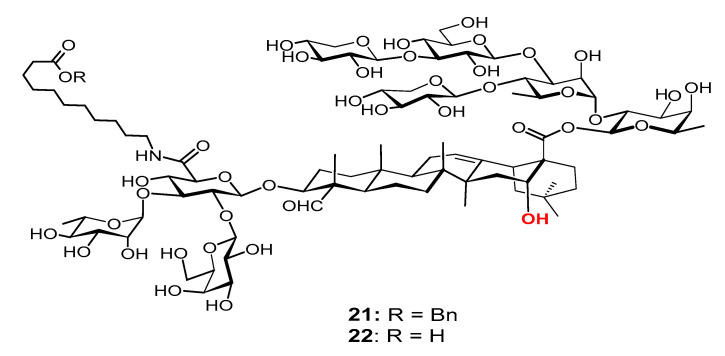
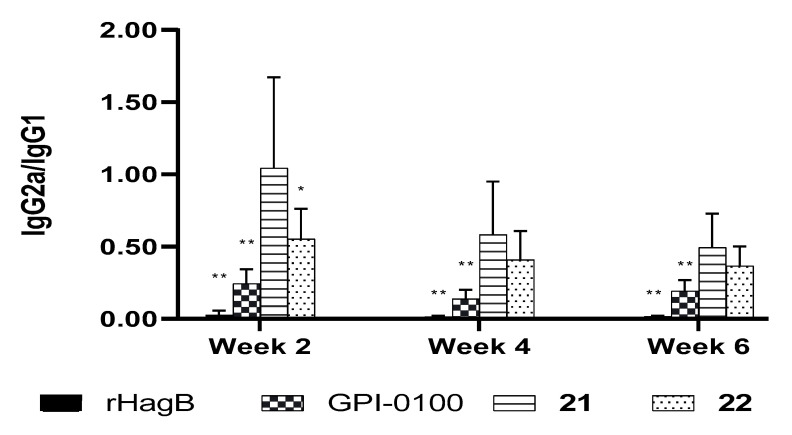
Semi-synthetic MS derivative VSA-2. Mice were immunized by the s.c. route with rHagB alone or with GPI-0100 or a saponin adjuvant on days 0, 14, and 28. Serum samples were collected prior to each immunization and at 6 weeks after the initial immunization. IgG2a/IgG1. Values are expressed as mean ± SD. Statistical significance compared with rHagB + VSA-2 (21). Statistical significance was evaluated by t tests (with unpaired, nonparametric, and Mann−Whitney test). * p < 0.05; ** p < 0.01.
Figure 8
Figure 8
Semi-synthetic MS derivative VSA-2. Mice were immunized by the s.c. route with rHagB alone or with GPI-0100 or a saponin adjuvant on days 0, 14, and 28. Serum samples were collected prior to each immunization and at 6 weeks after the initial immunization. IgG2a/IgG1. Values are expressed as mean ± SD. Statistical significance compared with rHagB + VSA-2 (21). Statistical significance was evaluated by t tests (with unpaired, nonparametric, and Mann−Whitney test). * p < 0.05; ** p < 0.01.
Figure 9
Figure 9
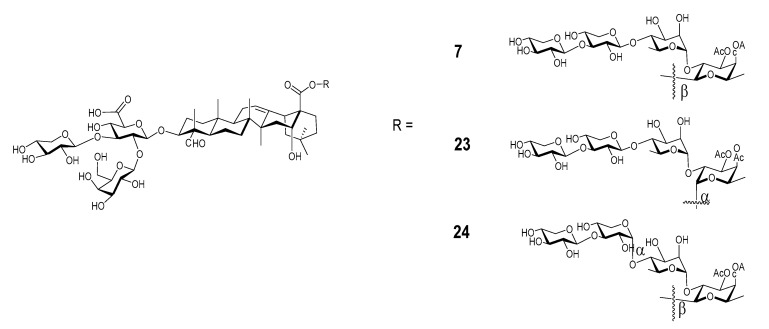
Synthetic QS isomeric analogs having different stereocenters.

References

    1. Ballou W.R. The development of the RTS,S malaria vaccine candidate: Challenges and lessons. Parasite Immunol. 2009;31:492–500. doi: 10.1111/j.1365-3024.2009.01143.x. - DOI - PubMed
    1. Delrieu J., Ousset P.J., Caillaud C., Vellas B. ‘Clinical trials in Alzheimer’s disease’: Immunotherapy approaches. J. Neurochem. 2012;120:186–193. doi: 10.1111/j.1471-4159.2011.07458.x. - DOI - PubMed
    1. Klebanoff C.A., Acquavella N., Yu Z., Restifo N.P. Therapeutic cancer vaccines: Are we there yet? Immunol. Rev. 2010;239:27–44. doi: 10.1111/j.1600-065X.2010.00979.x. - DOI - PMC - PubMed
    1. Rappuoli R., Aderem A. A 2020 vision for vaccines against HIV, tuberculosis and malaria. Nature. 2011;473:463–469. doi: 10.1038/nature10124. - DOI - PubMed
    1. Schijns V., Fernández-Tejada A., Barjaktarović Ž., Bouzalas I., Brimnes J., Chernysh S., Gizurarson S., Gursel I., Jakopin Ž., Lawrenz M., et al. Modulation of immune responses using adjuvants to facilitate therapeutic vaccination. Immunol. Rev. 2020;296:169–190. doi: 10.1111/imr.12889. - DOI - PMC - PubMed