Review
. 2021 Mar 5;10(5):1081.
doi: 10.3390/jcm10051081.

The Role of the Transsulfuration Pathway in Non-Alcoholic Fatty Liver Disease

Affiliations
Review

The Role of the Transsulfuration Pathway in Non-Alcoholic Fatty Liver Disease

Mikkel Parsberg Werge et al. J Clin Med. .

Abstract

The prevalence of non-alcoholic fatty liver disease (NAFLD) is increasing and approximately 25% of the global population may have NAFLD. NAFLD is associated with obesity and metabolic syndrome, but its pathophysiology is complex and only partly understood. The transsulfuration pathway (TSP) is a metabolic pathway regulating homocysteine and cysteine metabolism and is vital in controlling sulfur balance in the organism. Precise control of this pathway is critical for maintenance of optimal cellular function. The TSP is closely linked to other pathways such as the folate and methionine cycles, hydrogen sulfide (H2S) and glutathione (GSH) production. Impaired activity of the TSP will cause an increase in homocysteine and a decrease in cysteine levels. Homocysteine will also be increased due to impairment of the folate and methionine cycles. The key enzymes of the TSP, cystathionine β-synthase (CBS) and cystathionine γ-lyase (CSE), are highly expressed in the liver and deficient CBS and CSE expression causes hepatic steatosis, inflammation, and fibrosis in animal models. A causative link between the TSP and NAFLD has not been established. However, dysfunctions in the TSP and related pathways, in terms of enzyme expression and the plasma levels of the metabolites (e.g., homocysteine, cystathionine, and cysteine), have been reported in NAFLD and liver cirrhosis in both animal models and humans. Further investigation of the TSP in relation to NAFLD may reveal mechanisms involved in the development and progression of NAFLD.

Keywords: H2S production; cystathionine β-synthase/cystathionine γ-lyase (CBS/CSE) system; glutathione; liver fibrosis; non-alcoholic steatohepatitis; sulfur metabolism.


Conflict of interest statement

The submitted work is supported by Novo Nordisk.

Figures
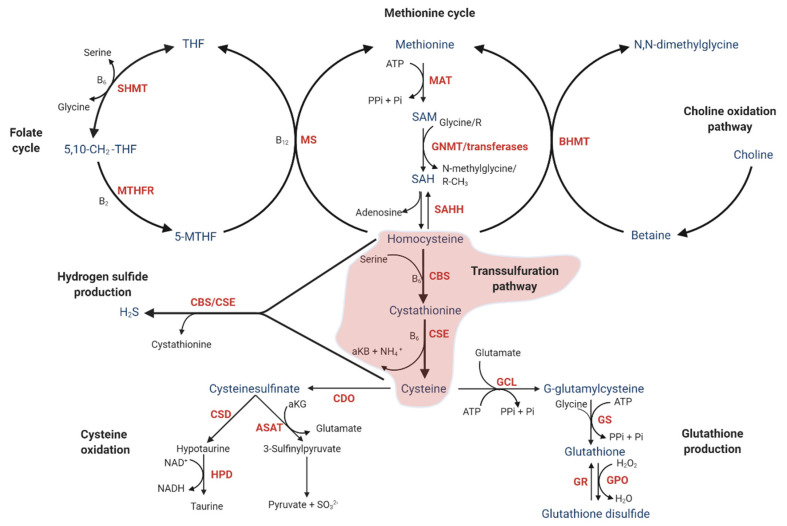
Figure 1
Figure 1
The transsulfuration pathway (TSP) and related pathways. Metabolites: 5-MTHF, 5-methyltetrahydrofolate; 5,10-CH2-THF. 5-10-methylenehydrofolate; aKG, α-ketoglutarate; aKB, α-ketobutyrate; ATP; adenosine triphosphate; B2, riboflavin; B6, pyridoxal 5′-phosphate; B12, cobalamin; H2S, hydrogen sulfide; NH4+, ammonia; Pi, inorganic phosphate; PPi, pyrophosphate; SAH, S-adenosylhomocysteine; SAM, S-adenosylmethionine; SO32−, sulfite; THF, tetrahydrofolate.
Figure 2
Figure 2
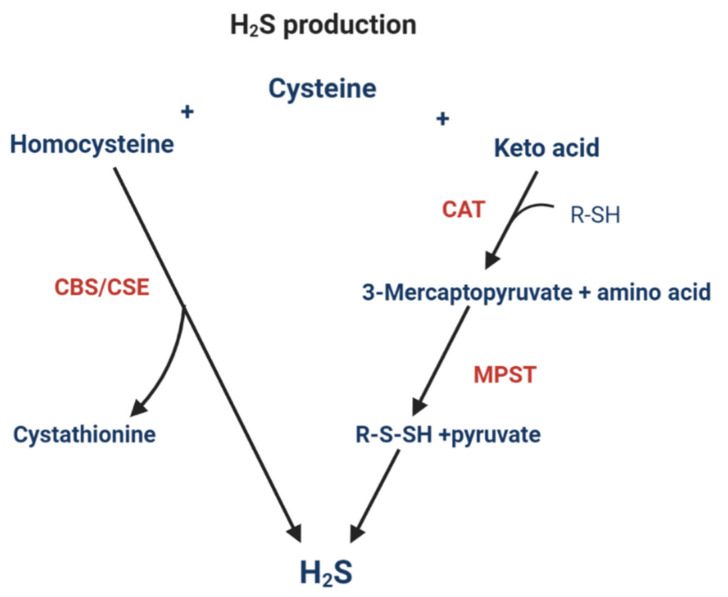
Hydrogen sulfide production pathways. The biosynthesis of hydrogen sulfide (H2S) involves the three enzymes, cystathionine β-synthetase (CBS), cystathionine γ-lyase (CSE), and 3-mercaptopyruvate sulfurtransferase (MPST). The process involving H2S production via CBS and CSE uses homocysteine and cysteine as substrates. The production of H2S via cysteine transaminase (CAT) and MPST uses cysteine and a keto-acid as substrates to form 3-mercaptopyruvate in the first step via CAT, followed by the synthesis of H2S from 3-mercaptopyruvate via MPST.
Figure 3
Figure 3
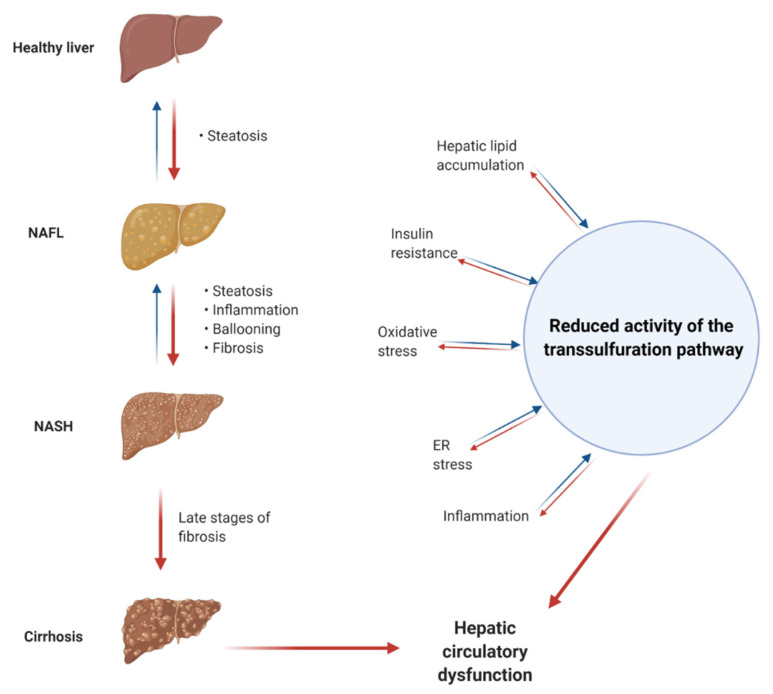
Potential links between the pathogenesis of non-alcoholic fatty liver disease (NAFLD) and reduced activity of the transsulfuration pathway (TSP) and related pathways. NAFL, non-alcoholic fatty liver; NASH, non-alcoholic steatohepatitis.

References

    1. Younossi Z.M., Koenig A.B., Abdelatif D., Fazel Y., Henry L., Wymer M. Global epidemiology of nonalcoholic fatty liver disease-Meta-analytic assessment of prevalence, incidence, and outcomes. Hepatology. 2016;64:73–84. doi: 10.1002/hep.28431. - DOI - PubMed
    1. Donnelly K.L., Smith C.I., Schwarzenberg S.J., Jessurun J., Boldt M.D., Parks E.J. Sources of fatty acids stored in liver and secreted via lipoproteins in patients with nonalcoholic fatty liver disease. J. Clin. Investig. 2005;115:1343–1351. doi: 10.1172/JCI23621. - DOI - PMC - PubMed
    1. Neuschwander-Tetri B.A. Hepatic lipotoxicity and the pathogenesis of nonalcoholic steatohepatitis: The central role of nontriglyceride fatty acid metabolites. Hepatology. 2010;52:774–788. doi: 10.1002/hep.23719. - DOI - PubMed
    1. Cusi K. Role of Obesity and Lipotoxicity in the Development of Nonalcoholic Steatohepatitis: Pathophysiology and Clinical Implications. Gastroenterol. 2012;142:711–725. doi: 10.1053/j.gastro.2012.02.003. - DOI - PubMed
    1. Friedman S.L., Neuschwander-Tetri B.A., Rinella M., Sanyal A.J. Mechanisms of NAFLD development and therapeutic strategies. Nat. Med. 2018;24:908–922. doi: 10.1038/s41591-018-0104-9. - DOI - PMC - PubMed

LinkOut - more resources