Review
. 2021 Mar 5;10(3):390.
doi: 10.3390/antiox10030390.

Oxidative Stress in Drug-Induced Liver Injury (DILI): From Mechanisms to Biomarkers for Use in Clinical Practice

Affiliations
Review

Oxidative Stress in Drug-Induced Liver Injury (DILI): From Mechanisms to Biomarkers for Use in Clinical Practice

Marina Villanueva-Paz et al. Antioxidants (Basel). .

Abstract

Idiosyncratic drug-induced liver injury (DILI) is a type of hepatic injury caused by an uncommon drug adverse reaction that can develop to conditions spanning from asymptomatic liver laboratory abnormalities to acute liver failure (ALF) and death. The cellular and molecular mechanisms involved in DILI are poorly understood. Hepatocyte damage can be caused by the metabolic activation of chemically active intermediate metabolites that covalently bind to macromolecules (e.g., proteins, DNA), forming protein adducts-neoantigens-that lead to the generation of oxidative stress, mitochondrial dysfunction, and endoplasmic reticulum (ER) stress, which can eventually lead to cell death. In parallel, damage-associated molecular patterns (DAMPs) stimulate the immune response, whereby inflammasomes play a pivotal role, and neoantigen presentation on specific human leukocyte antigen (HLA) molecules trigger the adaptive immune response. A wide array of antioxidant mechanisms exists to counterbalance the effect of oxidants, including glutathione (GSH), superoxide dismutase (SOD), catalase, and glutathione peroxidase (GPX), which are pivotal in detoxification. These get compromised during DILI, triggering an imbalance between oxidants and antioxidants defense systems, generating oxidative stress. As a result of exacerbated oxidative stress, several danger signals, including mitochondrial damage, cell death, and inflammatory markers, and microRNAs (miRNAs) related to extracellular vesicles (EVs) have already been reported as mechanistic biomarkers. Here, the status quo and the future directions in DILI are thoroughly discussed, with a special focus on the role of oxidative stress and the development of new biomarkers.

Keywords: DILI; biomarkers; mechanisms; oxidative stress; risk factors.


Conflict of interest statement

The authors declare no conflict of interest.

Figures
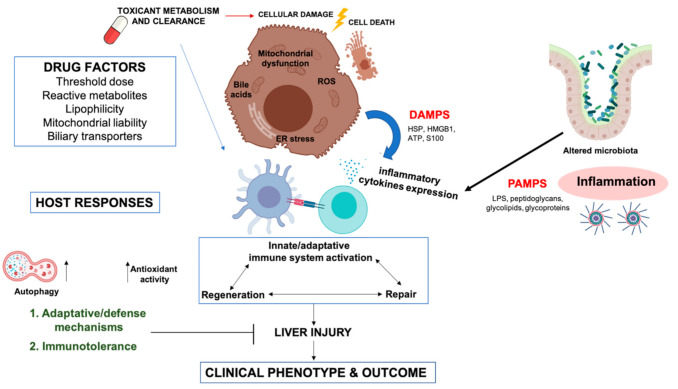
Figure 1
Figure 1
Cellular and molecular mechanisms involved in idiosyncratic drug-induced liver injury. Two key players in DILI, drug and host factors may interact in a multi-faceted manner at different functional pathways and determine individual susceptibility, clinical phenotype, and outcome. The hepatocyte damage caused by the action of drugs induce a complex, multivariant host response. First, cellular damage (oxidative stress, mitochondrial dysfunction, endoplasmic reticulum (ER) stress, and bile salt export pump (BSEP) inhibition, between others) can lead to cell death, provoking cell swelling and eventually rupture of the cell membrane, with the release of intracellular content, including damage-associated molecular patterns (damage-associated molecular patterns (DAMPs), such as high mobility group box protein 1 (HMGB1), heat shock proteins (HSP), ATP, S100 proteins, etc.) which stimulate a strong inflammatory/immune response. Inflammasome has also a very important role in development of liver injury, inducing cytokines secretion to attract and activate macrophages and neutrophils. Moreover, drugs can also alter intestinal microbiota (dysbiosis), and increase intestinal permeability, releasing bacterial products (Pathogen-associated molecular patterns, [PAMPs]) into the bloodstream. PAMPs (bacterial lipopolysaccharides (LPS), endotoxins, flagellin, etc.) act as costimulatory signals for the innate immune system activation. DAMPs and PAMPs are able to bind to TLR of the innate immune cells potentiating the immune response, cytokine release, and immune cell recruitment. Furthermore, drugs can form drug-endogenous proteins adducts that can act as neoantigens. Neoantigens presentation on specific HLA molecules could cause an adaptive immune response. Some HLA polymorphisms favor the presentation of drug-adducted neoantigens. Thus, individuals carrying the HLA variant are more susceptible to develop an adaptive immune response, typically leading to a T cell response directed at hepatocytes and usually involving cytotoxic CD8 T cells that target the peptide drug exposed on MHC class I molecules on the hepatocytes. Cellular damage also induces host adaptive and defense mechanisms, such as autophagy, antioxidant response and tissue repair. Moreover, because of its biological role with constant exposure to foreign antigens, the liver has a strong natural predisposition towards immune tolerance. This tolerance prevents a substantial immune response in the presence of the chemical insult, causing, at most, a mild liver injury that resolves spontaneously despite continued drug intake (i.e., adaptation). Clinically relevant liver injury is believed to result from a breakdown in hepatic immune tolerance. Concomitant inflammation can change the cytokine environment in favor of an immune response. Host factors such as age, gender, genetic factors, lifestyles, disease conditions, and co-medications are involved in the susceptibility of significant liver damage.

References

    1. Roth R.A., Ganey P.E. Intrinsic versus idiosyncratic drug-induced hepatotoxicity—Two villains or one? J. Pharmacol. Exp. Ther. 2010;332:692–697. doi: 10.1124/jpet.109.162651. - DOI - PMC - PubMed
    1. Hoofnagle J.H., Bjornsson E.S. Drug-Induced Liver Injury—Types and Phenotypes. N. Engl. J. Med. 2019;381:264–273. doi: 10.1056/NEJMra1816149. - DOI - PubMed
    1. Andrade R.J., Chalasani N., Bjornsson E.S., Suzuki A., Kullak-Ublick G.A., Watkins P.B., Devarbhavi H., Merz M., Lucena M.I., Kaplowitz N., et al. Drug-induced liver injury. Nat. Rev. Dis. Prim. 2019;5:58. doi: 10.1038/s41572-019-0105-0. - DOI - PubMed
    1. Bernal W., Hyyrylainen A., Gera A., Audimoolam V.K., McPhail M.J., Auzinger G., Rela M., Heaton N., O’Grady J.G., Wendon J., et al. Lessons from look-back in acute liver failure? A single centre experience of 3300 patients. J. Hepatol. 2013;59:74–80. doi: 10.1016/j.jhep.2013.02.010. - DOI - PubMed
    1. Gyamlani G.G., Parikh C.R. Acetaminophen toxicity: Suicidal vs. accidental. Crit. Care. 2002;6:155–159. doi: 10.1186/cc1475. - DOI - PMC - PubMed
