Review
. 2021 Mar 5;22(5):2626.
doi: 10.3390/ijms22052626.

Physcomitrium patens: A Single Model to Study Oriented Cell Divisions in 1D to 3D Patterning

Affiliations
Review

Physcomitrium patens: A Single Model to Study Oriented Cell Divisions in 1D to 3D Patterning

Jeroen de Keijzer et al. Int J Mol Sci. .

Abstract

Development in multicellular organisms relies on cell proliferation and specialization. In plants, both these processes critically depend on the spatial organization of cells within a tissue. Owing to an absence of significant cellular migration, the relative position of plant cells is virtually made permanent at the moment of division. Therefore, in numerous plant developmental contexts, the (divergent) developmental trajectories of daughter cells are dependent on division plane positioning in the parental cell. Prior to and throughout division, specific cellular processes inform, establish and execute division plane control. For studying these facets of division plane control, the moss Physcomitrium (Physcomitrella) patens has emerged as a suitable model system. Developmental progression in this organism starts out simple and transitions towards a body plan with a three-dimensional structure. The transition is accompanied by a series of divisions where cell fate transitions and division plane positioning go hand in hand. These divisions are experimentally highly tractable and accessible. In this review, we will highlight recently uncovered mechanisms, including polarity protein complexes and cytoskeletal structures, and transcriptional regulators, that are required for 1D to 3D body plan formation.

Keywords: Physcomitrium; asymmetric cell division; division plane positioning; gametophore initiation; proliferative cell division.


Conflict of interest statement

The authors declare no conflict of interest.

Figures
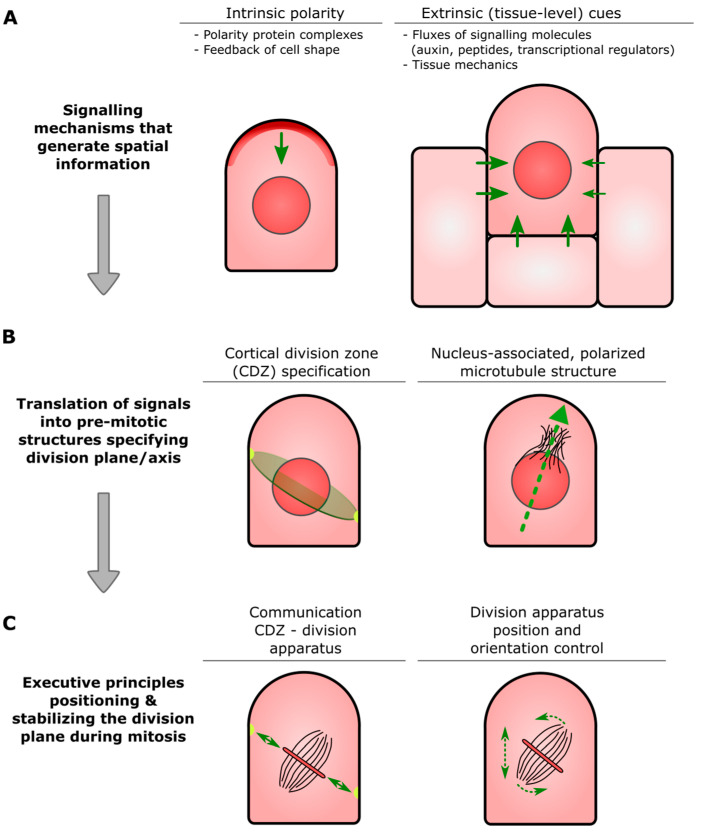
Figure 1
Figure 1
Generalized schematic representation of the processes and factors necessary for correct positioning of division planes during (asymmetrical) plant cell division. (A) For a parental cell to polarize, positional information is required. Positional information is generated by both cell-intrinsic factors (left) and extrinsic factors from surrounding tissues (right). Cell-intrinsic factors chiefly act at the cell cortex, where they can establish polarized signaling domains (red). Extrinsic signaling occurs via (unequal) exposure to cues, examples of which are provided. (B) As the parental cell is about to undergo mitosis, specific structures arise that will instruct the prospective division apparatus on the position and orientation of the desired division plane. The most prominent structure is the cortical division zone (CDZ; light green) that marks the partitioning plane (left). Additionally, polarized microtubule structures that are associated with the nucleus affect the axis along which division will take place (right). (C) As mitosis is executed, continuous control over the position and orientation of the division apparatus is required for proper division plane control (right). Final guidance of the division apparatus constructing the nascent dividing wall towards the CDZ is achieved by physical and/or biochemical communication between these two structures (left).
Figure 2
Figure 2
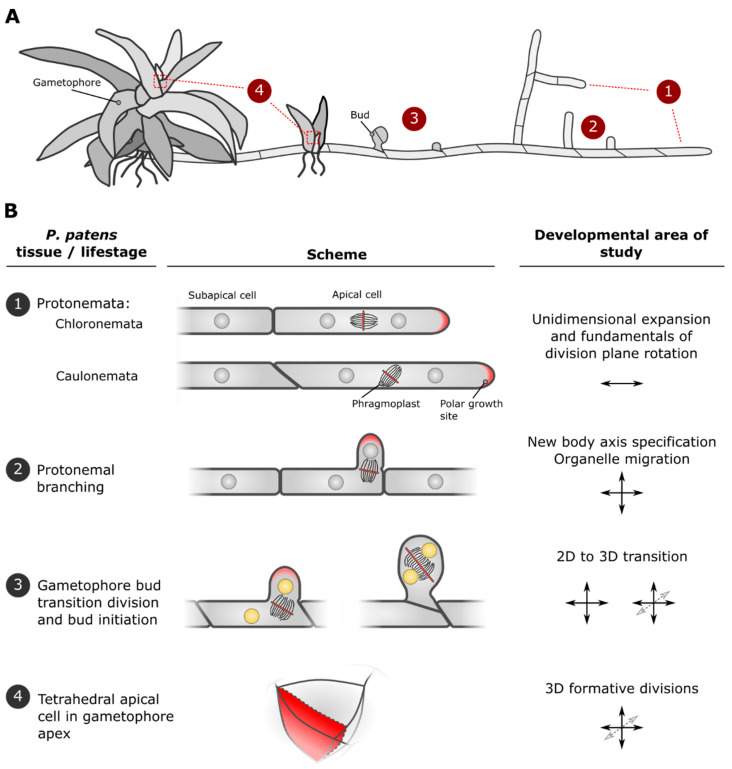
Developmental progression in Physcomitrium patens and the accompanying cellular phenomena that can be studied. (A) Schematic overview of stages in P. patens (gametophytic) development. Cellular outlines (protonemata/buds) or tissue outlines (gametophores) are depicted. Tissue types predominantly associated with juvenile up to adult phases are arranged right to left. Numbers correspond to particular tissues and/or life stages, with oriented cell divisions leading to tissue type specification or changes in growth axes that are further detailed in B. (B) Four P. patens tissues/life stages where various aspects of cell division plane orientation and the establishment of new organismal axes can be studied: (1) Two types of filamentous protonemata (chloronemata + caulonemata) both grow by polarized, unidimensional cell expansion at their apex. The former produces division planes (red line) perpendicular to the growth axis, while the latter exhibits tilting of the division apparatus (phragmoplast), leading to slanted division planes. (2) A secondary growth axis (indicated by arrows) within protonemal tissue can be established by branching of subapical cells. This involves cell polarization and control over nuclear position and division plane orientation. (3) From the juvenile protonema, a transition to 3D developing gametophores can be initiated. This starts by outgrowth of a bud accompanied by cell divisions with specific division plane orientations that establish new organismal axes. Initiation of this developmental program is regulated by distinct transcriptional and hormonal pathways (indicated by yellow nuclei). (4) The apex of the bud ultimately gives rise to a singular stem cell with three cutting faces (one is indicated). Its continued production of daughter cells and their further developmental trajectories drive gametophore morphogenesis.

References

    1. Du Y., Scheres B. PLETHORA transcription factors orchestrate de novo organ patterning during Arabidopsislateral root outgrowth. Proc. Natl. Acad. Sci. USA. 2017;114:11709–11714. doi: 10.1073/pnas.1714410114. - DOI - PMC - PubMed
    1. Camilleri C., Azimzadeh J., Pastuglia M., Bellini C., Grandjean O., Bouchez D. The Arabidopsis TONNEAU2 Gene Encodes a Putative Novel Protein Phosphatase 2A Regulatory Subunit Essential for the Control of the Cortical Cytoskeleton. Plant Cell. 2002;14:833–845. doi: 10.1105/tpc.010402. - DOI - PMC - PubMed
    1. Traas J., Bellini C., Nacry P., Kronenberger J., Bouchez D., Caboche M. Normal differentiation patterns in plants lacking microtubular preprophase bands. Nat. Cell Biol. 1995;375:676–677. doi: 10.1038/375676a0. - DOI
    1. Torres-Ruiz R.A., Jürgens G. Mutations in the FASS gene uncouple pattern formation and morphogenesis in Arabidopsis development. Development. 1994;120:2967–2978. - PubMed
    1. Berleth T., Jurgens G. The role of the monopteros gene in organising the basal body region of the Arabidopsis embryo. Development. 1993;118:575–587.

MeSH terms

LinkOut - more resources