Review
. 2021 Mar 5;10(3):574.
doi: 10.3390/cells10030574.

High Density Lipoprotein Cholesterol Efflux Capacity and Atherosclerosis in Cardiovascular Disease: Pathophysiological Aspects and Pharmacological Perspectives

Affiliations
Review

High Density Lipoprotein Cholesterol Efflux Capacity and Atherosclerosis in Cardiovascular Disease: Pathophysiological Aspects and Pharmacological Perspectives

Maria Pia Adorni et al. Cells. .

Abstract

Over the years, the relationship between high-density lipoprotein (HDL) and atherosclerosis, initially highlighted by the Framingham study, has been revealed to be extremely complex, due to the multiple HDL functions involved in atheroprotection. Among them, HDL cholesterol efflux capacity (CEC), the ability of HDL to promote cell cholesterol efflux from cells, has emerged as a better predictor of cardiovascular (CV) risk compared to merely plasma HDL-cholesterol (HDL-C) levels. HDL CEC is impaired in many genetic and pathological conditions associated to high CV risk such as dyslipidemia, chronic kidney disease, diabetes, inflammatory and autoimmune diseases, endocrine disorders, etc. The present review describes the current knowledge on HDL CEC modifications in these conditions, focusing on the most recent human studies and on genetic and pathophysiologic aspects. In addition, the most relevant strategies possibly modulating HDL CEC, including lifestyle modifications, as well as nutraceutical and pharmacological interventions, will be discussed. The objective of this review is to help understanding whether, from the current evidence, HDL CEC may be considered as a valid biomarker of CV risk and a potential pharmacological target for novel therapeutic approaches.

Keywords: atherosclerosis; cardiovascular disease; cholesterol efflux capacity; high density lipoprotein; reverse cholesterol transport.


Conflict of interest statement

The authors declare no conflict of interest.

Figures
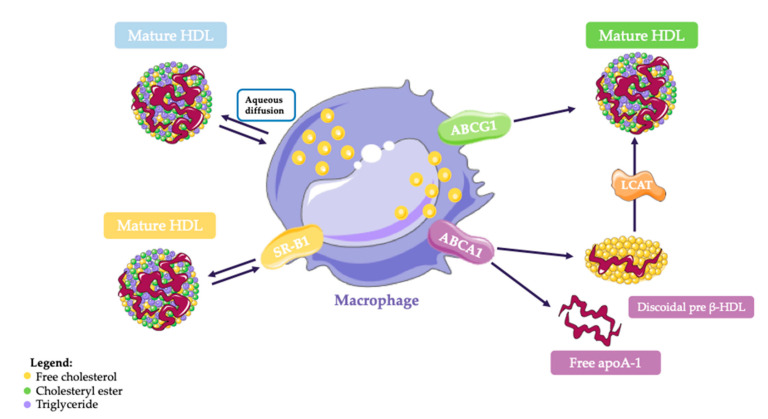
Figure 1
Figure 1
Mechanisms of cellular cholesterol efflux. This scheme shows the different pathways involved in macrophage cholesterol efflux and the specific high-density lipoprotein (HDL) subclasses acting as cholesterol acceptors. Cholesterol efflux occurs by four independent routes, including aqueous diffusion (AD), scavenger receptor B1 (SR-BI), ATP-binding membrane cassette transporter A1 (ABCA1) and G1 (ABCG1). The AD and SR-BI pathways consist of bidirectional flux of cholesterol between mature HDL particles and the cell plasma membrane and, as such, cholesterol transfer is driven by the cholesterol concentration gradient. Furthermore, cholesterol efflux can be unidirectionally and actively transported through the transporter ABCA1 to lipid free apoA-1 or discoidal pre β-HDL or through the transporter ABCG1 to mature HDL particles.

References

    1. Wilson P.W., Garrison R.J., Castelli W.P., Feinleib M., McNamara P.M., Kannel W.B. Prevalence of coronary heart disease in the Framingham Offspring Study: Role of lipoprotein cholesterols. Am. J. Cardiol. 1980;46:649–654. doi: 10.1016/0002-9149(80)90516-0. - DOI - PubMed
    1. Gordon D.J., Probstfield J.L., Garrison R.J., Neaton J.D., Castelli W.P., Knoke J.D., Jacobs D.R.J., Bangdiwala S., Tyroler H.A. High-density lipoprotein cholesterol and cardiovascular disease. Four prospective American studies. Circulation. 1989;79:8–15. doi: 10.1161/01.CIR.79.1.8. - DOI - PubMed
    1. Madsen C.M., Varbo A., Nordestgaard B.G. Extreme high high-density lipoprotein cholesterol is paradoxically associated with high mortality in men and women: Two prospective cohort studies. Eur. Heart J. 2017;38:2478–2486. doi: 10.1093/eurheartj/ehx163. - DOI - PubMed
    1. Schwartz G.G., Olsson A.G., Abt M., Ballantyne C.M., Barter P.J., Brumm J., Chaitman B.R., Holme I.M., Kallend D., Leiter L.A., et al. Effects of Dalcetrapib in Patients with a Recent Acute Coronary Syndrome. N. Engl. J. Med. 2012;367:2089–2099. doi: 10.1056/NEJMoa1206797. - DOI - PubMed
    1. Lincoff A.M., Nicholls S.J., Riesmeyer J.S., Barter P.J., Brewer H.B., Fox K.A.A., Gibson C.M., Granger C., Menon V., Montalescot G., et al. Evacetrapib and Cardiovascular Outcomes in High-Risk Vascular Disease. N. Engl. J. Med. 2017;376:1933–1942. doi: 10.1056/NEJMoa1609581. - DOI - PubMed

Substances
