


Increasing Capacity to Detect Clusters of Rapid HIV Transmission in Varied Populations-United States
- PMID: 33808053
- PMCID: PMC8066706
- DOI: 10.3390/v13040577
Increasing Capacity to Detect Clusters of Rapid HIV Transmission in Varied Populations-United States
Abstract
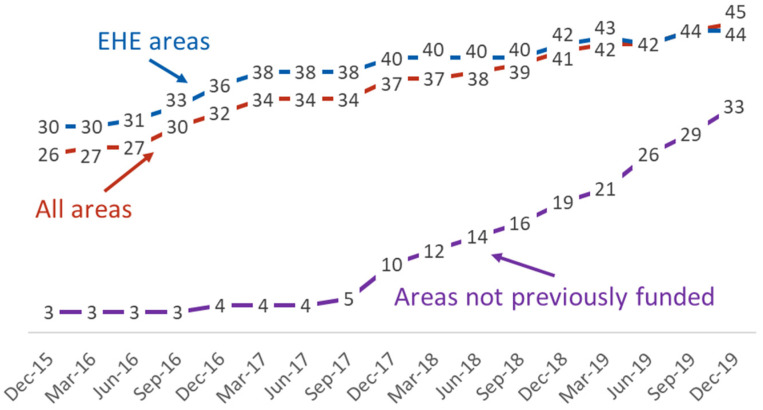
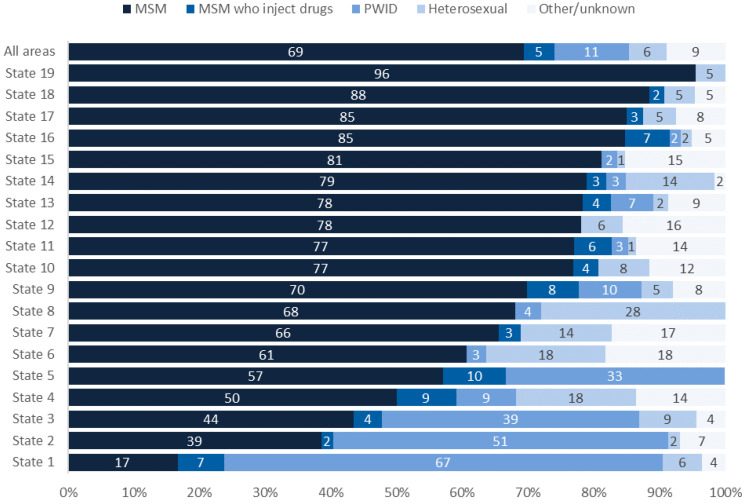
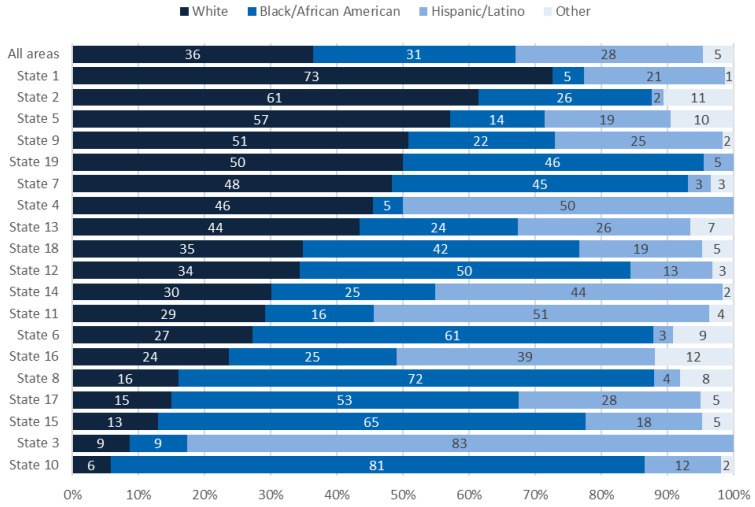
Molecular cluster detection analyzes HIV sequences to identify rapid HIV transmission and inform public health responses. We describe changes in the capability to detect molecular clusters and in geographic variation in transmission dynamics. We examined the reporting completeness of HIV-1 polymerase sequences in quarterly National HIV Surveillance System datasets from December 2015 to December 2019. Priority clusters were identified quarterly. To understand populations recently affected by rapid transmission, we described the transmission risk and race/ethnicity of people in clusters first detected in 2018-2019. During December 2015 to December 2019, national sequence completeness increased from 26% to 45%. Of the 1212 people in the 136 clusters first detected in 2018-2019, 69% were men who have sex with men (MSM) and 11% were people who inject drugs (PWID). State-by-state analysis showed substantial variation in transmission risk and racial/ethnic groups in clusters of rapid transmission. HIV sequence reporting has increased nationwide. Molecular cluster analysis identifies rapid transmission in varied populations and identifies emerging patterns of rapid transmission in specific population groups, such as PWID, who, in 2015-2016, comprised only 1% of people in such molecular clusters. These data can guide efforts to focus, tailor, and scale up prevention and care services for these populations.
Keywords: HIV-1; cluster analysis; epidemiology; intravenous; public health; sexual and gender minorities; substance abuse.
Conflict of interest statement
The authors declare no conflict of interest.
Figures
References
-
- Department of Health and Human Services. What Is Ending the HIV Epidemic: A Plan for America? [(accessed on 18 June 2020)]; Available online: https://www.hiv.gov/federal-response/ending-the-hiv-epidemic/overview.
-
- Oster A.M., France A.M., Panneer N., Banez Ocfemia M.C., Campbell E., Dasgupta S., Switzer W.M., Wertheim J.O., Hernandez A.L. Identifying Clusters of Recent and Rapid HIV Transmission Through Analysis of Molecular Surveillance Data. J. Acquir. Immune Defic. Syndr. 2018;79:543–550. doi: 10.1097/QAI.0000000000001856. - DOI - PMC - PubMed
-
- Poon A.F., Gustafson R., Daly P., Zerr L., Demlow S.E., Wong J., Woods C.K., Hogg R.S., Krajden M., Moore D., et al. Near real-time monitoring of HIV transmission hotspots from routine HIV genotyping: An implementation case study. Lancet HIV. 2016;3:231–238. doi: 10.1016/S2352-3018(16)00046-1. - DOI - PMC - PubMed
-
- Centers for Disease Control and Prevention. Funding Opportunity Announcement (FOA) PS18-1802: Integrated Human Immunodeficiency Virus (HIV) Surveillance and Prevention Programs for Health Departments. [(accessed on 21 January 2021)]; Available online: https://www.cdc.gov/hiv/funding/announcements/ps18-1802/index.html.
Publication types
MeSH terms
Grants and funding
LinkOut - more resources
Full Text Sources
Other Literature Sources
Medical
