


Dietary Fats, Serum Cholesterol and Liver Cancer Risk: A Systematic Review and Meta-Analysis of Prospective Studies
- PMID: 33808094
- PMCID: PMC8037522
- DOI: 10.3390/cancers13071580
Dietary Fats, Serum Cholesterol and Liver Cancer Risk: A Systematic Review and Meta-Analysis of Prospective Studies
Abstract
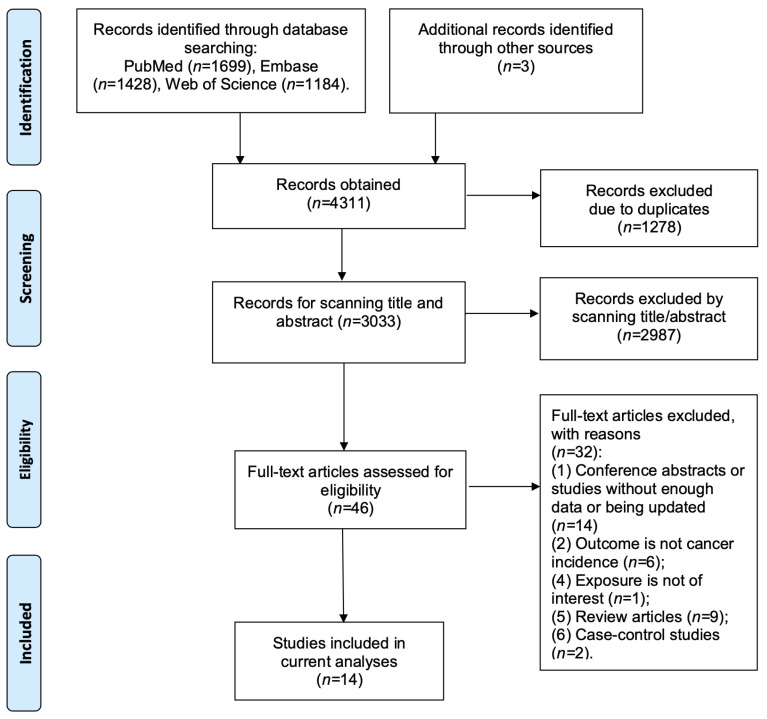
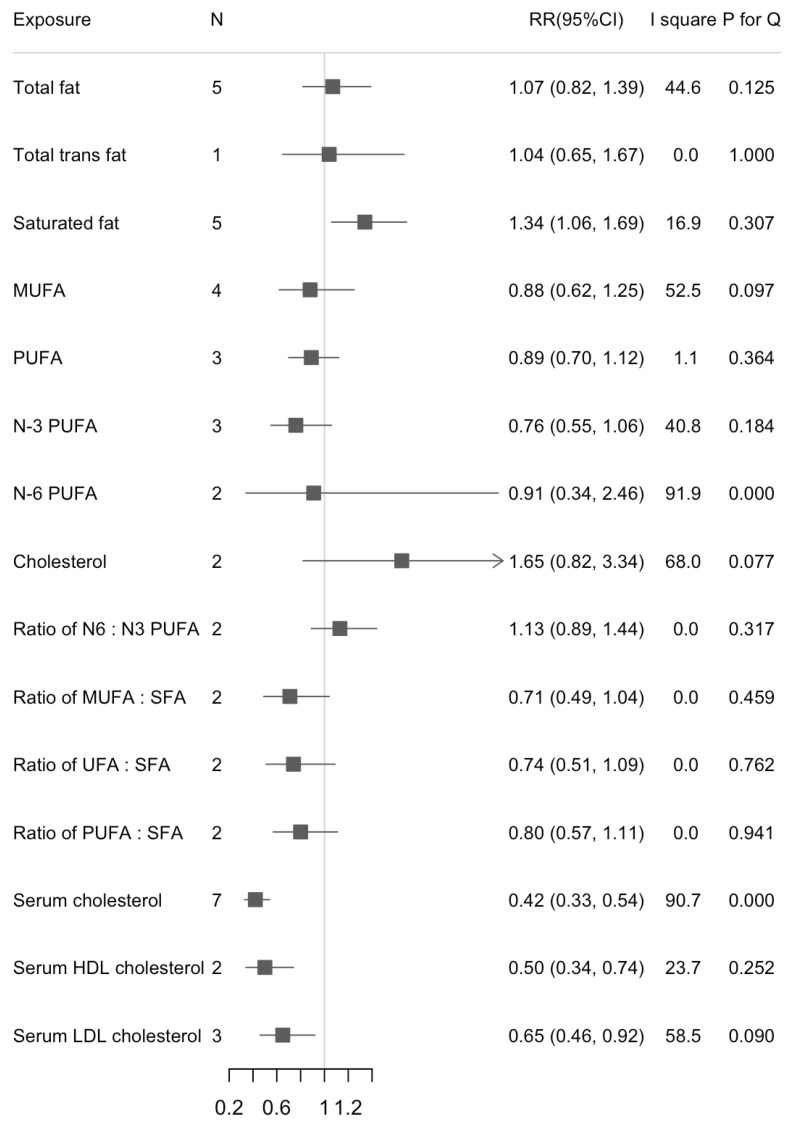
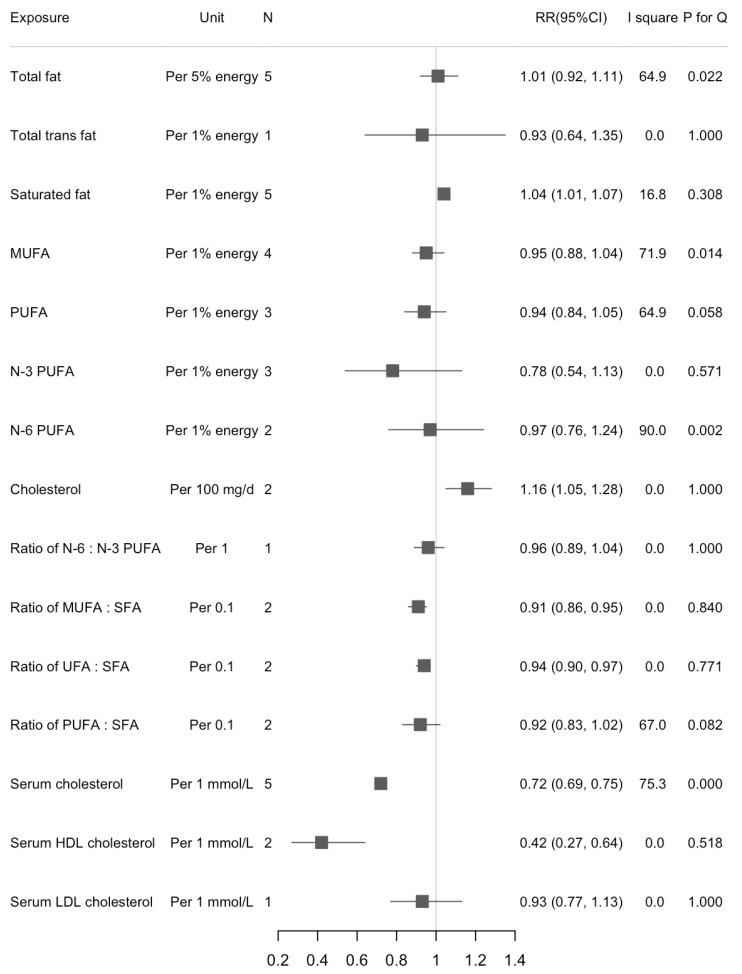
To quantify the associations between dietary fats and their major components, as well as serum levels of cholesterol, and liver cancer risk, we performed a systematic review and meta-analysis of prospective studies. We searched PubMed, Embase, and Web of Science up to October 2020 for prospective studies that reported the risk estimates of dietary fats and serum cholesterol for liver cancer risk. We carried out highest versus lowest intake or level and dose-response analyses. Higher intake of dietary saturated fatty acids (SFA) was associated with a higher liver cancer risk in both category analysis (relative risk [RR]highest vs. lowest intake = 1.34, 95% confidence interval [CI]: 1.06, 1.69) and dose-response analysis (RR1% energy = 1.04, 95%CI: 1.01, 1.07). Higher serum total cholesterol was inversely associated with liver cancer but with large between-studies variability (RR1 mmol/L = 0.72, 95%CI: 0.69, 0.75, I2 = 75.3%). The inverse association was more pronounced for serum high-density lipoprotein (HDL) cholesterol (RR1 mmol/L = 0.42, 95%CI: 0.27, 0.64). Higher intake of dietary SFA was associated with higher risk of liver cancer while higher serum levels of cholesterol and HDL were associated with a lower risk of liver cancer with high between-studies variability.
Keywords: cholesterol; dietary fat; epidemiological study; high-density lipoprotein cholesterol; liver cancer; low-density lipoprotein cholesterol; meta-analysis.
Conflict of interest statement
The authors declare that they have no competing interest.
Figures
References
-
- Savard C., Tartaglione E.V., Kuver R., Haigh W.G., Farrell G.C., Subramanian S., Chait A., Yeh M.M., Quinn L.S., Ioannou G.N. Synergistic interaction of dietary cholesterol and dietary fat in inducing experimental steatohepatitis. Hepatology. 2013;57:81–92. doi: 10.1002/hep.25789. - DOI - PMC - PubMed
Publication types
LinkOut - more resources
Full Text Sources
Other Literature Sources
