. 2021 Mar 30;11(4):884.
doi: 10.3390/nano11040884.

Bioinspired Green Synthesis of Zinc Oxide Nanoparticles from a Native Bacillus cereus Strain RNT6: Characterization and Antibacterial Activity against Rice Panicle Blight Pathogens Burkholderia glumae and B. gladioli

Affiliations

Bioinspired Green Synthesis of Zinc Oxide Nanoparticles from a Native Bacillus cereus Strain RNT6: Characterization and Antibacterial Activity against Rice Panicle Blight Pathogens Burkholderia glumae and B. gladioli

Temoor Ahmed et al. Nanomaterials (Basel). .

Abstract

Burkholderia glumae and B. gladioli are seed-borne rice pathogens that cause bacterial panicle blight (BPB) disease, resulting in huge rice yield losses worldwide. However, the excessive use of chemical pesticides in agriculture has led to an increase in environmental toxicity. Microbe-mediated nanoparticles (NPs) have recently gained significant attention owing to their promising application in plant disease control. In the current study, we biologically synthesize zinc oxide nanoparticles (ZnONPs) from a native Bacillus cereus RNT6 strain, which was taxonomically identified using 16S rRNA gene analysis. The biosynthesis of ZnONPs in the reaction mixture was confirmed by using UV-Vis spectroscopy. Moreover, XRD, FTIR, SEM-EDS, and TEM analysis revealed the functional groups, crystalline nature, and spherical shape of ZnONPs with sizes ranging from 21 to 35 nm, respectively. Biogenic ZnONPs showed significant antibacterial activity at 50 µg mL-1 against B. glumae and B. gladioli with a 2.83 cm and 2.18 cm zone of inhibition, respectively, while cell numbers (measured by OD600) of the two pathogens in broth culture were reduced by 71.2% and 68.1%, respectively. The ultrastructure studies revealed the morphological damage in ZnONPs-treated B. glumae and B. gladioli cells as compared to the corresponding control. The results of this study revealed that ZnONPs could be considered as promising nanopesticides to control BPB disease in rice.

Keywords: ZnONPs; antibacterial activity; biosynthesis; nanopesticides; rice pathogen.


Conflict of interest statement

The authors declare no conflict of interest.

Figures

Figure 1
Figure 1
Phylogenetic analysis of B. cereus RNT6 with the type strains and closest Genbank matches of genus Bacillus.
Figure 2
Figure 2
The UV–Vis spectra of reaction mixture containing stabilized biogenic zinc oxide nanoparticles (ZnONPs).
Figure 3
Figure 3
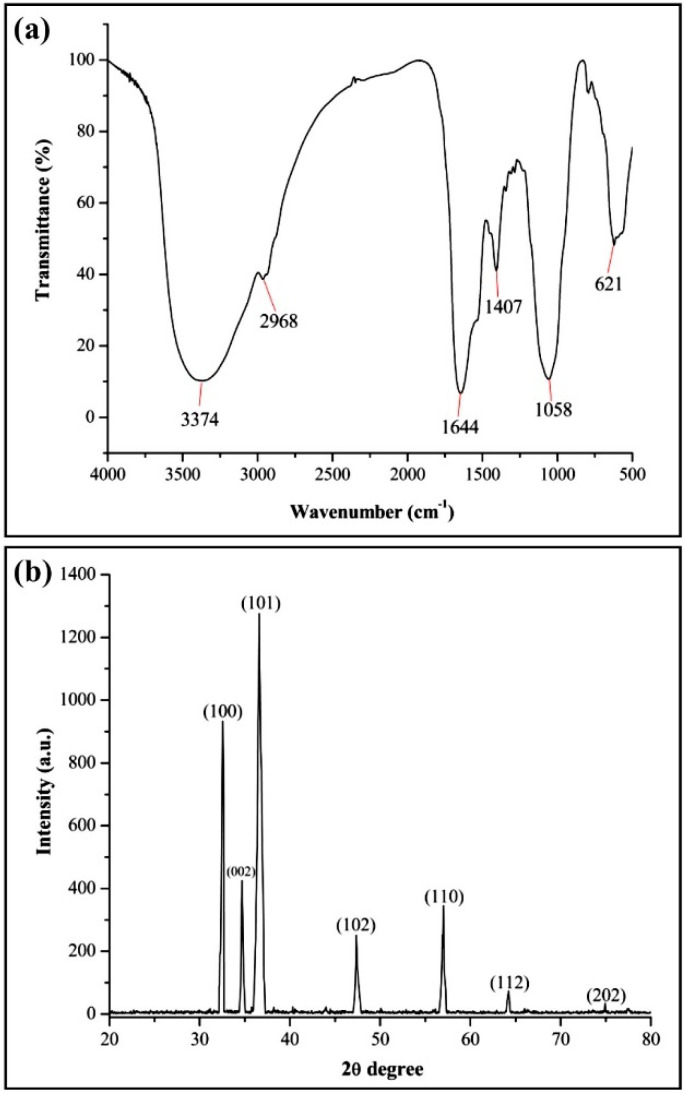
Characterization of biogenic ZnONPs synthesized from B. cereus RNT6. (a) FTIR spectra, (b) XRD analysis.
Figure 4
Figure 4
Characterization of biogenic ZnONPs through SEM-EDS and TEM analysis to observe the shape, size, and elemental composition of nanoparticles (NPs) (scale bar = 200 nm). (a) SEM analysis of ZnONPs, (b) TEM analysis of ZnONPs, and (c) EDS analysis of ZnONPs.
Figure 5
Figure 5
In vitro antibacterial activity of biogenic ZnONPs at three different concentrations (10, 25, and 50 µg mL−1) against B. glumae and B. gladioli. (a) The zone of inhibition was observed by well diffusion assay, (b) the inhibition of B. glumae and B. gladioli growth in liquid medium, (c) the inhibition of biofilm formation.
Figure 6
Figure 6
Antibacterial potential of biogenic ZnONPs against B. glumae and B. gladioli cells after 8 h treatment with (50 µg mL−1) and without (control) biogenic ZnONPs. (a) Live/dead cell staining, with green fluorescence representing the live bacteria, while red fluorescence presents dead bacteria (scale bar = 20 μm]. (b) Formation of reactive oxygen species (ROS) in B. glumae and B. gladioli cells. (c) Flow cytometry images of B. glumae and B. gladioli cells.
Figure 7
Figure 7
Electron microscopic SEM and TEM images of rice bacterial pathogens B. glumae and B. gladioli cells after 8 h treatment with (50 µg mL−1) and without (control) biogenic ZnONPs. (a) SEM images reveal a highly ruptured structure and small cellular holes; (b) TEM images show integrated bacterial membranes, disorganized cytoplasm, and leakage of bacterial genetic material.

References

    1. Ahmed T., Noman M., Shahid M., Shahid M.S., Li B. Antibacterial potential of green magnesium oxide nanoparticles against rice pathogen Acidovorax oryzae. Mater. Lett. 2021;282:128839. doi: 10.1016/j.matlet.2020.128839. - DOI
    1. Edwards J., Johnson C., Santos-Medellín C., Lurie E., Podishetty N.K., Bhatnagar S., Eisen J.A., Sundaresan V. Structure, variation, and assembly of the root-associated microbiomes of rice. Proc. Natl. Acad. Sci. USA. 2015;112:E911–E920. doi: 10.1073/pnas.1414592112. - DOI - PMC - PubMed
    1. Nandakumar R., Shahjahan A., Yuan X., Dickstein E., Groth D., Clark C., Cartwright R., Rush M. Burkholderia glumae and B. gladioli cause bacterial panicle blight in rice in the southern United States. Plant Dis. 2009;93:896–905. doi: 10.1094/PDIS-93-9-0896. - DOI - PubMed
    1. Ortega L., Rojas C. Bacterial Panicle Blight and Burkholderia glumae: From pathogen biology to disease control. Phytopathology. 2020 doi: 10.1094/PHYTO-09-20-0401-RVW. - DOI - PubMed
    1. Pedraza L.A., Bautista J., Uribe-Vélez D. Seed-born Burkholderia glumae infects rice seedling and maintains bacterial population during vegetative and reproductive growth stage. Plant Pathol. J. 2018;34:393. doi: 10.5423/PPJ.OA.02.2018.0030. - DOI - PMC - PubMed