. 2021 Mar 30;13(4):1142.
doi: 10.3390/nu13041142.

Blood Pressure-Lowering Effect of Wine Lees: Dose-Response Study, Effect of Dealcoholization and Possible Mechanisms of Action

Affiliations

Blood Pressure-Lowering Effect of Wine Lees: Dose-Response Study, Effect of Dealcoholization and Possible Mechanisms of Action

Raúl López-Fernández-Sobrino et al. Nutrients. .

Abstract

The antihypertensive effect of wine lees (WL) has been previously evidenced. In this study, the antihypertensive properties of different doses of WL were evaluated in spontaneously hypertensive rats (SHR). In addition, the blood pressure (BP)-lowering effect of dried (dealcoholized) WL powder (WLPW) and the mechanisms involved in its functionality were investigated. Furthermore, a possible hypotensive effect of WLPW was discarded in Wistar-Kyoto (WKY) rats. The administration of WL at different doses caused a dose-dependent decrease in BP of SHR up to 5.0 mL/kg bw, exhibiting the maximum decrease at 6 h post-administration. WLPW caused a greater drop in BP than WL, showing an antihypertensive effect higher and more prolonged than the drug Captopril. Moreover, the BP-lowering effect of WLPW was specific to the hypertensive state since an undesirable hypotensive effect in normotensive WKY rats was ruled out. Finally, WLPW improved oxidative stress and increased the activity of the antioxidant endogen system of SHR. These results suggest that WLPW could be used as functional ingredient for foods or nutraceuticals to ameliorate hypertension. Nevertheless, further clinical studies are needed to evaluate its long-term antihypertensive efficiency.

Keywords: angiotensin-converting enzyme activity; antihypertensive activity; antioxidant activity; spontaneously hypertensive rats; winery byproducts.


Conflict of interest statement

The authors declare no conflict of interest.

Figures

Figure 1
Figure 1
Experimental design of the different in vivo studies. (A) Effect of 3 different doses (2.5. 5.0 and 7.5 mL/kg bw) of wine lees (WL) on blood pressure (BP) in spontaneously hypertensive rats (SHR). (B) Effect of dried WL powder (WLPW) on BP in SHR. (C) Effect of WLPW on BP in normotensive Wistar Kyoto rats (WKY) and (D) mechanisms involved in the antihypertensive effect of WLPW in SHR at 6 h post-administration. ACE: angiotensin-converting enzyme; ROS: reactive oxygen species; GSH: reduced glutathione; MDA: malondialdehyde; NOx: nitric oxide metabolites.
Figure 2
Figure 2
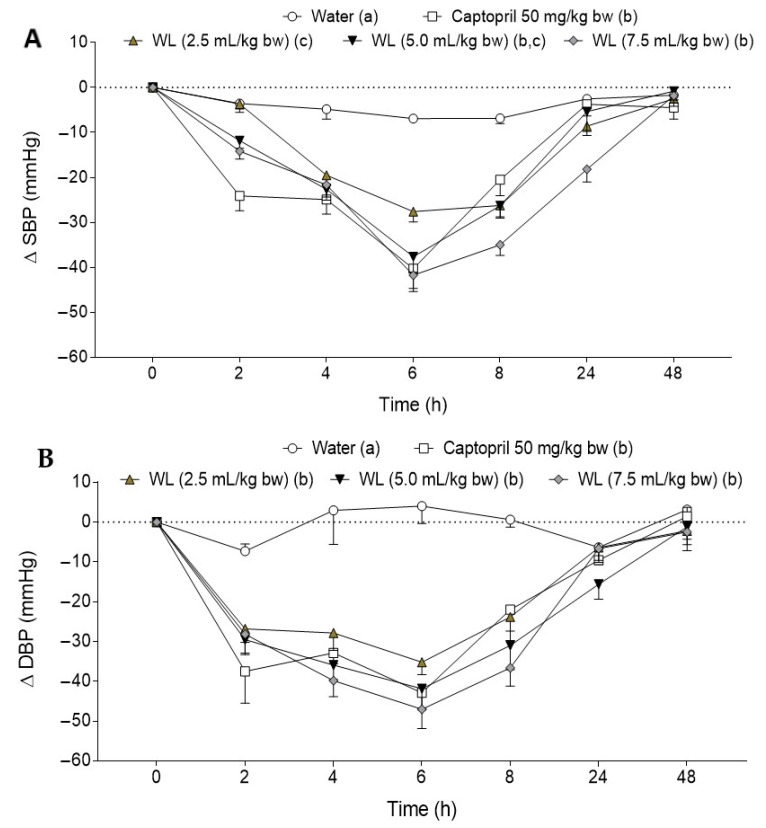
(A) Changes in systolic blood pressure (SBP) and (B) diastolic blood pressure (DBP) caused in spontaneous hypertensive rats by the administration of water, Captopril (50 mg/kg bw) or different doses of wine lees: 2.5 mL/kg bw. 5.0 mL/kg bw and 7.5 mL/kg bw. Data are expressed as mean (n = 6) ± SEM. Significant differences (p < 0.05) are represented by different letters in the legend and p was estimated by two-way ANOVA. Tukey test was used as post hoc.
Figure 3
Figure 3
(A) Changes in systolic blood pressure (SBP) and (B) diastolic blood pressure (DBP) caused in spontaneously hypertensive rats by the acute administration of water, Captopril (50 mg/kg bw) or dried wine lees powder (WLPW) (125 mg/kg bw). Data are expressed as mean (n = 6) ± SEM. Significant differences (p < 0.05) are represented by different letters and p was estimated by two-way ANOVA. Tukey test was used as post hoc.
Figure 4
Figure 4
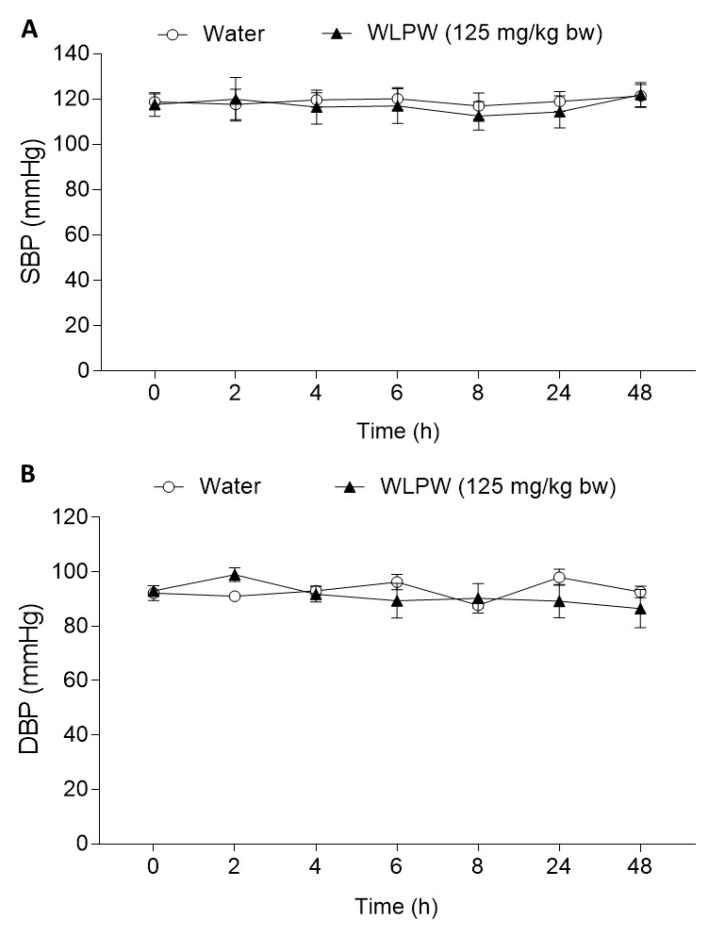
(A) Systolic blood pressure (SBP) and (B) diastolic blood pressure (DBP) of the Wistar–Kyoto rats before and after a single administration of water or dried wine lees powder (WLPW) (125 mg/kg bw). Data are expressed as mean (n = 6) ± SEM. No significant differences (p < 0.05) were found between both groups (two-way ANOVA).
Figure 5
Figure 5
Plasma angiotensin-converting enzyme (ACE) activity in spontaneously hypertensive rats 6 h after administration of 125 mg/kg bw dried wine lees powder (WLPW) or water. Data are expressed as mean (n = 6) ± SEM. No significant differences (p < 0.05) were found between both groups (Student’s t-test).
Figure 6
Figure 6
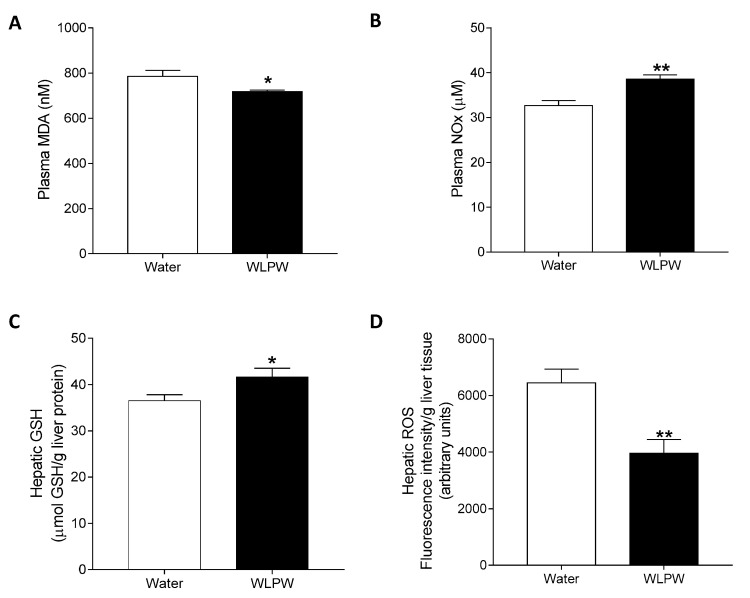
Levels of (A) plasma malondialdehyde (MDA) (B) plasma nitric oxide metabolites (NOx), (C) hepatic reduced glutathione (GSH) and (D) hepatic reactive oxygen species (ROS) in spontaneously hypertensive rats 6 h after administration of 125 mg/kg bw dried wine lees powder (WLPW) or water. Data are expressed as mean (n = 6) ± SEM. Significant differences are represented with (*) or (**) for p < 0.05 or p < 0.01, respectively. p was estimated by Student’s t-test.

References

    1. WHO Hypertension. [(accessed on 29 January 2021)]; Available online: https://www.who.int/news-room/fact-sheets/detail/hypertension.
    1. Nishiyama A., Kobori H. Independent Regulation of Renin–Angiotensin–Aldosterone System in the Kidney. Clin. Exp. Nephrol. 2018;22:1231–1239. doi: 10.1007/s10157-018-1567-1. - DOI - PMC - PubMed
    1. Te Riet L., van Esch J.H.M., Roks A.J.M., Van Den Meiracker A.H., Danser A.H.J. Hypertension: Renin-Angiotensin-Aldosterone System Alterations. Circ. Res. 2015;116:960–975. doi: 10.1161/CIRCRESAHA.116.303587. - DOI - PubMed
    1. Brown N.J., Vaughan D.E. Angiotensin-Converting Enzyme Inhibitors. Circulation. 1998;97:1411–1420. doi: 10.1161/01.CIR.97.14.1411. - DOI - PubMed
    1. Shi L., Mao C., Xu Z., Zhang L. Angiotensin-Converting Enzymes and Drug Discovery in Cardiovascular Diseases. Drug Discov. Today. 2010;15:332–341. doi: 10.1016/j.drudis.2010.02.003. - DOI - PMC - PubMed

Substances

LinkOut - more resources