


Novel Inorganic Nanomaterial-Based Therapy for Bone Tissue Regeneration
- PMID: 33808788
- PMCID: PMC8003392
- DOI: 10.3390/nano11030789
Novel Inorganic Nanomaterial-Based Therapy for Bone Tissue Regeneration
Abstract
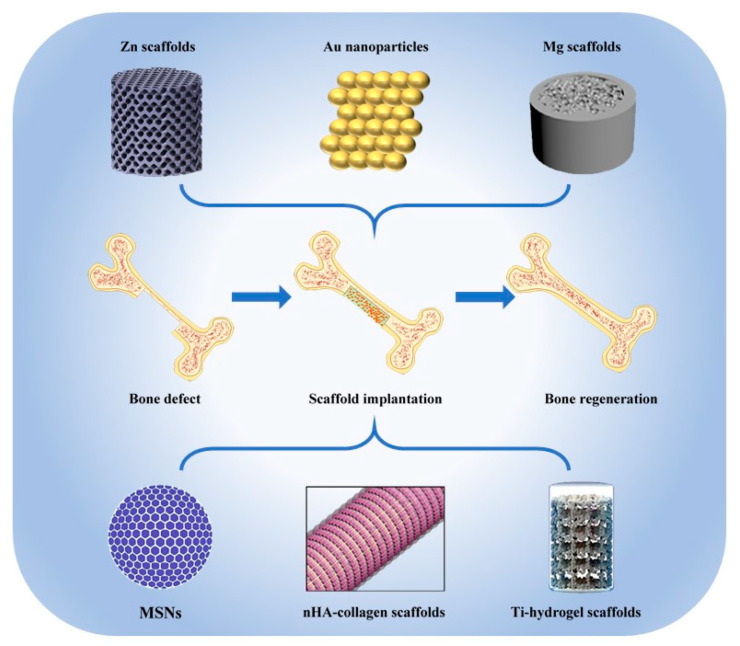
Extensive bone defect repair remains a clinical challenge, since ideal implantable scaffolds require the integration of excellent biocompatibility, sufficient mechanical strength and high biological activity to support bone regeneration. The inorganic nanomaterial-based therapy is of great significance due to their excellent mechanical properties, adjustable biological interface and diversified functions. Calcium-phosphorus compounds, silica and metal-based materials are the most common categories of inorganic nanomaterials for bone defect repairing. Nano hydroxyapatites, similar to natural bone apatite minerals in terms of physiochemical and biological activities, are the most widely studied in the field of biomineralization. Nano silica could realize the bone-like hierarchical structure through biosilica mineralization process, and biomimetic silicifications could stimulate osteoblast activity for bone formation and also inhibit osteoclast differentiation. Novel metallic nanomaterials, including Ti, Mg, Zn and alloys, possess remarkable strength and stress absorption capacity, which could overcome the drawbacks of low mechanical properties of polymer-based materials and the brittleness of bioceramics. Moreover, the biodegradability, antibacterial activity and stem cell inducibility of metal nanomaterials can promote bone regeneration. In this review, the advantages of the novel inorganic nanomaterial-based therapy are summarized, laying the foundation for the development of novel bone regeneration strategies in future.
Keywords: bone regeneration; inorganic nanomaterials; metallic nanomaterials; nano hydroxyapatites; nano silica.
Conflict of interest statement
The authors declare no conflict of interest.
Figures


References
-
- Griffin K.S., Davis K.M., McKinley T.O., Anglen J.O., Chu T.-M.G., Boerckel J.D., Kacena M.A. Evolution of Bone Grafting: Bone Grafts and Tissue Engineering Strategies for Vascularized Bone Regeneration. Clin. Rev. Bone Miner. Metab. 2015;13:232–244. doi: 10.1007/s12018-015-9194-9. - DOI
-
- Burk T., Del Valle J., Finn R.A., Phillips C. Maximum Quantity of Bone Available for Harvest From the Anterior Iliac Crest, Posterior Iliac Crest, and Proximal Tibia Using a Standardized Surgical Approach: A Cadaveric Study. J. Oral Maxillofac. Surg. 2016;74:2532–2548. doi: 10.1016/j.joms.2016.06.191. - DOI - PubMed
Publication types
Grants and funding
LinkOut - more resources
Full Text Sources
Other Literature Sources
