. 2021 Mar 19;10(3):683.
doi: 10.3390/cells10030683.

Metabolomic Variation Aligns with Two Geographically Distinct Subpopulations of Brachypodium Distachyon before and after Drought Stress

Affiliations

Metabolomic Variation Aligns with Two Geographically Distinct Subpopulations of Brachypodium Distachyon before and after Drought Stress

Aleksandra Skalska et al. Cells. .

Abstract

Brachypodium distachyon (Brachypodium) is a non-domesticated model grass that has been used to assess population level genomic variation. We have previously established a collection of 55 Brachypodium accessions that were sampled to reflect five different climatic regions of Turkey; designated 1a, 1c, 2, 3 and 4. Genomic and methylomic variation differentiated the collection into two subpopulations designated as coastal and central (respectively from regions 1a, 1c and the other from 2, 3 and 4) which were linked to environmental variables such as relative precipitation. Here, we assessed how far genomic variation would be reflected in the metabolomes and if this could be linked to an adaptive trait. Metabolites were extracted from eight-week-old seedlings from each accession and assessed using flow infusion high-resolution mass spectrometry (FIE-HRMS). Principal Component Analysis (PCA) of the derived metabolomes differentiated between samples from coastal and central subpopulations. The major sources of variation between seedling from the coastal and central subpopulations were identified. The central subpopulation was typified by significant increases in alanine, aspartate and glutamate metabolism and the tricarboxylic acid (TCA) cycle. Coastal subpopulation exhibited elevated levels of the auxin, indolacetic acid and rhamnose. The metabolomes of the seedling were also determined following the imposition of drought stress for seven days. The central subpopulation exhibited a metabolomic shift in response to drought, but no significant changes were seen in the coastal one. The drought responses in the central subpopulation were typified by changes in amino acids, increasing the glutamine that could be functioning as a stress signal. There were also changes in sugars that were likely to be an osmotic counter to drought, and changes in bioenergetic metabolism. These data indicate that genomic variation in our Turkish Brachypodium collection is largely reflected as distinctive metabolomes ("metabolotypes") through which drought tolerance might be mediated.

Keywords: Brachypodium distachyon; amino acids; auxin; drought; metabolome; metabolotypes; osmolytes.


Conflict of interest statement

Aleksandra Skalska is an employee of MDPI, however she is not working for the journal Cells at the time of submission and publication.

Figures

Figure 1
Figure 1
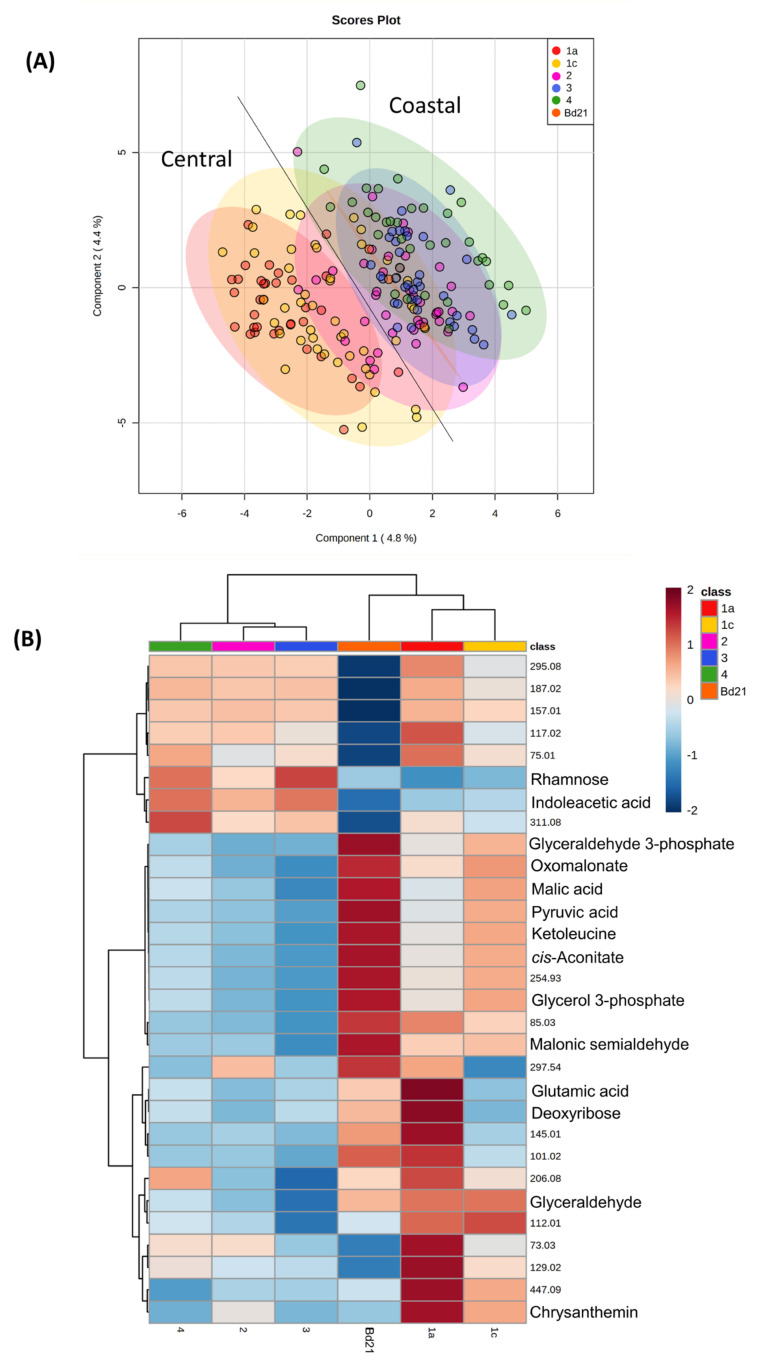
Metabolomic variation in Brachypodium accessions from different climatic regions of Turkey. Metabolite profiles from the leaves of eight-week-old Brachypodium seedlings were derived by Flow Infusion Electrospray-High Resolution Mass Spectroscopy (FIE-HRMS). Accessions are classified according of Turkish climate region of origin; 1a (red), 1c (yellow), 2 (purple), 3 (blue) and 4 (green) [6]. Profiles from the reference accession Bd21 are represented by dark orange points or block as relevant. Profiles were initially assessed using (A) Partial Least Square—Discriminant Analysis (PLS-DA). The major sources of variation were identified using one-way ANOVA correcting for false discovery rates (FDR). (B) Key variables are displayed as a heatmap. Some mass-ions (m/z) were identified from comparison with databases and are labelled with names. Where m/z could not be identified these are given as the raw data values.
Figure 2
Figure 2
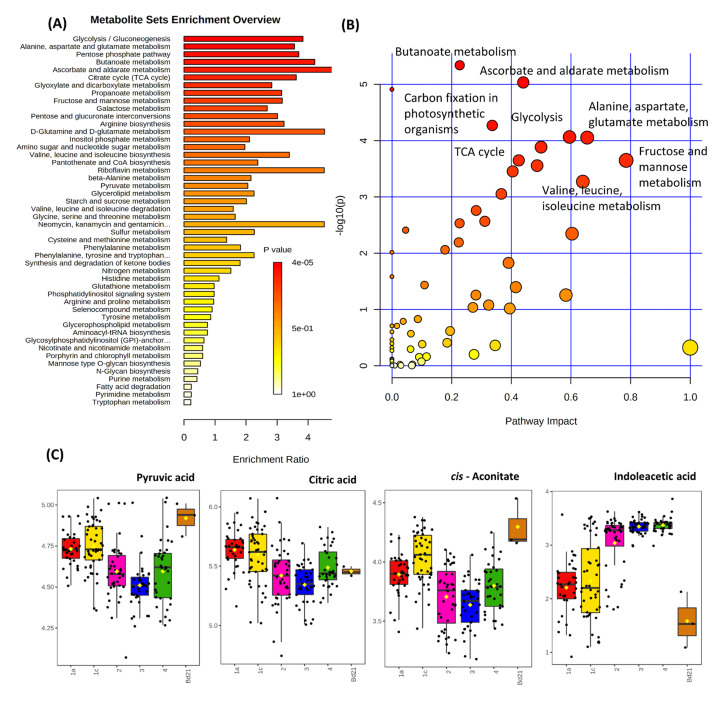
Biochemical pathway and metabolite analyses showing discrimination between Brachypodium metabolomes from different climatic regions of Turkey. FIE-HRMS derived metabolites which exhibited significant (one-way ANOVA correcting for false discovery rates, FDR) differences between accessions from different Turkish regions [6] were assessed using (A) metabolite set enrichment analysis (MSEA) or (B) the mummichog algorithm where significantly enriched pathways are also ranged for biological impact. (C) Exemplar metabolites exhibiting significant differences between accessions from different regions are shown using box and whisker plots. Regions 1a (red), 1c (yellow), 2 (purple), 3 (blue) and 4 (green) are indicated with Bd21 (dark orange) as the reference accession.
Figure 3
Figure 3
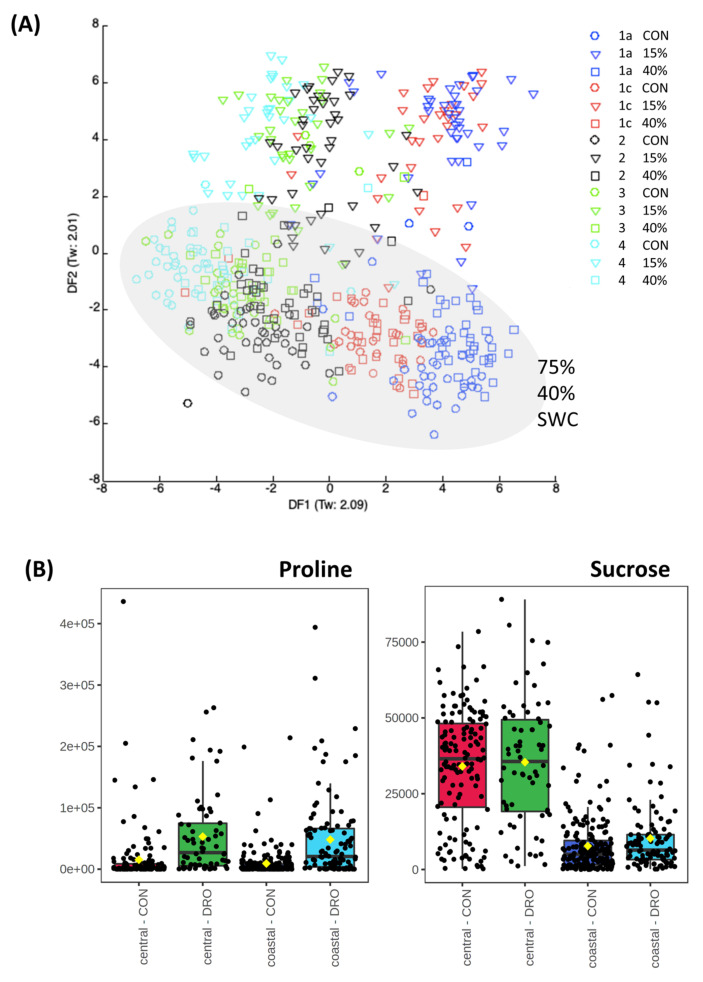
The metabolomes of Brachypodium accessions under drought stress and in controls. Eight-week-old Brachypodium accessions were transferred to the National Plant Phenomics Centre, Aberystwyth, UK. The watering was regulated to achieve three different soil water contents (SWC); 15%, 40% and 75% (control, CON). After 12 days of drought, leaves were sampled and the metabolomes were assessed using FIE-HRMS. (A) Discriminant Function Analysis of the derived metabolite profiles. Accessions are classified according of Turkish climate region of origin [6]: 1a (blue symbols), 1c (red symbols), 2 (black symbols), 3 (green symbols) and 4 (turquoise symbols). The 75% and 50% symbols are highlighted with a grey ellipsis to highlight their similarity but has no mathematical relevance. (B) Metabolomes from control (40%, 75% SWC) and droughted (15% SWC Brachypodium accessions forming the central (region 1a, 1c) and coastal (region 2, 3, 4) subpopulations were assessed for variation. Functionally important metabolites in drought responses; proline and sucrose are shown.
Figure 4
Figure 4
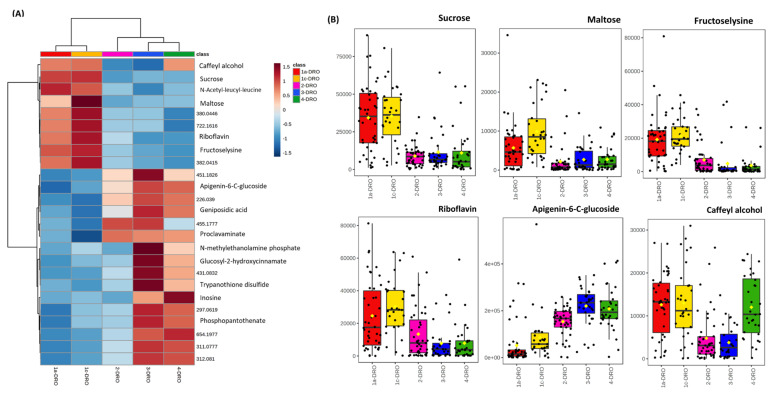
Key variables in the metabolomes of droughted Brachypodium accessions collected from different Turkish regions. Eight-week-old Brachypodium accessions were transferred to the National Plant Phenomics Centre, Aberystwyth, UK. The watering was regulated to achieve three different soil water contents (SWC): 15%, (droughted, DRO) 40% and 75% (control, CON). After 12 days of drought, leaves were sampled and the metabolomes were assessed using FIE-HRMS. The key variables discriminating between the droughted samples were identified by one way ANOVA (corrected for false discovery rates, FDR). (A) The relative levels of the m/z are displayed using a heatmap. Some mass-ions (m/z) were identified from comparison with databases and are labelled with names. Where m/z could not be identified these are given as the raw data values. (B) Box and whisker plot of exemplar metabolites which are increased in the central subpopulation (Turkish climatic region 1a, 1c) [6].
Figure 5
Figure 5
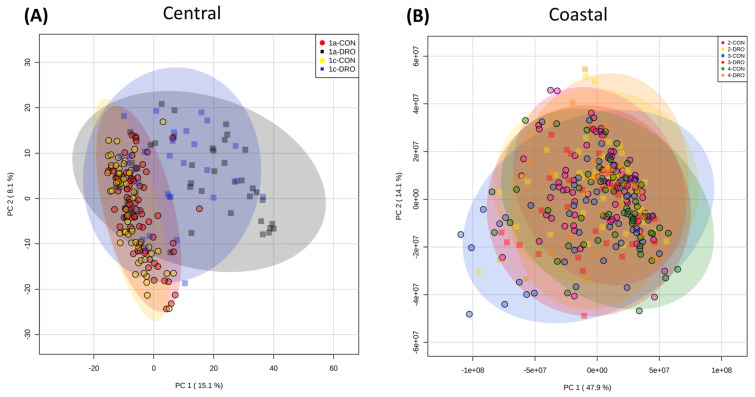
The metabolomes of Brachypodium central and coastal accessions under drought stress and in controls. Eight- week-old Brachypodium accessions were transferred to the National Plant Phenomics Centre, Aberystwyth, UK. The watering was regulated to soil water contents (SWC) of 15% (droughted, DRO), 40% and 75% (controls, CON). After 12 days of drought, leaves were sampled and the metabolomes were assessed using FIE-HRMS. Principal component analysis of Brachypodium accessions within the (A) central (Turkish climatic regions 1a, 1c) and (B) coastal (Turkish climatic regions 2, 3, 4) subpopulations [6].
Figure 6
Figure 6
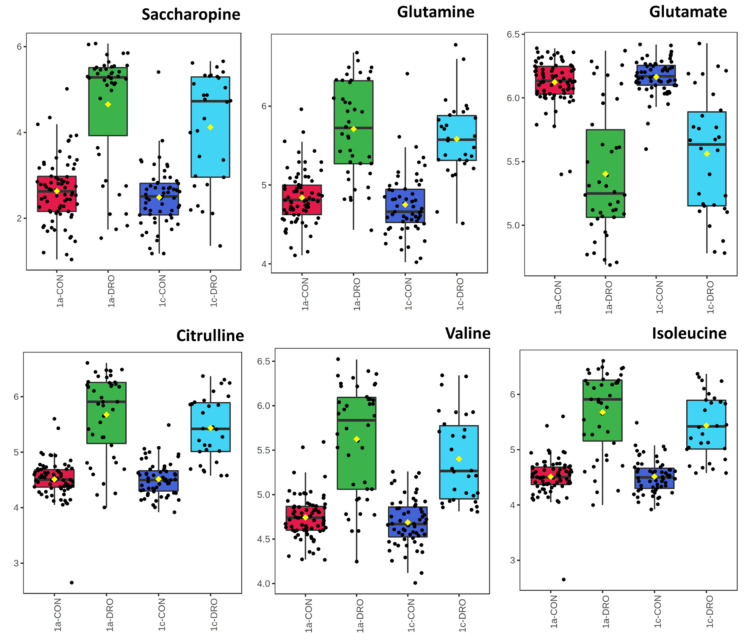
Amino acid changes seen in the central subpopulations in response to drought. Eight-week-old Brachypodium accessions were transferred to the National Plant Phenomics Centre, Aberystwyth, UK. The watering was regulated to soil water contents (SWC) of 15% (droughted, DRO), 40% and 75% (controls, CON). After 12 days of drought, leaves were sampled and the metabolomes were assessed using FIE-HRMS. Key variables changing in Brachypodium accessions within the central subpopulation (Turkish climatic regions 1a, 1c) [6] with drought and related to amino acid are displayed using box and whisker plots.
Figure 7
Figure 7
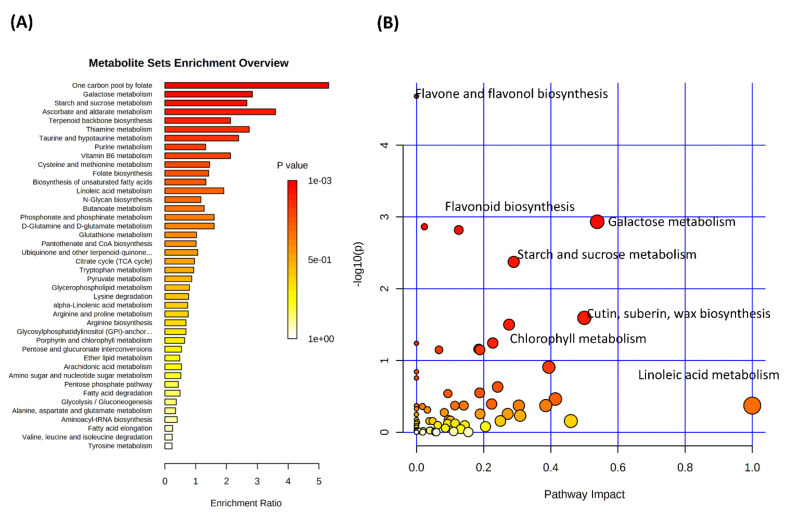
Enrichment analysis of the key metabolites responding to drought on the Brachypodium central subpopulation. Eight-week-old Brachypodium accessions were transferred to the National Plant Phenomics Centre, Aberystwyth, UK. The watering was regulated to soil water contents (SWC) of 15% (droughted, DRO), 40% and 75% (controls, CON). After 12 days of drought, leaves were sampled and the metabolomes were assessed using FIE-HRMS. Key variables changing in Brachypodium accessions within the central subpopulation (Turkish climatic regions 1a, 1c) [6] with drought and related to amino acid were identified and assessed using (A) metabolite set enrichment analysis (MSEA) or (B) the mummichog algorithm where significantly enriched pathways are also ranged for biological impact.

References

    1. Draper J., Mur L.A., Jenkins G., Ghosh-Biswas G.C., Bablak P., Hasterok R., Routledge A.P. Brachypodium distachyon. A new model system for functional genomics in grasses. Plant Physiol. 2001;127:1539–1555. doi: 10.1104/pp.010196. - DOI - PMC - PubMed
    1. Mur L.A., Allainguillaume J., Catalan P., Hasterok R., Jenkins G., Lesniewska K., Thomas I., Vogel J. Exploiting the brachypodium tool box in cereal and grass research. New Phytol. 2011;191:334–347. doi: 10.1111/j.1469-8137.2011.03748.x. - DOI - PubMed
    1. Brkljacic J., Grotewold E., Scholl R., Mockler T., Garvin D.F., Vain P., Brutnell T., Sibout R., Bevan M., Budak H., et al. Brachypodium as a model for the grasses: Today and the future. Plant Physiol. 2011;157:3–13. doi: 10.1104/pp.111.179531. - DOI - PMC - PubMed
    1. Gordon S.P., Contreras-Moreira B., Woods D.P., Des Marais D.L., Burgess D., Shu S., Stritt C., Roulin A.C., Schackwitz W., Tyler L., et al. Extensive gene content variation in the Brachypodium distachyon pan-genome correlates with population structure. Nat. Commun. 2017;8:2184. doi: 10.1038/s41467-017-02292-8. - DOI - PMC - PubMed
    1. Wilson P.B., Streich J.C., Murray K.D., Eichten S.R., Cheng R., Aitken N.C., Spokas K., Warthmann N., Gordon S.P., Accession C., et al. Global diversity of the Brachypodium species complex as a resource for genome-wide association studies demonstrated for agronomic traits in response to climate. Genetics. 2019;211:317–331. doi: 10.1534/genetics.118.301589. - DOI - PMC - PubMed

Publication types

MeSH terms

LinkOut - more resources