. 2021 Mar 12;18(6):2900.
doi: 10.3390/ijerph18062900.

Analysis of Heart-Rate Variability during Angioedema Attacks in Patients with Hereditary C1-Inhibitor Deficiency

Affiliations

Analysis of Heart-Rate Variability during Angioedema Attacks in Patients with Hereditary C1-Inhibitor Deficiency

Francesca Perego et al. Int J Environ Res Public Health. .

Abstract

C1-inhibitor hereditary angioedema (C1-INH-HAE) is a rare disease characterized by self-limiting edema associated with localized vasodilation due to increased levels of circulating bradykinin. C1-INH-HAE directly influences patients' everyday lives, as attacks are unpredictable in frequency, severity, and the involved anatomical site. The autonomic nervous system could be involved in remission. The cardiac autonomic profile has not yet been evaluated during the attack or prodromal phases. In this study, a multiday continuous electrocardiogram was obtained in four C1-INH-HAE patients until attack occurrence. Power spectral heart rate variability (HRV) indices were computed over the 4 h preceding the attack and during the first 4 h of the attack in three patients. Increased vagal modulation of the sinus node was detected in the prodromal phase. This finding may reflect localized vasodilation mediated by the release of bradykinin. HRV analysis may furnish early markers of an impending angioedema attack, thereby helping to identify patients at higher risk of attack recurrence. In this perspective, it could assist in the timing, titration, and optimization of prophylactic therapy, and thus improve patients' quality of life.

Keywords: C1-inhibitor hereditary angioedema; autonomic nervous system; burden of disease; cardiac neural control; heart rate variability; multiday ECG monitoring; quality of life; spectral analysis.


Conflict of interest statement

The authors declare no conflict of interest.

Figures
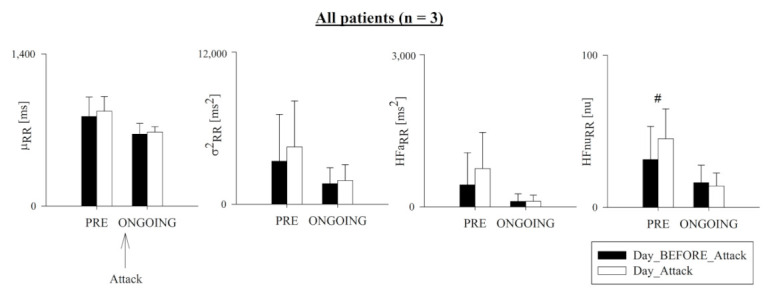
Figure 1
Figure 1
Pooled time- and frequency-domain heart-rate variability (HRV) markers in all patients (n = 3). Bar graphs show RR mean (μRR), RR variance (σ2RR), and the absolute (HFaRR) and normalized (HFnuRR) power in the high-frequency (HF) band. Data in the 4 h preceding (PRE) and the first 4 h following the onset of the hereditary angioedema (HAE) attack (ONGOING) were pooled together on the day of the attack (Day_Attack, white bars) and compared with data during the same phase of the circadian rhythm on the day before (Day_BEFORE_Attack, black bars). Data are relevant to all patients and presented as mean ± standard deviation. Symbol # indicates p < 0.05 Day_Attack vs. Day_BEFORE_Attack.
Figure 2
Figure 2
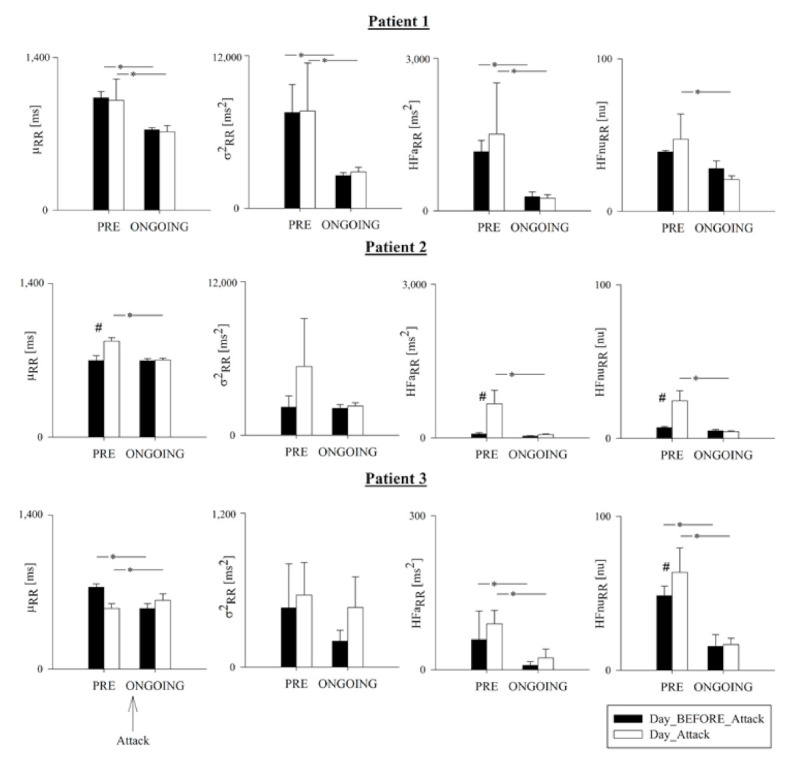
Pooled time- and frequency-domain HRV markers in Patients 1, 2 and 3. Bar graphs show RR mean (μRR), RR variance (σ2RR), and absolute (HFaRR) and normalized (HFnuRR) power in the HF band. Hour-by-hour data in the 4 h preceding (PRE) and in the first 4 h following the onset of the HAE attack (ONGOING) were pooled together on the day of the attack (Day_Attack, white bars) and compared with data during the same phase of the circadian rhythm on the day before (Day_BEFORE_Attack, black bars). Data pertain to Patient 1 (upper panels), Patient 2 (middle panels), and Patient 3 (lower panels), and are presented as mean ± standard deviation. Symbol # indicates p < 0.05 Day_Attack vs. Day_BEFORE_Attack and the symbol * indicates p < 0.05 PRE vs. ONGOING.
Figure 3
Figure 3
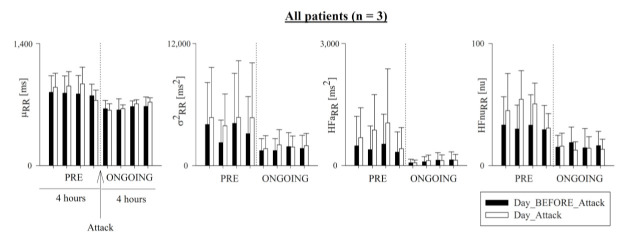
Temporal evolution of time- and frequency-domain HRV markers in all patients. Bar graphs show RR mean (μRR), RR variance (σ2RR), and absolute (HFaRR) and normalized (HFnuRR) power in the HF band in all patients. Indices were calculated hour-by-hour in the 4 h preceding (PRE) and the first 4 h following the onset of the HAE attack (ONGOING) on the day of the attack (Day_Attack, white bars), and compared to data during the same circadian phase on the day before (Day_BEFORE_Attack, black bars). Results shown as mean ± standard deviation.
Figure 4
Figure 4
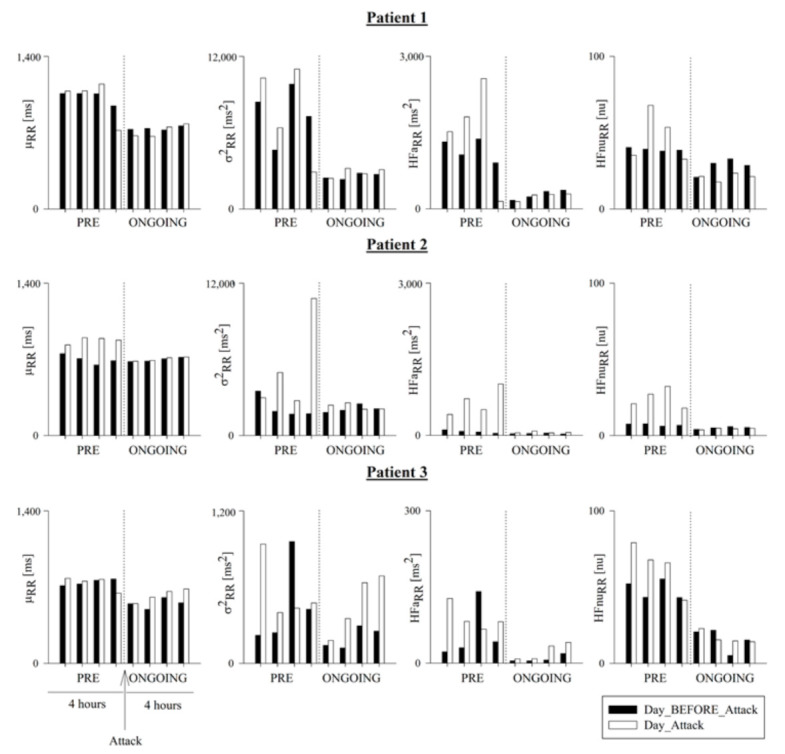
Temporal evolution of time and frequency domain HRV markers in Patients 1, 2 and 3. Bar graphs show the RR mean (μRR), RR variance (σ2RR), and the absolute (HFaRR) and normalized (HFnuRR) power in the HF band in Patient 1 (upper panels), Patient 2 (middle panels), and Patient 3 (lower panels). Indices were calculated hour-by-hour in the 4 h preceding (PRE) and the first 4 h following the onset of the HAE attack (ONGOING) on the day of the attack (Day_Attack, white bars) and compared to data during the same circadian phase on the day before (Day_BEFORE_Attack, black bars). Results are shown as mean ± standard deviation.

References

    1. Zanichelli A., Arcoleo F., Barca M.P., Borrelli P., Bova M., Cancian M., Cicardi M., Cillari E., De Carolis C., De Pasquale T., et al. A Nationwide Survey of Hereditary Angioedema due to C1 Inhibitor Deficiency in Italy. Orphanet J. Rare Dis. 2015;10:11. doi: 10.1186/s13023-015-0233-x. - DOI - PMC - PubMed
    1. Cicardi M., Aberer W., Banerji A., Bas M., Bernstein J.A., Bork K., Caballero T., Farkas H., Grumach A., Kaplan A.P., et al. Classification, Diagnosis, and Approach to Treatment for Angioedema: Consensus Report from the Hereditary Angioedema International Working Group. Allergy. 2014;69:602–616. doi: 10.1111/all.12380. - DOI - PubMed
    1. Longhurst H., Cicardi M. Hereditary Angio-Oedema. Lancet. 2012;379:474–481. doi: 10.1016/S0140-6736(11)60935-5. - DOI - PubMed
    1. Nussberger J., Cugno M., Cicardi M., Agostoni A. Local Bradykinin Generation in Hereditary Angioedema. J. Allergy Clin. Immunol. 1999;104:1321–1322. doi: 10.1016/S0091-6749(99)70030-8. - DOI - PubMed
    1. Buske-Kirschbaum A., Geiben A., Hollig H., Morschhauser E., Hellhammer D. Altered Responsiveness of the Hypothalamus-Pituitary-Adrenal Axis and the Sympathetic Adrenomedullary System to Stress in Patients with Atopic Dermatitis. J. Clin. Endocrinol. Metab. 2002;87:4245–4251. doi: 10.1210/jc.2001-010872. - DOI - PubMed