Review
. 2021 Mar 12;22(6):2890.
doi: 10.3390/ijms22062890.

Cachexia as Evidence of the Mechanisms of Resistance and Tolerance during the Evolution of Cancer Disease

Affiliations
Review

Cachexia as Evidence of the Mechanisms of Resistance and Tolerance during the Evolution of Cancer Disease

Antonio Maccio et al. Int J Mol Sci. .

Abstract

During its evolution, cancer induces changes in patients' energy metabolism that strongly affect the overall clinical state and are responsible for cancer-related cachexia syndrome. To better understand the mechanisms underlying cachexia and its metabolic derangements, research efforts should focus on the events that are driven by the immune system activation during the evolution of neoplastic disease and on the phenomena of "resistance" and "tolerance" typically involved in the human body response against stress, pathogens, or cancer. Indeed, in the case where resistance is not able to eliminate the cancer, tolerance mechanisms can utilize the symptoms of cachexia (anemia, anorexia, and fatigue) to counteract unregulated cancer growth. These notions are also sustained by the evidence that cancer cachexia may be reversible if the resistance and tolerance phases are supported by appropriate antineoplastic treatments. Accordingly, there is no doubt that anticachectic therapies have an irreplaceable role in cases of reversible cancer cachexia where, if harmoniously associated with effective antineoplastic therapies, they can contribute to preserve the quality of life and improve prognosis. Such anticachectic treatments should be based on targeting the complex immunological, inflammatory, and metabolic pathways involved in the complex pathogenesis of cachexia. Meanwhile, the role of the anticachectic therapies is very different in the stage of irreversible cachexia when the available antineoplastic treatments are not able to control the disease and the resistance mechanisms fail with the prevalence of the tolerance phenomena. At this stage, they can be useful only to improve the quality of life, allowing the patient and their family to get a better awareness of the final phases of life, thereby opening to the best spiritual remodulation of the final event, death.

Keywords: cancer cachexia; inflammation; interleukin-6; muscle wasting; resistance; tolerance.


Conflict of interest statement

The authors declare no conflict of interest.

Figures
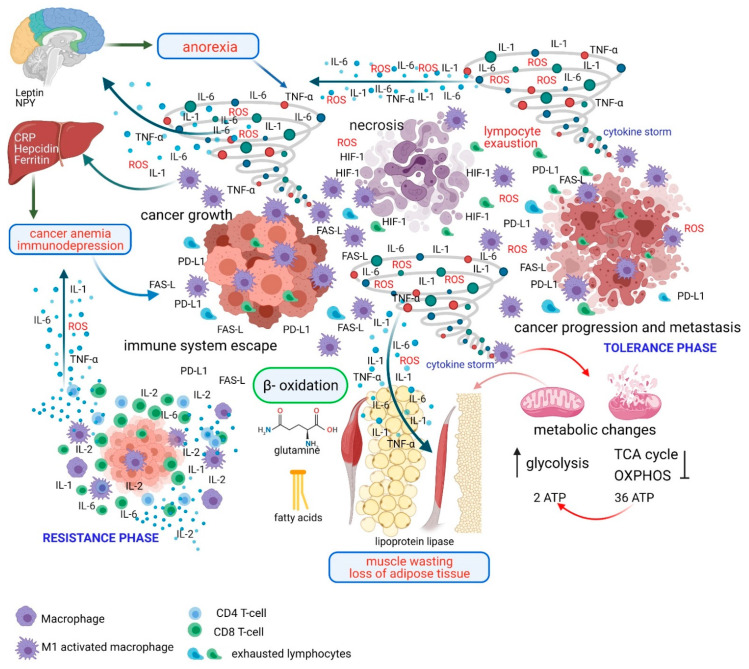
Figure 1
Figure 1
Mechanism of resistance and tolerance and pathogenesis of cachexia during the evolution of cancer. In the resistance phase the immune system recognize the antigenic diversity of the tumor and tries to eliminate it. Macrophages, dendritic cells and T and B cells are the main participants. In this phase the presence of cancer cells and the activation of the immune system with the release of proinflammatory cytokines (IL-6, IL-1, TNF-α), HIF-1, and ROS determine specific changes in energy metabolism (increased glycolysis and impaired TCA cycle and OXPHOS) that promote uncontrolled tumor growth. The tumor growth overcoming the resistance phase underlines the lack of efficacy of the specific immune response (lymphocyte exhaustion) followed by the mac-rophage-mediated inflammatory response (cytokine storm) whose persistence leads to the phenomena of tolerance and related symptoms (anorexia, anemia, muscle wasting, loss of adipose tissue). Cachexia as an expression of tolerance aims to minimize the damages induced both by the cancer-growth and by immunopathology. Abbreviations: NPY, Neuropeptide Y; CRP, C-reactive Protein; IL, Interleukin; TNF, Tumor Necrosis Factor; PD-L1, Programmed death-ligand 1; ROS, reactive oxygen species; HIF, hypoxia-inducible factor; FAS-L, Fas ligand; TCA, tricarboxylic acid; OXPHOS, Oxidative phosphorylation; ATP, Adenosine Triphosphate. Figure created with BioRender.com (accessed on 12 March 2021).
Figure 2
Figure 2
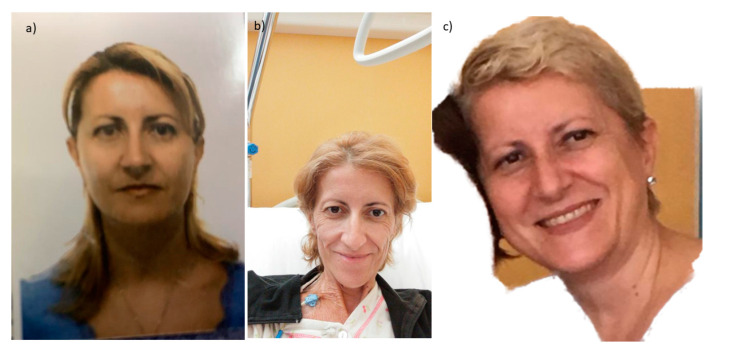
Reversibility of cancer cachexia. The images report the case of a female patient with advanced ovarian cancer, which exemplify the change of clinical objective status of a patient before cancer diagnosis (a), at cancer diagnosis with features of cancer cachexia (b), and after surgical and medical treatment that obtained a complete response with clinical resolution of cancer cachexia (c). The patient gave signed informed consent for the publication of the images.

References

    1. Macciò A., Madeddu C. The role of interleukin-6 in the evolution of ovarian cancer: Clinical and prognostic implications–A review. J. Mol. Med. 2013;91:1355–1368. doi: 10.1007/s00109-013-1080-7. - DOI - PubMed
    1. Baracos V., Martin L., Korc M., Guttridge D.C., Fearon K.C.H. Cancer-associated cachexia. Nat. Rev. Dis. Primers. 2018;4:17105. doi: 10.1038/nrdp.2017.105. - DOI - PubMed
    1. Baracos V.E. Cancer-associated malnutrition. Eur. J. Clin. Nutr. 2018;72:1255–1259. doi: 10.1038/s41430-018-0245-4. - DOI - PubMed
    1. Fearon K., Strasser F., Anker S.D., Bosaeus I., Bruera E., Fainsinger R.L., Jatoi A., Loprinzi C., MacDonald N., Mantovani G., et al. Definition and classification of cancer cachexia: An international consensus. Lancet Oncol. 2011;12:489–495. doi: 10.1016/S1470-2045(10)70218-7. - DOI - PubMed
    1. Skipworth R.J., Stewart G.D., Dejong C.H., Preston T., Fearon K.C. Pathophysiology of cancer cachexia: Much more than host-tumour interaction? Clin. Nutr. 2007;26:667–676. doi: 10.1016/j.clnu.2007.03.011. - DOI - PubMed

LinkOut - more resources