


Space-Time Trends in Lassa Fever in Sierra Leone by ELISA Serostatus, 2012-2019
- PMID: 33809204
- PMCID: PMC8000031
- DOI: 10.3390/microorganisms9030586
Space-Time Trends in Lassa Fever in Sierra Leone by ELISA Serostatus, 2012-2019
Abstract
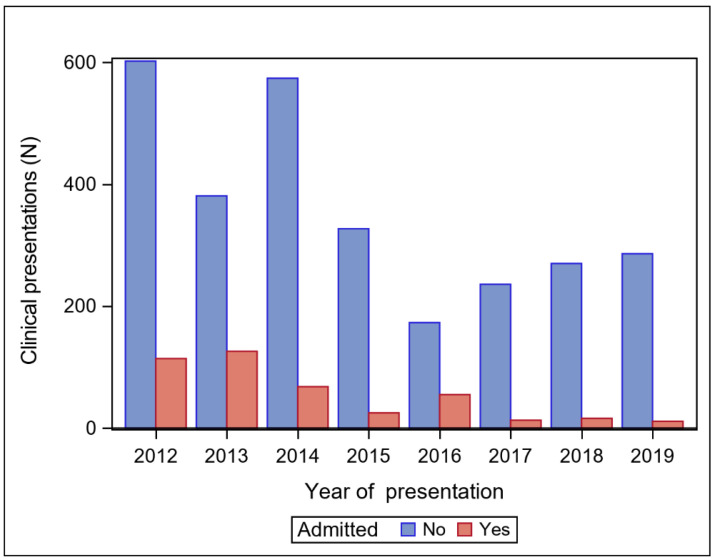
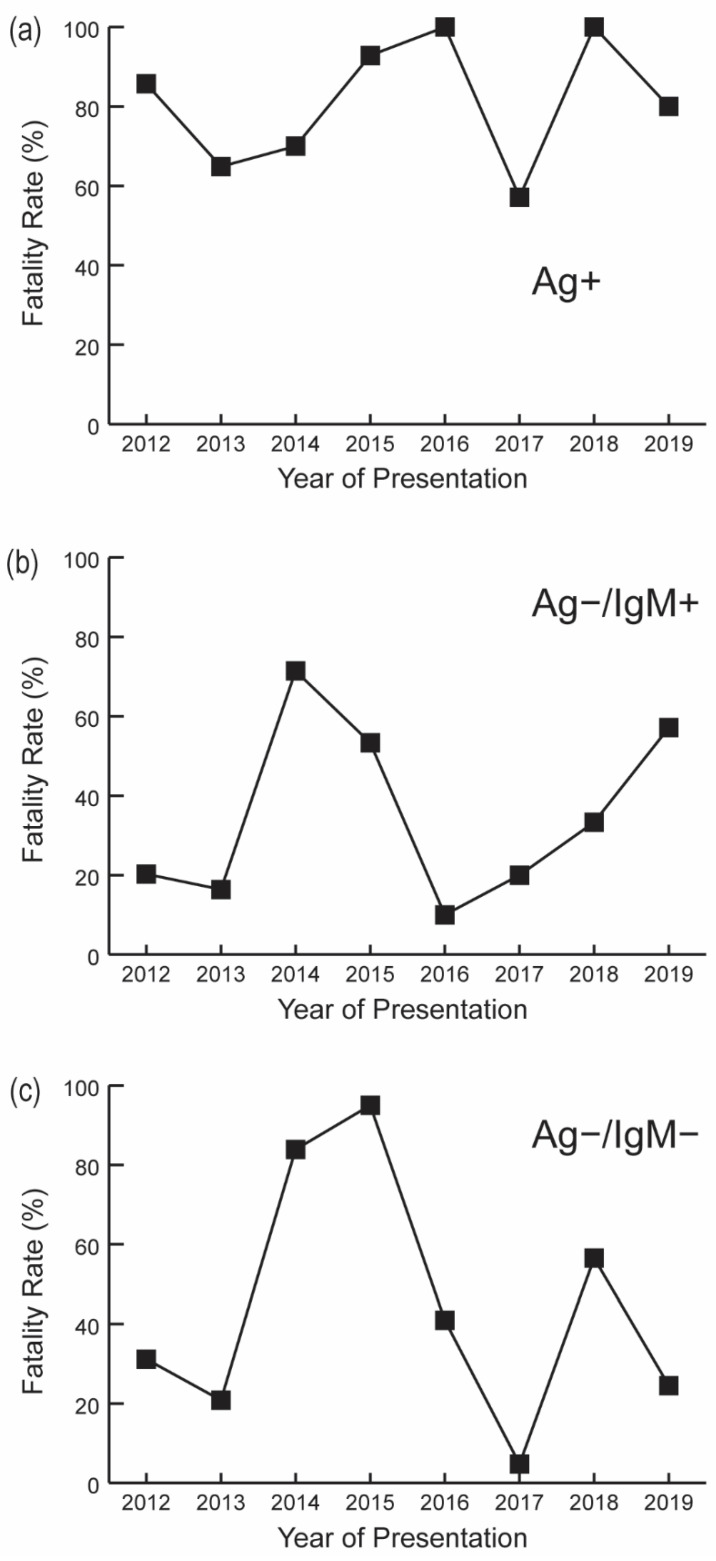
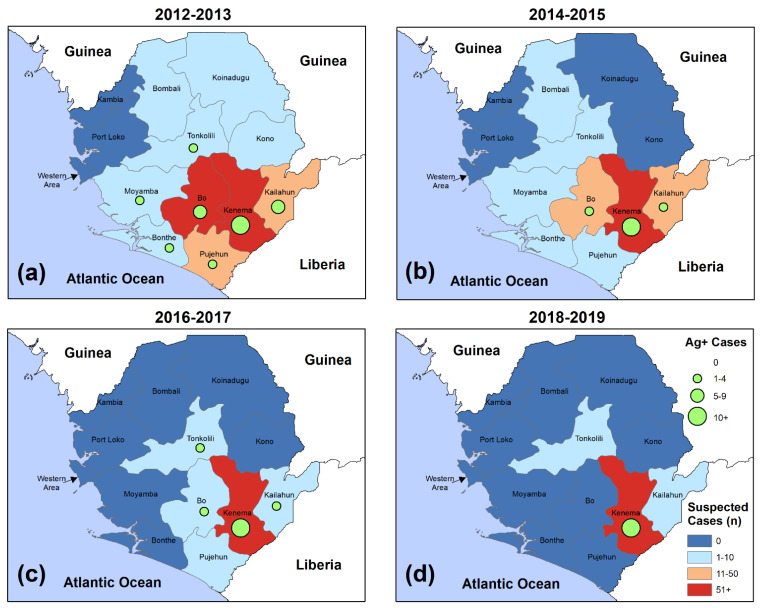
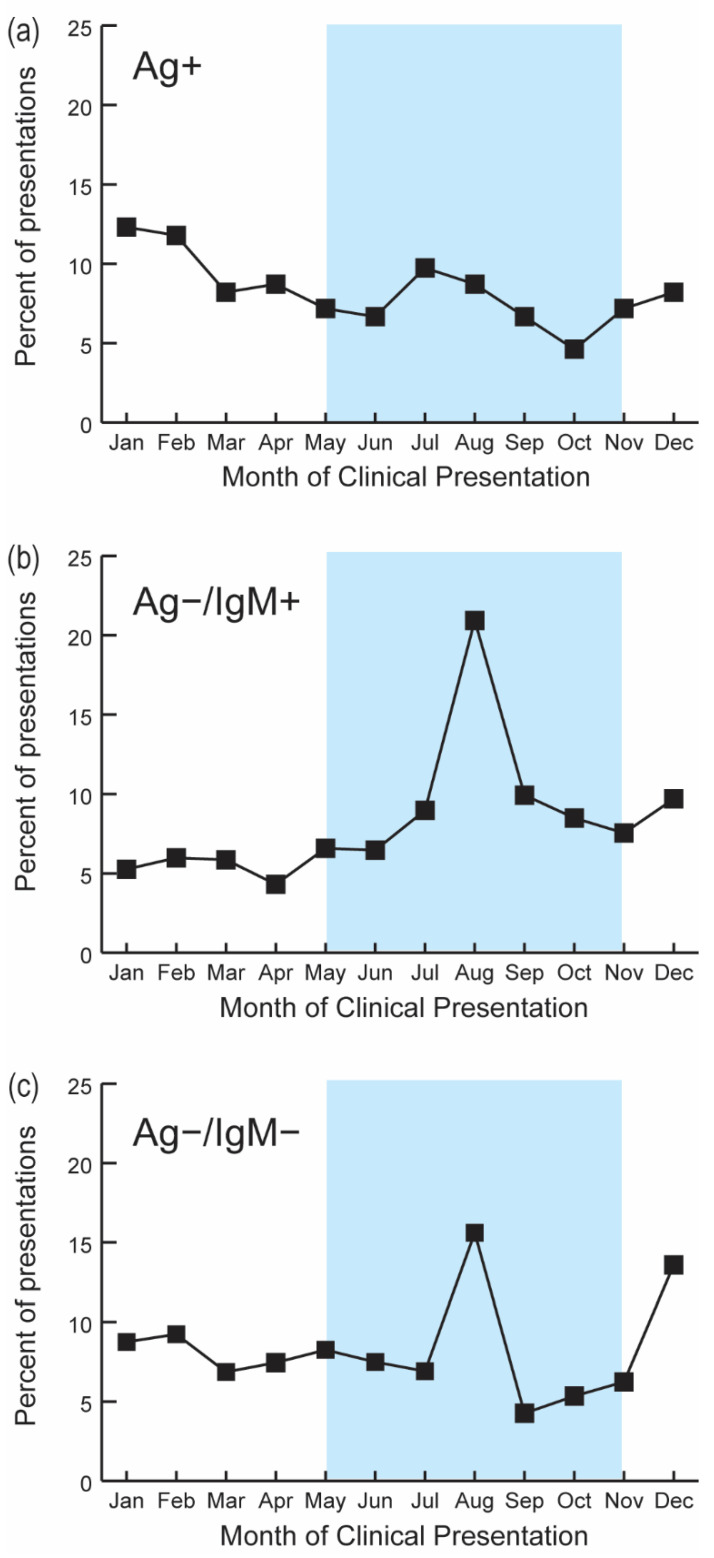
Lassa fever (LF) is a viral hemorrhagic disease found in Sub-Saharan Africa and is responsible for up to 300,000 cases and 5000 deaths annually. LF is highly endemic in Sierra Leone, particularly in its Eastern Province. Kenema Government Hospital (KGH) maintains one of only a few LF isolation facilities in the world with year-round diagnostic testing. Here we focus on space-time trends for LF occurring in Sierra Leone between 2012 and 2019 to provide a current account of LF in the wake of the 2014-2016 Ebola epidemic. Data were analyzed for 3277 suspected LF cases and classified as acute, recent, and non-LF or prior LF exposure using enzyme-linked immunosorbent assays (ELISAs). Presentation rates for acute, recent, and non-LF or prior LF exposure were 6.0% (195/3277), 25.6% (838/3277), and 68.4% (2244/3277), respectively. Among 2051 non-LF or prior LF exposures, 33.2% (682/2051) tested positive for convalescent LF exposure. The overall LF case-fatality rate (CFR) was 78.5% (106/135). Both clinical presentations and confirmed LF cases declined following the Ebola epidemic. These declines coincided with an increased duration between illness onset and clinical presentation, perhaps suggesting more severe disease or presentation at later stages of illness. Acute LF cases and their corresponding CFRs peaked during the dry season (November to April). Subjects with recent (but not acute) LF exposure were more likely to present during the rainy season (May to October) than the dry season (p < 0.001). The findings here suggest that LF remains endemic in Sierra Leone and that caseloads are likely to resume at levels observed prior to the Ebola epidemic. The results provide insight on the current epidemiological profile of LF in Sierra Leone to facilitate LF vaccine studies and accentuate the need for LF cohort studies and continued advancements in LF diagnostics.
Keywords: Ebola virus disease; Lassa fever; Lassa virus; Sierra Leone; case-fatality rate; enzyme-linked immunosorbent assay.
Conflict of interest statement
The Viral Hemorrhagic Fever Consortium (VHFC;
Figures
References
-
- World Health Organization Lassa Fever. [(accessed on 11 January 2021)];2021 Available online: https://www.who.int/health-topics/lassa-fever#tab=tab_1.
-
- World Health Organization Lassa Fever. [(accessed on 12 January 2021)]; Available online: https://www.who.int/news-room/fact-sheets/detail/lassa-fever.
-
- Ogbu O., Ajuluchukwu E., Uneke C.J. Lassa fever in West African sub-region: An overview. J. Vector Borne Dis. 2007;44:1–11. - PubMed
Grants and funding
- AI067188/NH/NIH HHS/United States
- AI104216/NH/NIH HHS/United States
- AI082119/NH/NIH HHS/United States
- AI104621/NH/NIH HHS/United States
- AI2008031/NH/NIH HHS/United States
- U01AI151812/NH/NIH HHS/United States
- U01 AI151812/AI/NIAID NIH HHS/United States
- HHSN272201000022C/NH/NIH HHS/United States
- HHSN272200900018C/NH/NIH HHS/United States
- HHSN272200900049C/NH/NIH HHS/United States
- AI2009061/NH/NIH HHS/United States
- P20GM103501/NH/NIH HHS/United States
- U19AI115589/NH/NIH HHS/United States
LinkOut - more resources
Full Text Sources
Other Literature Sources
Miscellaneous
