Review
. 2021 Mar 16;14(6):1435.
doi: 10.3390/ma14061435.

Strategies for Cancer Treatment Based on Photonic Nanomedicine

Affiliations
Review

Strategies for Cancer Treatment Based on Photonic Nanomedicine

Sueli Aparecida de Oliveira et al. Materials (Basel). .

Abstract

Traditional cancer treatments, such as surgery, radiotherapy, and chemotherapy, are still the most effective clinical practice options. However, these treatments may display moderate to severe side effects caused by their low temporal or spatial resolution. In this sense, photonic nanomedicine therapies have been arising as an alternative to traditional cancer treatments since they display more control of temporal and spatial resolution, thereby yielding fewer side effects. In this work, we reviewed the challenge of current cancer treatments, using the PubMed and Web of Science database, focusing on the advances of three prominent therapies approached by photonic nanomedicine: (i) photothermal therapy; (ii) photodynamic therapy; (iii) photoresponsive drug delivery systems. These photonic nanomedicines act on the cancer cells through different mechanisms, such as hyperthermic effect and delivery of chemotherapeutics and species that cause oxidative stress. Furthermore, we covered the recent advances in materials science applied in photonic nanomedicine, highlighting the main classes of materials used in each therapy, their applications in the context of cancer treatment, as well as their advantages, limitations, and future perspectives. Finally, although some photonic nanomedicines are undergoing clinical trials, their effectiveness in cancer treatment have already been highlighted by pre-clinical studies.

Keywords: cancer treatment; drug delivery systems; nanomedicine; photodynamic therapy; photonic; photothermal therapy.


Conflict of interest statement

The authors declare no conflict of interest.

Figures

Figure 1
Figure 1
Absorption coefficient in the function of the light wavelength of the main components of several significant tissues: epidermis, water, whole blood, melanin. The therapeutic window refers to the range between ~500 and 1500 nm, which exhibit a low absorption coefficient [26].
Figure 2
Figure 2
Use of nanoparticles and high-affinity ligands to target cancer and increase the spatial resolution of photothermal therapy (PTT): (a) nanoparticle accumulation in cancer cells through cancer-target ligands, where either the nanoparticles or the ligands can come from a wide range of materials; (b) scheme of drug accumulation in the cancer site—step 1 shows the nanoparticle injection, step 2 evidences the nanoparticle distribution in the human body, step 3 shows the nanoparticle accumulation in the tumor, step 4 highlights the photonic nanomedicine being used, and step 5 shows the complete tumor regression after the therapy. Copyright (2020) Springer Nature Limited. Source [30].
Figure 3
Figure 3
Schematic representation of the dual hypoxia-responsive amphiphilic polyethyleneimine−alkyl nitroimidazole (PA)/hyaluronic acid-chlorin e6 tirapazamine (HA-Ce6@TPZ) nanoparticles toward photodynamic therapy (PDT)-strengthened bioreductive therapy. Source: reprinted with permission from [75]. Copyright (2019) American Chemical Society.
Figure 4
Figure 4
Schematic representation of multiple synergistic effects between PDT and nitric oxide (NO) generated from the nanoparticles α-cyclodextrin-chlorin e6-NO (α-CD-Ce6-NO) nanoparticles (NPs) improves anticancer efficacy. Reproduced with permission from Elsevier. Source: [81].
Figure 5
Figure 5
Representative photoreactive moieties used in photoresponsive hydrogels systems. Copyright (2011) Elsevier B.V. Source: [97].
Figure 6
Figure 6
Representative figure of the mechanism of drug release from a light-responsive hydrogel: photoreactive moieties placed at the side group (upper example); photoreactive moieties placed at the main chain (lower example). Source: adapted with permission from [103]. Copyright (2011) American Chemical Society.
Figure 7
Figure 7
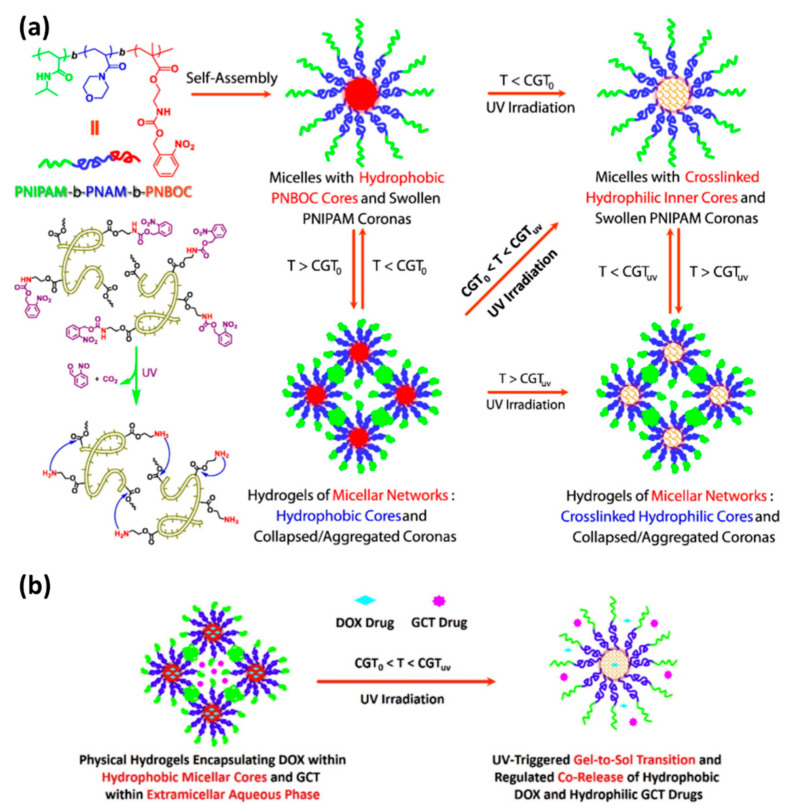
An example of a complex photoresponsive hydrogel: (a) schematics of temperature and ultraviolet (UV)-responsive micelles and supramolecular structures upon different conditions of temperature (T), critical gelation temperature before (CGT0), and after (CGTUV) UV irradiation; (b) scheme of UV-triggered gel-to-sol transition and co-delivery of doxorubicin (DOX) and gemcitabine (GCT) release. Copyright (2016) Elsevier B.V. Source: [94].

References

    1. Maude S.L., Frey N., Shaw P.A., Aplenc R., Barrett D.M., Bunin N.J., Chew A., Gonzalez V.E., Zheng Z., Lacey S.F., et al. Chimeric Antigen Receptor T Cells for Sustained Remissions in Leukemia. N. Engl. J. Med. 2014;371:1507–1517. doi: 10.1056/NEJMoa1407222. - DOI - PMC - PubMed
    1. WHO The Top 10 Causes of Death. [(accessed on 24 September 2020)]; Available online: https://www.who.int/news-room/fact-sheets/detail/the-top-10-causes-of-death.
    1. Dagogo-Jack I., Shaw A.T. Tumour Heterogeneity and Resistance to Cancer Therapies. Nat. Rev. Clin. Oncol. 2017;15:81–94. doi: 10.1038/nrclinonc.2017.166. - DOI - PubMed
    1. Schilsky R.L. Personalized Medicine in Oncology: The Future Is Now. Nat. Rev. Drug Discov. 2010;9:363–366. doi: 10.1038/nrd3181. - DOI - PubMed
    1. Gatenby R., Brown J. The Evolution and Ecology of Resistance in Cancer Therapy. Cold Spring Harb. Perspect. Med. 2018;8:a033415. doi: 10.1101/cshperspect.a033415. - DOI - PMC - PubMed

LinkOut - more resources