


Detection of Rare Germline Variants in the Genomes of Patients with B-Cell Neoplasms
- PMID: 33809641
- PMCID: PMC8001490
- DOI: 10.3390/cancers13061340
Detection of Rare Germline Variants in the Genomes of Patients with B-Cell Neoplasms
Abstract
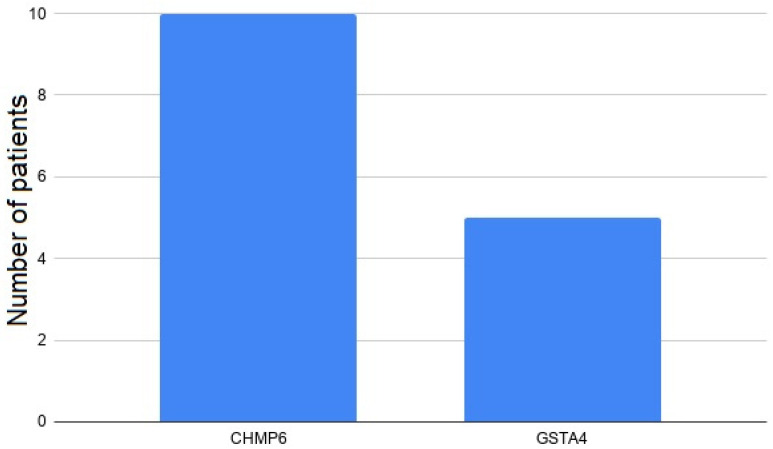
There is growing evidence indicating the implication of germline variation in cancer predisposition and prognostication. Here, we describe an analysis of likely disruptive rare variants across the genomes of 726 patients with B-cell lymphoid neoplasms. We discovered a significant enrichment for two genes in rare dysfunctional variants, both of which participate in the regulation of oxidative stress pathways (CHMP6 and GSTA4). Additionally, we detected 1675 likely disrupting variants in genes associated with cancer, of which 44.75% were novel events and 7.88% were protein-truncating variants. Among these, the most frequently affected genes were ATM, BIRC6, CLTCL1A, and TSC2. Homozygous or germline double-hit variants were detected in 28 cases, and coexisting somatic events were observed in 17 patients, some of which affected key lymphoma drivers such as ATM, KMT2D, and MYC. Finally, we observed that variants in six different genes were independently associated with shorter survival in CLL. Our study results support an important role for rare germline variation in the pathogenesis and prognosis of B-cell lymphoid neoplasms.
Keywords: B-cell; CLL; cancer; driver; germline; lymphoid; lymphoma; prognosis; rare variant.
Conflict of interest statement
The authors declare no conflict of interest.
Figures
References
-
- Law P.J., Berndt S.I., Speedy H.E., Camp N.J., Sava G.P., Skibola C.F., Holroyd A., Joseph V., Sunter N.J., Nieters A., et al. Genome-wide association analysis implicates dysregulation of immunity genes in chronic lymphocytic leukaemia. Nat. Commun. 2017;8:14175. doi: 10.1038/ncomms14175. - DOI - PMC - PubMed
-
- Kleinstern G., Yan H., Hildebrandt M.A.T., Vijai J., Berndt S.I., Ghesquières H., McKay J., Wang S.S., Nieters A., Ye Y., et al. Inherited variants at 3q13.33 and 3p24.1 are associated with risk of diffuse large B-cell lymphoma and implicate immune pathways. Hum. Mol. Genet. 2020;29:70–79. doi: 10.1093/hmg/ddz228. - DOI - PMC - PubMed
-
- Skibola C.F., Berndt S.I., Vijai J., Conde L., Wang Z., Yeager M., De Bakker P.I., Birmann B.M., Vajdic C.M., Foo J.-N., et al. Genome-wide Association Study Identifies Five Susceptibility Loci for Follicular Lymphoma outside the HLA Region. Am. J. Hum. Genet. 2014;95:462–471. doi: 10.1016/j.ajhg.2014.09.004. - DOI - PMC - PubMed
LinkOut - more resources
Full Text Sources
Other Literature Sources
Research Materials
Miscellaneous
