


A Significant Decrease in the Incidence of Shigellosis in Israel during COVID-19 Pandemic
- PMID: 33809746
- PMCID: PMC8002282
- DOI: 10.3390/ijerph18063070
A Significant Decrease in the Incidence of Shigellosis in Israel during COVID-19 Pandemic
Abstract
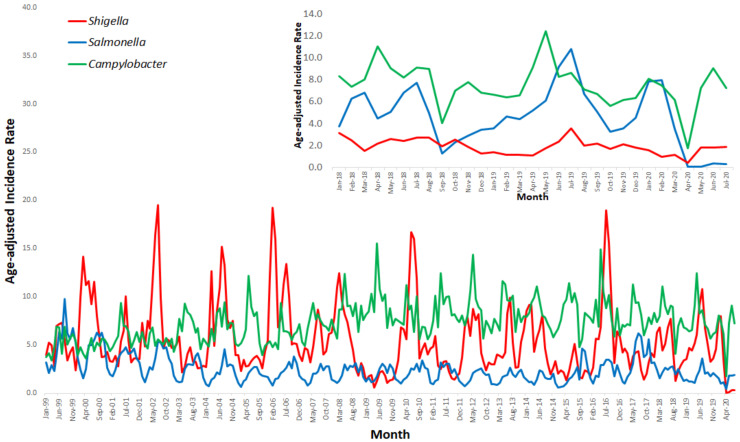
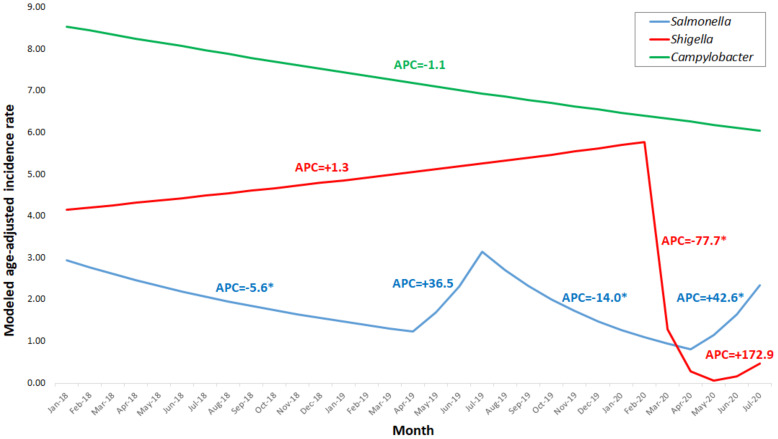
Severe Acute Respiratory Syndrome Coronavirus 2 (SARS-CoV-2) causes COVID-19 and is mostly person-to-person transmitted through respiratory droplets. The implications of the strategies implemented to prevent COVID-19 transmission on other infectious diseases are unclear. We aimed to appraise trends in the incidence of salmonellosis, shigellosis and campylobacteriosis in Israel during COVID-19 pandemic. Positive stool samples for Salmonella, Shigella and Campylobacter are reported on a monthly basis to the Israel Center for Disease Control from sentinel laboratories, within the framework of a surveillance network of bacterial culture-proven enteric diseases. Age-adjusted incidence rates per 100,000 of shigellosis, salmonellosis and campylobacteriosis were calculated. Mean rates before and after the local onset of COVID-19 pandemic in Israel were compared and Relative Risk Reduction (RRR) was calculated. Joinpoint was used to evaluate secular trends. The mean age-adjusted incidence rate of shigellosis in March-July 2020 was lower than the rate observed in March-July 2018-2019 (RRR = 86.6%), but also decreased for salmonellosis (RRR = 33.0%) and campylobacteriosis (RRR = 30.0%). Using Joinpoint we have shown that the decrease observed for shigellosis was significantly sharper (Annual Percent Change (APC) = -77.7) between February 2020 and May 2020 than for salmonellosis (APC = -14.0) between July 2019 and April 2020 and for campylobacteriosis (APC = -1.1) between January 2018 and July 2020. The preventive measures applied to reduce transmission of COVID-19, including social distancing and hand washing, were ecologically associated with a decreased risk of bacterial enteric diseases in Israel. The association was strongest for shigellosis, a disease that is mostly person-to-person transmitted, as compared to salmonellosis and campylobacteriosis which are mostly foodborne transmitted.
Keywords: COVID-19; enteric diseases; incidence; outbreak; trend.
Conflict of interest statement
The authors declare no conflict of interest.
Figures
References
-
- Chan J.F., Yuan S., Kok K.H., To K.K., Chu H., Yang J., Xing F., Liu J., Yip C.C., Poon R.W., et al. A familial cluster of pneumonia associated with the 2019 novel coronavirus indicating person-to-person transmission: A study of a family cluster. Lancet. 2020;395:514–523. doi: 10.1016/S0140-6736(20)30154-9. - DOI - PMC - PubMed
-
- Modes of Transmission of Virus Causing COVID-19: Implications for IPC Precaution Recommendations. [(accessed on 4 February 2021)]; Available online: https://www.who.int/news-room/commentaries/detail/modes-of-transmission-....
-
- Centers for Disease Control and Prevention, National Center for Zoonotic and Emerging Infectious Diseases, Division of Foodborne, Waterborne, and Environmental Diseases (DFWED) Shigellosis. [(accessed on 4 February 2021)]; Available online: https://www.cdc.gov/shigella/index.html.
-
- The Centers for Disease Control and Prevention (CDC) The Yellow Book, Health Information for International Travel 2020. Oxford University Press; Oxford, UK: 2020. Shigellosis.
MeSH terms
LinkOut - more resources
Full Text Sources
Other Literature Sources
Medical
Miscellaneous
