


Evaluation of Patient No-Shows in a Tertiary Hospital: Focusing on Modes of Appointment-Making and Type of Appointment
- PMID: 33810096
- PMCID: PMC8005203
- DOI: 10.3390/ijerph18063288
Evaluation of Patient No-Shows in a Tertiary Hospital: Focusing on Modes of Appointment-Making and Type of Appointment
Abstract
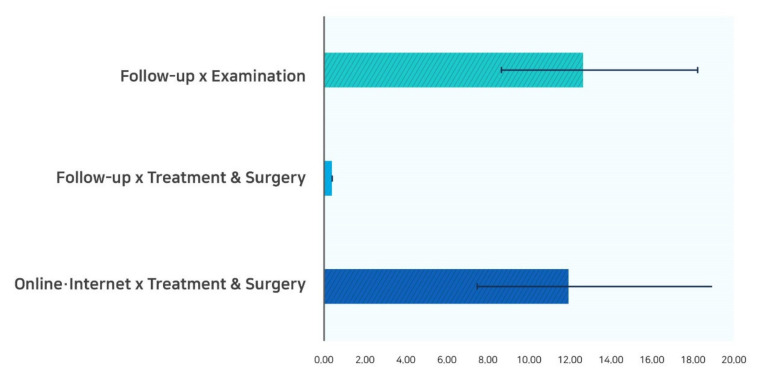
No-show appointments waste resources and decrease the sustainability of care. This study is an attempt to evaluate patient no-shows based on modes of appointment-making and types of appointments. We collected hospital information system data and appointment data including characteristics of patients, service providers, and clinical visits over a three-month period (1 September 2018 to 30 November 2018), at a large tertiary hospital in Seoul, Korea. We used multivariate logistic regression analyses to identify the factors associated with no-shows (Model 1). We further assessed no-shows by including the interaction term ("modes of appointment-making" X "type of appointment") (Model 2). Among 1,252,127 appointments, the no-show rate was 6.12%. Among the modes of appointment-making, follow-up and online/telephone appointment were associated with higher odds of no-show compared to walk-in. Appointments for treatment and surgery had higher odds ratios of no-show compared to consultations. Tests for the interaction between the modes of appointment-making and type of appointment showed that follow-up for examination and online/telephone appointments for treatment and surgery had much higher odds ratios of no-shows. Other significant factors of no-shows include age, type of insurance, time of visit, lead time (time between scheduling and the appointment), type of visits, doctor's position, and major diagnosis. Our results suggest that future approaches for predicting and addressing no-show should also consider and analyze the impact of modes of appointment-making and type of appointment on the model of prediction.
Keywords: health care resource planning; modes of appointment-making; no-show; types of appointment.
Conflict of interest statement
The authors declare no conflict of interest.
Figures
References
-
- Turkcan A., Nuti L., DeLaurentis P.C., Tian Z., Daggy J., Zhang L., Lawley M., Sands L. No-show modeling for adult ambulatory clinics. In: Denton B.T., editor. Handbook of Healthcare Operations Management. Volume 184. Springer; New York, NY, USA: 2013. pp. 251–288.
-
- DuMontier C., Rindfleisch K., Pruszynski J., Frey J.J., 3rd A multi-method intervention to reduce no-shows in an urban residency clinic. Fam. Med. 2013;45:634–641. - PubMed
-
- Partin M.R., Burgess D.J., Burgess J.F., Jr., Gravely A., Haggstrom D., Lillie S.E., Nugent S., Powell A.A., Shaukat A., Walter L.C., et al. Organizational predictors of colonoscopy follow-up for positive fecal occult blood test results: An observational study. Cancer Epidemiol. Biomark. Prev. 2015;24:422–434. doi: 10.1158/1055-9965.EPI-14-1170. - DOI - PMC - PubMed
-
- Wang W.-Y., Gupta D. Adaptive appointment systems with patient preferences. Manuf. Serv. Oper. Manag. 2011;13:373–389. doi: 10.1287/msom.1110.0332. - DOI
MeSH terms
LinkOut - more resources
Full Text Sources
Other Literature Sources
