Review
. 2021 Mar 26;22(7):3404.
doi: 10.3390/ijms22073404.

Stiffness and Aging in Cardiovascular Diseases: The Dangerous Relationship between Force and Senescence

Affiliations
Review

Stiffness and Aging in Cardiovascular Diseases: The Dangerous Relationship between Force and Senescence

Silvia Ferrari et al. Int J Mol Sci. .

Abstract

Biological aging is a process associated with a gradual decline in tissues' homeostasis based on the progressive inability of the cells to self-renew. Cellular senescence is one of the hallmarks of the aging process, characterized by an irreversible cell cycle arrest due to reactive oxygen species (ROS) production, telomeres shortening, chronic inflammatory activation, and chromatin modifications. In this review, we will describe the effects of senescence on tissue structure, extracellular matrix (ECM) organization, and nucleus architecture, and see how these changes affect (are affected by) mechano-transduction. In our view, this is essential for a deeper understanding of the progressive pathological evolution of the cardiovascular system and its relationship with the detrimental effects of risk factors, known to act at an epigenetic level.

Keywords: aging; epigenetics; mechano-transduction; senescence.


Conflict of interest statement

The Author have no conflict of interest.

Figures
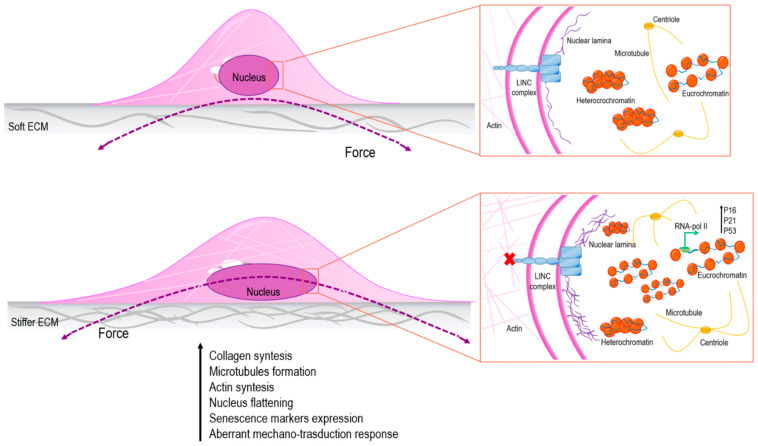
Figure 1
Figure 1
Stiffness of the nucleus affects structure and organization of chromatin with consequences on gene transcription. In particular, in the presence of soft extracellular matrix (ECM), the cell nucleus is subject to low straining forces and the amount of heterochromatin is higher than euchromatin; on the other hand, in presence of stiffer ECM, the cell nucleus is stretched, and, as a result, chromatin changes its status into a more relaxed conformation, promoting senescence markers’ expression [59,60,61].

References

    1. North B.J., Sinclair D.A. The Intersection Between Aging and Cardiovascular Disease. Circ. Res. 2012;110:1097–1108. doi: 10.1161/CIRCRESAHA.111.246876. - DOI - PMC - PubMed
    1. McHugh D., Gil J. Senescence and aging: Causes, consequences, and therapeutic avenues. J. Cell Biol. 2018;217:65–77. doi: 10.1083/jcb.201708092. - DOI - PMC - PubMed
    1. Ziegler D.V., Wiley C.D., Velarde M.C. Mitochondrial effectors of cellular senescence: Beyond the free radical theory of aging. Aging Cell. 2015;14:1–7. doi: 10.1111/acel.12287. - DOI - PMC - PubMed
    1. Korolchuk V.I., Miwa S., Carroll B., von Zglinicki T. Mitochondria in Cell Senescence: Is Mitophagy the Weakest Link? Ebiomedicine. 2017;21:7–13. doi: 10.1016/j.ebiom.2017.03.020. - DOI - PMC - PubMed
    1. Parkes T.L., Elia A.J., Dickinson D., Hilliker A.J., Phillips J.P., Boulianne G.L. Extension of Drosophila lifespan by overexpression of human SOD1 in motorneurons. Nat. Genet. 1998;19:171–174. doi: 10.1038/534. - DOI - PubMed

LinkOut - more resources
