


Long-Chain Acylcarnitines and Monounsaturated Fatty Acids Discriminate Heart Failure Patients According to Pulmonary Hypertension Status
- PMID: 33810372
- PMCID: PMC8066759
- DOI: 10.3390/metabo11040196
Long-Chain Acylcarnitines and Monounsaturated Fatty Acids Discriminate Heart Failure Patients According to Pulmonary Hypertension Status
Abstract
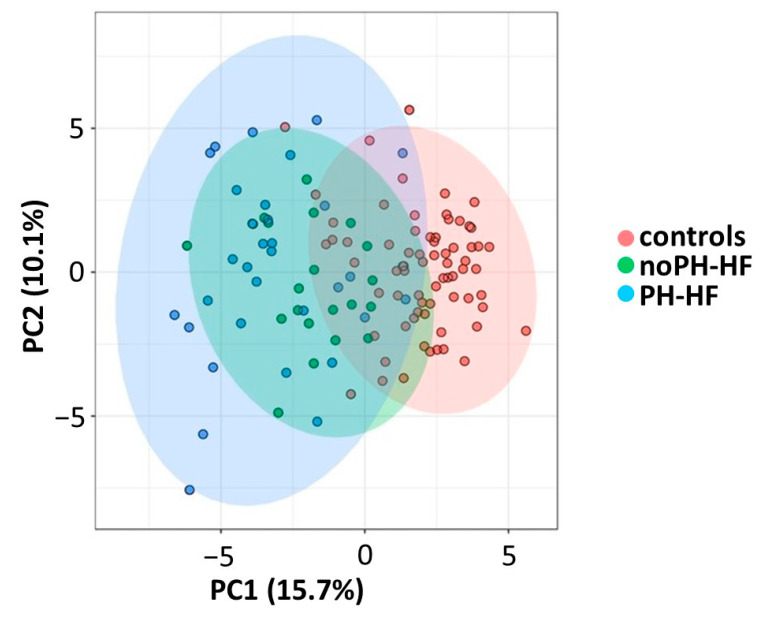
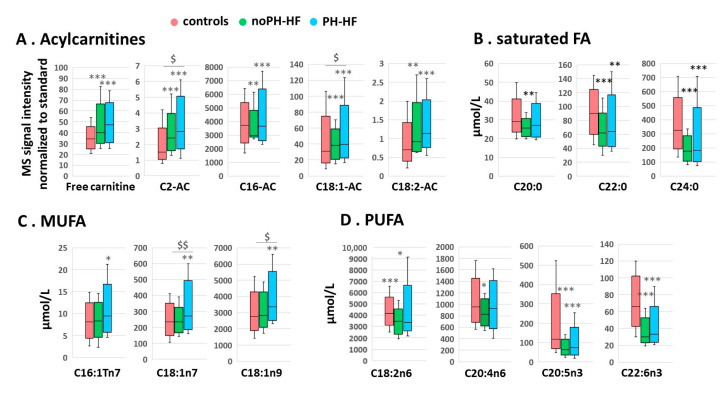
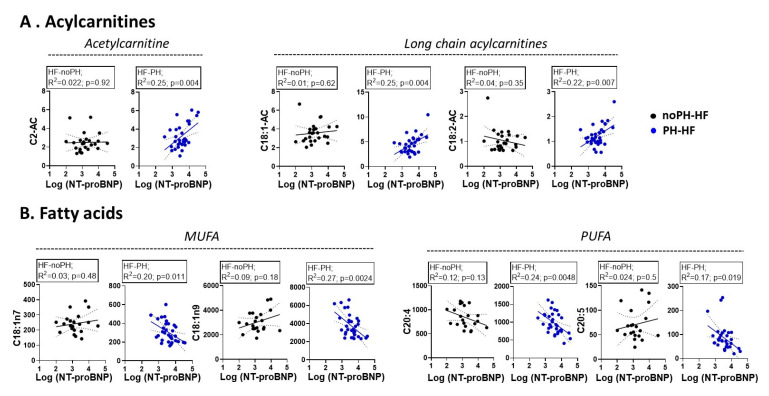
Defects in fatty acid (FA) utilization have been well described in group 1 pulmonary hypertension (PH) and in heart failure (HF), yet poorly studied in group 2 PH. This study was to assess whether the metabolomic profile of patients with pulmonary hypertension (PH) due HF, classified as group 2 PH, differs from those without PH. We conducted a proof-of-principle cross-sectional analysis of 60 patients with chronic HF with reduced ejection fraction and 72 healthy controls in which the circulating level of 71 energy-related metabolites was measured using various methods. Echocardiography was used to classify HF patients as noPH-HF (n = 27; mean pulmonary artery pressure [mPAP] 21 mmHg) and PH-HF (n = 33; mPAP 35 mmHg). The profile of circulating metabolites among groups was compared using principal component analysis (PCA), analysis of covariance (ANCOVA), and Pearson's correlation tests. Patients with noPH-HF and PH-HF were aged 64 ± 11 and 68 ± 10 years, respectively, with baseline left ventricular ejection fractions of 27 ± 7% and 26 ± 7%. Principal component analysis segregated groups, more markedly for PH-HF, with long-chain acylcarnitines, acetylcarnitine, and monounsaturated FA carrying the highest loading scores. After adjustment for age, sex, kidney function, insulin resistance, and N-terminal pro-brain natriuretic peptide (NT-proBNP), 5/15 and 8/15 lipid-related metabolite levels were significantly different from controls in noPH-HF and PH-HF subjects, respectively. All metabolites for which circulating levels interacted between group and NT-proBNP significantly correlated with NT-proBNP in HF-PH, but none with HF-noPH. FA-related metabolites were differently affected in HF with or without PH, and may convey adverse outcomes given their distinct correlation with NT-proBNP in the setting of PH.
Keywords: acylcarnitines; fatty acids; heart failure; type 2 pulmonary hypertension.
Conflict of interest statement
The authors declare no conflict of interest.
Figures
References
-
- Djousse L., Benkeser D., Arnold A., Kizer J.R., Zieman S.J., Lemaitre R.N., Tracy R.P., Gottdiener J.S., Mozaffarian D., Siscovick D.S., et al. Plasma free fatty acids and risk of heart failure: The Cardiovascular Health Study. Circ. Heart Fail. 2013;6:964–969. doi: 10.1161/CIRCHEARTFAILURE.113.000521. - DOI - PMC - PubMed
-
- Oie E., Ueland T., Dahl C.P., Bohov P., Berge C., Yndestad A., Gullestad L., Aukrust P., Berge R.K. Fatty acid composition in chronic heart failure: Low circulating levels of eicosatetraenoic acid and high levels of vaccenic acid are associated with disease severity and mortality. J. Intern. Med. 2011;270:263–272. doi: 10.1111/j.1365-2796.2011.02384.x. - DOI - PubMed
LinkOut - more resources
Full Text Sources
Other Literature Sources
Research Materials
Miscellaneous
