


Iterative guided machine learning-assisted systematic literature reviews: a diabetes case study
- PMID: 33810798
- PMCID: PMC8017891
- DOI: 10.1186/s13643-021-01640-6
Iterative guided machine learning-assisted systematic literature reviews: a diabetes case study
Abstract
Background: Systematic Reviews (SR), studies of studies, use a formal process to evaluate the quality of scientific literature and determine ensuing effectiveness from qualifying articles to establish consensus findings around a hypothesis. Their value is increasing as the conduct and publication of research and evaluation has expanded and the process of identifying key insights becomes more time consuming. Text analytics and machine learning (ML) techniques may help overcome this problem of scale while still maintaining the level of rigor expected of SRs.
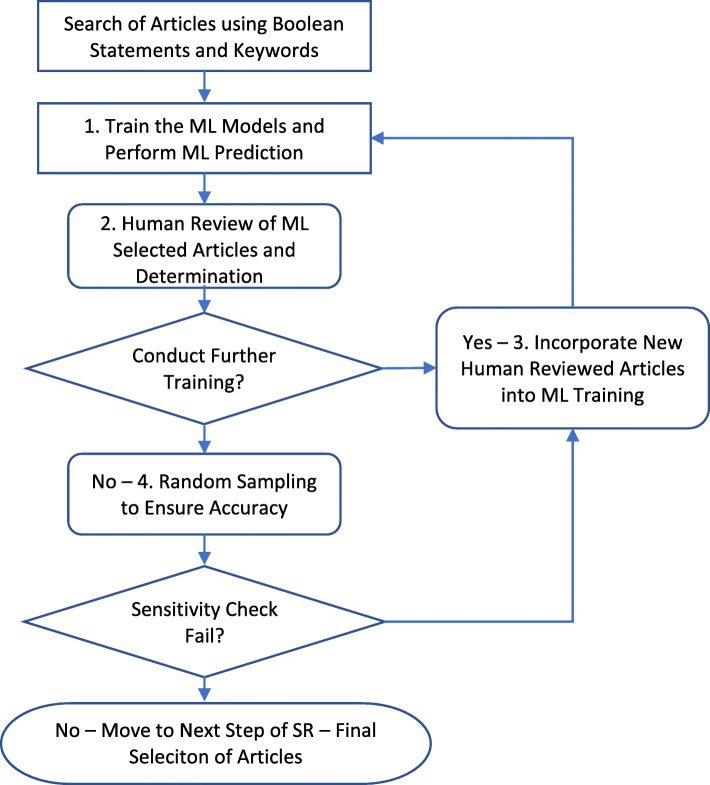
Methods: In this article, we discuss an approach that uses existing examples of SRs to build and test a method for assisting the SR title and abstract pre-screening by reducing the initial pool of potential articles down to articles that meet inclusion criteria. Our approach differs from previous approaches to using ML as a SR tool in that it incorporates ML configurations guided by previously conducted SRs, and human confirmation on ML predictions of relevant articles during multiple iterative reviews on smaller tranches of citations. We applied the tailored method to a new SR review effort to validate performance.
Results: The case study test of the approach proved a sensitivity (recall) in finding relevant articles during down selection that may rival many traditional processes and show ability to overcome most type II errors. The study achieved a sensitivity of 99.5% (213 out of 214) of total relevant articles while only conducting a human review of 31% of total articles available for review.
Conclusions: We believe this iterative method can help overcome bias in initial ML model training by having humans reinforce ML models with new and relevant information, and is an applied step towards transfer learning for ML in SR.
Keywords: Applied case study; Machine learning; Machine learning configurations; Natural language processing; Systematic review screening; Transfer learning.
Conflict of interest statement
The authors declare that they have no competing interests.
Figures
References
-
- Munn Z, Stern C, Lockwood C & Jordan Z. What kind of systematic review should I conduct? A proposed typology and guidance for systematic reviewers in the medical and health sciences. BMC Med Res Methodol, 2018:18:5. https://doi.org/10.1186/s12874-017-0468-4, 1 - PMC - PubMed
-
- Moreno-Garcia CF, Aceves-Martins M, Serratosa F. Unsupervised machine learning application to perform a systematic and meta-analysis in medical research. Computación y Sistemas. 2016;20(1):7–17. doi: 10.13053/CyS-20-1-2360. - DOI
Publication types
MeSH terms
LinkOut - more resources
Full Text Sources
Other Literature Sources
Medical
Research Materials
