. 2021 May;40(5):805-818.
doi: 10.1007/s00299-021-02671-y. Epub 2021 Apr 3.

Agroinfiltration for transient gene expression and characterisation of fungal pathogen effectors in cool-season grain legume hosts

Affiliations

Agroinfiltration for transient gene expression and characterisation of fungal pathogen effectors in cool-season grain legume hosts

Johannes W Debler et al. Plant Cell Rep. 2021 May.

Abstract

Modified pEAQ-HT-DEST1 vectors were used for agroinfiltration in legumes. We demonstrate protein expression and export in pea, lentil, and faba bean; however, the method for chickpea was not successful. Agroinfiltration is a valuable research method for investigating virulence and avirulence effector proteins from pathogens and pests, where heterologous effector proteins are transiently expressed in plant leaves and hypersensitive necrosis responses and other effector functions can be assessed. Nicotiana benthamiana is widely used for agroinfiltration and the characterisation of broad-spectrum effectors. The method has also been used in other plant species including field pea, but not yet developed for chickpea, lentil, or faba bean. Here, we have modified the pEAQ-HT-DEST1 vector for expression of 6 × histidine-tagged green-fluorescent protein (GFP) and the known necrosis-inducing broad-spectrum effector necrosis and ethylene-inducing peptide (Nep1)-like protein (NLP). Modified pEAQ-based vectors were adapted to encode signal peptide sequences for apoplast targeting of expressed proteins. We used confocal microscopy to assess the level of GFP expression in agroinfiltrated leaves. While at 3 days after infiltration in N. benthamiana, GFP was expressed at a relatively high level, expression in field pea and faba bean at the same time point was relatively low. In lentil, an expression level of GFP similar to field pea and faba bean at 3 days was only observed after 5 days. Chickpea leaf cells were transformed at low frequency and agroinfiltration was concluded to not be successful for chickpea. We concluded that the pEAQ vector is suitable for testing host-specific effectors in field pea, lentil, and faba bean, but low transformation efficiency limits the utility of the method for chickpea.

Keywords: Agrobacterium; Ascochyta; Dothideomycete; Necrotroph; Phytopathogen; Plant pathogen.


Conflict of interest statement

The authors declare no conflict of interest.

Figures

Fig. 1
Fig. 1
Agroinfiltration constructs (not to scale) based on the pEAQ-HT-DEST1 vector. a, b pEAQ-HT-DEST1-MtPR1-His, c pEAQ-HT-DEST1-GFP-His (cytoplasm-localised GFP), d pEAQ-HT-DEST1-MtPR1-GFP-His (apoplast-targeted GFP), and e pEAQ-HT-DEST1-MtPR1-NLP2-His (apoplast-targeted NLP2)
Fig. 2
Fig. 2
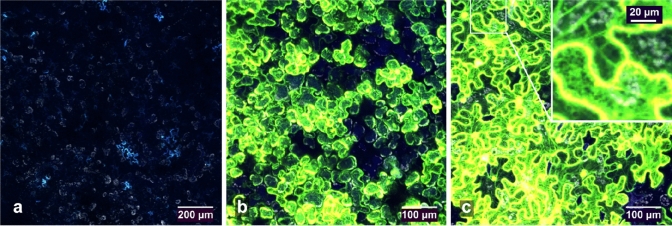
Agroinfiltration (abaxial) of N. benthamiana for the constitutive expression of GFP, observed using confocal microscopy at 5 days after infiltration. a GUS control 10 × objective. b Expression of GFP and localisation to cytoplasm by agroinfiltration of A. tumefaciens carrying GFPcyt construct for non-targeted GFP. c Apoplast-targeted GFP expressed by agroinfiltration of A. tumefaciens with GFPapo construct with M. truncatula PR-1 secretion signal sequence. c Inset image, enlarged section showing an apparent striated and granular appearance of GFP
Fig. 3
Fig. 3
Agroinfiltration of grain legume species for the constitutive expression of GFP, observed using confocal microscopy. Leaves of Kaspa field pea (ad), PBA HatTrick chickpea (eh), PBA Ace lentil (il), and PBA Rana faba bean (mp) were agroinfiltrated with A. tumefaciens strains carrying constructs for the expression of GUS control, cytoplasm-localised GFP (GFPcyt) or apoplast-targeted GFP (GFPapo). Confocal microscopy was performed at 3 and 5 days after infiltration and all images were collected using the 20 × objective. Green fluorescence of epidermal cells was clearly evident for field pea, lentil, and faba bean, but not for chickpea. GFP expression and export for faba bean (p) was observed when agroinfiltrated with the A. tumefaciens GFPapo strains. Low-level GFP expression around occasional cells was observed for field pea (d) and lentil (l), as indicated with arrows and featured in inset images, but these observations were inconclusive as to the successful apoplast targeting of GFP in these species
Fig. 4
Fig. 4
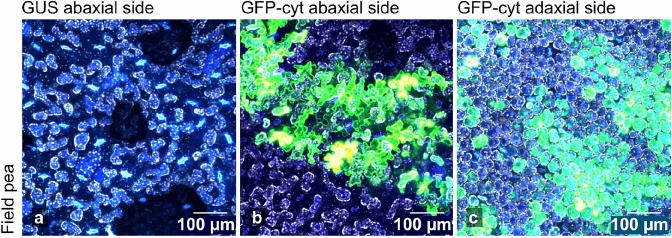
Agroinfiltration of field pea leaf tissue for the constitutive expression of (a) GUS control and (b, c) GFP at 5 days after infiltration, observed using confocal microscopy. Field pea leaves were infiltrated from the abaxial side and confocal imaging was performed both from the abaxial side into the tissue (b), and from the adaxial side (c). Imaging from the abaxial side towards the interior of the leaves shows that epidermal cells at the infiltration site were transformed and efficiently express GFP (b). Imaging from the adaxial side of leaves (c) shows that spherical and ovoid mesophyll cells of field pea are transformed and able to produce GFP
Fig. 5
Fig. 5
a Relative fluorescence units (RFU) of whole crude leaf extracts of 5-day agroinfiltrated leaf samples of N. benthamiana (Nb) and field pea (Ps) expressing recombinant GFP (apoplast-targeted—apo and cytoplasm-localised—cyt). Average fluorescence for cytoplasm-localised GFP in N. benthamiana was approximately tenfold higher than for field pea (P < 0.05). Apoplast targeted GFP fluorescence for N. benthamiana was 63% of the level for cytoplasm (P < 0.05). For field pea, cytoplasm-localised GFP fluorescence was significantly higher than the GUS control (P < 0.05) and the apoplast-targeted GFP fluorescence was 14% of the level for the cytoplasm-localised GFP sample. b SDS-PAGE of pooled extracts from nicotiana and pea for cytoplasm-localised GFP (lane 2) and nickel-NTA eluate containing partially purified GFP (27 KDa band; lane 3)
Fig. 6
Fig. 6
Agroinfiltration of grain legume species for the constitutive expression of necrosis and ethylene-inducing peptide (Nep1)-like protein (NLP2) from P. pinodes or A. rabiei, compared with GUS and GFP controls, at 5 days after infiltration. ad Leaves of field pea, e, f lentil, and g, h faba bean were agroinfiltrated with A. tumefaciens strains carrying constructs for the expression of GUS and GFP controls, and cytoplasm or apoplast-localised NLP. Apoplast targeting of transiently expressed proteins was achieved by 5′-end fusion of signal peptide-encoding sequences of PR-1 genes from M. truncatula and L. culinaris, as indicated. Abbreviations: cyt, cytoplasm-localised; apo, apoplast-targeted; Mt SP, Medicago signal peptide; Lentil SP, lentil signal peptide; Pp, P. pinodes; Ar, A. rabiei

References

    1. Bailey BA. Purification of a protein from culture filtrates of Fusarium oxysporum that induces ethylene and necrosis in leaves of Erythroxylum coca. Phytopathology. 1995;85:1250–1255. doi: 10.1094/Phyto-85-1250. - DOI
    1. Bally J, Jung H, Mortimer C, et al. The rise and rise of Nicotiana benthamiana : A plant for all reasons. Annu Rev Phytopathol. 2018;56:405–426. doi: 10.1146/annurev-phyto-080417-050141. - DOI - PubMed
    1. Böhm H, Albert I, Oome S, et al. A conserved peptide pattern from a widespread microbial virulence factor triggers pattern-induced immunity in Arabidopsis. PLoS Pathog. 2014;10:1–11. doi: 10.1371/journal.ppat.1004491. - DOI - PMC - PubMed
    1. Breen S, Williams SJ, Outram M, et al. Emerging insights into the functions of Pathogenesis-Related protein 1. Trends Plant Sci. 2017;22:871–879. doi: 10.1016/j.tplants.2017.06.013. - DOI - PubMed
    1. Chen XR, Huang SX, Zhang Y, et al. Identification and functional analysis of the NLP-encoding genes from the phytopathogenic oomycete Phytophthora capsici. Mol Genet Genomics. 2018;293:931–943. doi: 10.1007/s00438-018-1432-7. - DOI - PubMed

MeSH terms

LinkOut - more resources