


Parents' experiences of caring for a young child with type 1 diabetes: a systematic review and synthesis of qualitative evidence
- PMID: 33814007
- PMCID: PMC8019496
- DOI: 10.1186/s12887-021-02569-4
Parents' experiences of caring for a young child with type 1 diabetes: a systematic review and synthesis of qualitative evidence
Abstract
Aims: To synthesise the qualitative evidence on parents' experiences of caring for a child aged ≤8 years with type 1 diabetes to identify: the challenges they encounter; their views about support received; ways in which support could be improved; and, directions for future research.
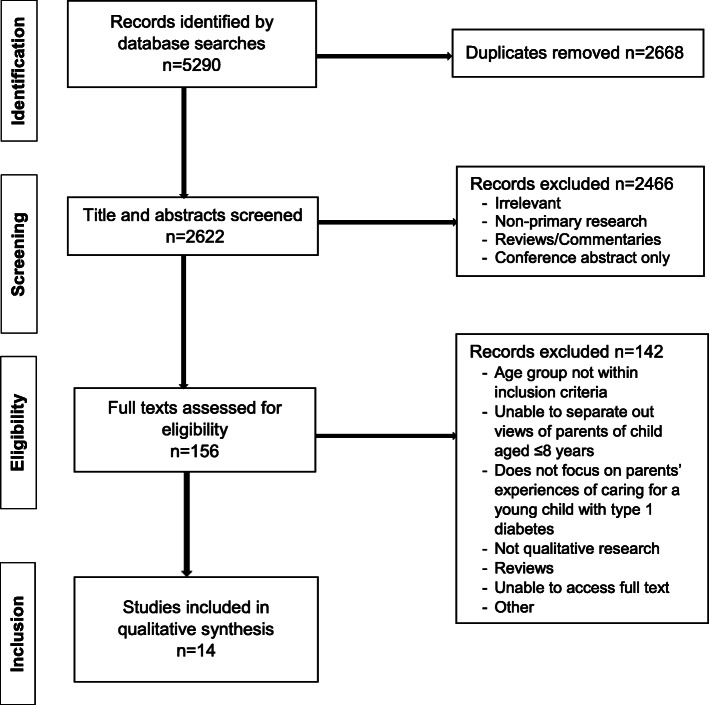
Methods: We searched Medline, EMBASE, CINAHL, PsycINFO and Web of Science databases to identify qualitative studies reporting parents' views and experiences of caring for a child with type 1 diabetes aged ≤8 years. Key analytical themes were identified using thematic synthesis.
Results: Fourteen studies were included. The synthesis resulted in the generation of two overarching themes. Monopolisation of life describes the all-encompassing impact diabetes could have on parents due to the constant worry they experienced and the perceived need for vigilance. It describes how parents' caring responsibilities could affect their wellbeing, relationships and finances, and how a lack of trusted sources of childcare and a desire to enable a 'normal' childhood constrained personal choices and activities. However, use of diabetes technologies could lessen some of these burdens. Experiences of professional and informal support describes how encounters with healthcare professionals, while generally perceived as helpful, could lead to frustration and anxiety, and how connecting with other parents caring for a child with type 1 diabetes provided valued emotional and practical support.
Conclusions: This synthesis outlines the challenges parents encounter, their views about support received and ways in which support might be improved. It also highlights significant limitations in the current literature and points to important areas for future research, including how sociodemographic factors and use of newer diabetes technologies influence parents' diabetes management practices and experiences. PROSPERO: https://www.crd.york.ac.uk/prospero/display_record.php?ID=CRD42019128710.
Keywords: Child; Parents; Qualitative synthesis; Type 1 diabetes.
Conflict of interest statement
RH reports having received speaker honoraria from Eli Lilly and Novo Nordisk, serving on advisory panels for Eli Lilly and Novo Nordisk; receiving license fees from BBraun and Medtronic; having served as a consultant to BBraun, patents and patent applications related to closed-loop insulin delivery, and director at CamDiab. BK, JL, CB and DR have no competing interests to report.
Figures
References
-
- Patterson CC, Harjutsalo V, Rosenbauer J, Neu A, Cinek O, Skrivarhaug T, et al. Trends and cyclical variation in the incidence of childhood type 1 diabetes in 26 European centres in the 25 year period 1989-2013: a multicentre prospective registration study. Diabetologia. 2019;62:408–417. doi: 10.1007/s00125-018-4763-3. - DOI - PubMed
-
- Silverstein J, Klingensmith G, Copeland K, Plotnick L, Kaufman F, Laffel L, et al. Care of children and adolescents with type 1 diabetes. Astatement Am Diabetes Assoc. 2005;28:186–212. - PubMed
-
- Wood JR, Miller KM, Maahs DM, Beck RW, DiMeglio LA, Libman IM, et al. Most youth with type 1 diabetes in the T1D exchange clinic registry do not meet American Diabetes Association or International Society for Pediatric and Adolescent Diabetes clinical guidelines. Diabetes Care. 2013;36:2035–2037. doi: 10.2337/dc12-1959. - DOI - PMC - PubMed
Publication types
MeSH terms
Grants and funding
LinkOut - more resources
Full Text Sources
Other Literature Sources
Medical
