


Container volume may affect growth rates of ciliates and clearance rates of their microcrustacean predators in microcosm experiments
- PMID: 33814976
- PMCID: PMC8009685
- DOI: 10.1093/plankt/fbab017
Container volume may affect growth rates of ciliates and clearance rates of their microcrustacean predators in microcosm experiments
Abstract
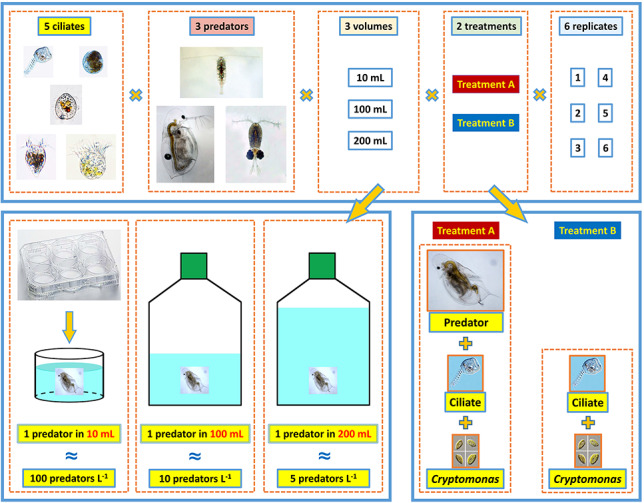
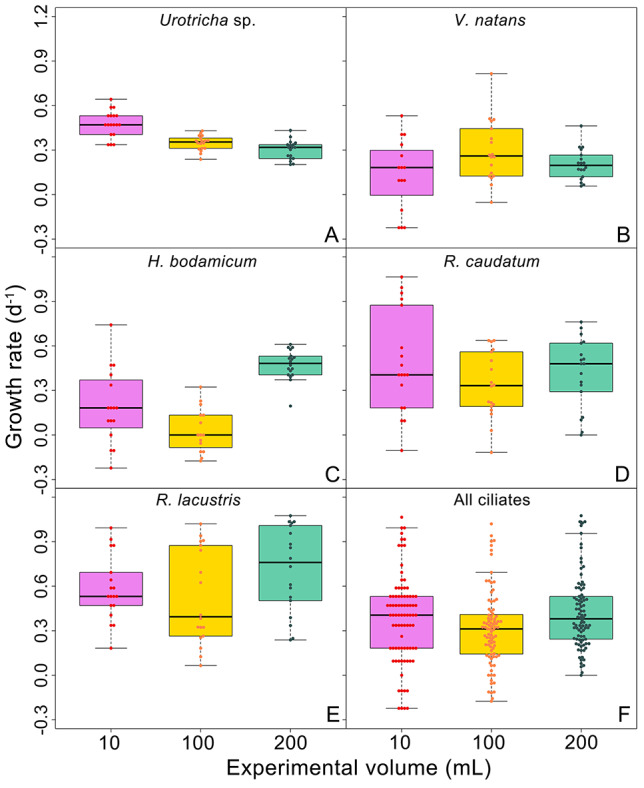
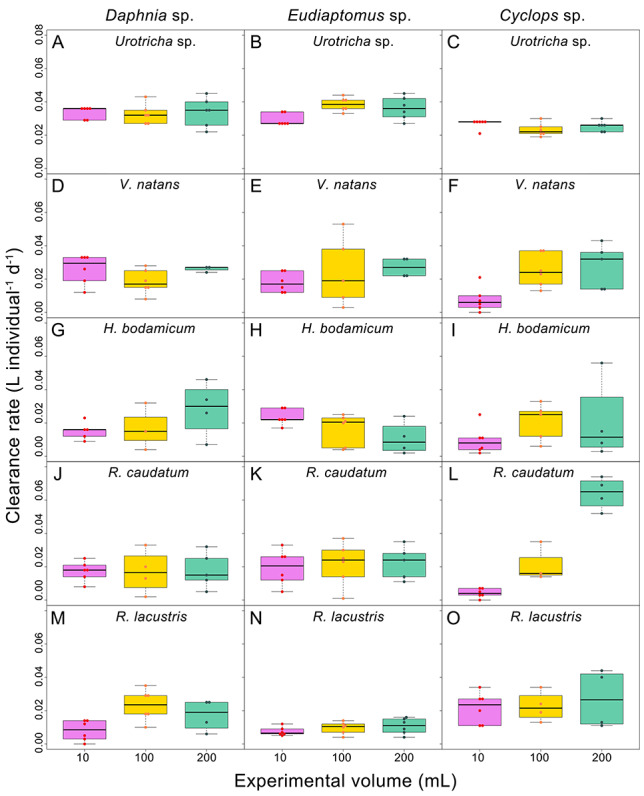
We studied the effect of volume in small containers (microcosms) on five common planktonic freshwater ciliates and three zooplankton species, namely Daphnia sp., the calanoid copepod Eudiaptomus sp., and the cyclopoid copepod Cyclops sp. We measured ciliate specific growth rates and their loss rates due to microcrustacean predation in short-term experiments. We hypothesized that container volume ranging from 10 to 200 mL would not affect the activity of our prey and predator species. We found that the response to volume was species-specific; growth rates of three ciliate species were sensitive to volume. However, the volume effect was not unequivocal because different timing of the microcosm experiments (block effects) may have caused random bias due to varying morphological and/or physiological conditions of the ciliates and their predators. For predator clearance rate, the volume effect was insignificant in the filter-feeding Daphnia and Eudiaptomus but was significant for the predatory copepod Cyclops, which was hampered in the smallest experimental containers. Total crustacean clearance rates averaged over all treatments appeared unaffected by predator species, while ciliate species significantly affected the results. Our growth and clearance rates are close to previous findings with the same or similar planktonic prey and predator species.
Keywords: Cyclops; Daphnia; Eudiaptomus; ciliates; growth and clearance rates; volume effect.
© The Author(s) 2021. Published by Oxford University Press.
Figures
References
-
- Adrian, R. and Schneider-Olt, B. (1999) Top-down effects of crustacean zooplankton on pelagic microorganisms in a mesotrophic lake. J. Plankton Res., 21, 2175–2190.
-
- Agasild, H., Zingel, P. and Nõges, T. (2012) Live labeling technique reveals contrasting role of crustacean predation on microbial loop in two large shallow lakes. Hydrobiologia, 684, 177–187.
-
- Altermatt, F., Fronhofer, E. A., Garnier, A., Giometto, A., Hammes, F., Klecka, J., Legrand, D., Mächler, E. et al. (2015) Big answers from small worlds: a user's guide for protist microcosms as a model system in ecology and evolution. Methods Ecol. Evol., 6, 218–231.
-
- Armengol, L., Franchy, G., Ojeda, A., Santana-del Pino, Á. and Hernández-León, S. (2017) Effects of copepods on natural microplankton communities: do they exert top-down control? Marine Biol., 164, 136.
-
- Bergkemper, V. and Weisse, T. (2017) Phytoplankton response to the summer heat wave 2015 – a case study from Lake Mondsee, Austria. Inland Waters, 7, 88–99.
LinkOut - more resources
Full Text Sources
Other Literature Sources
